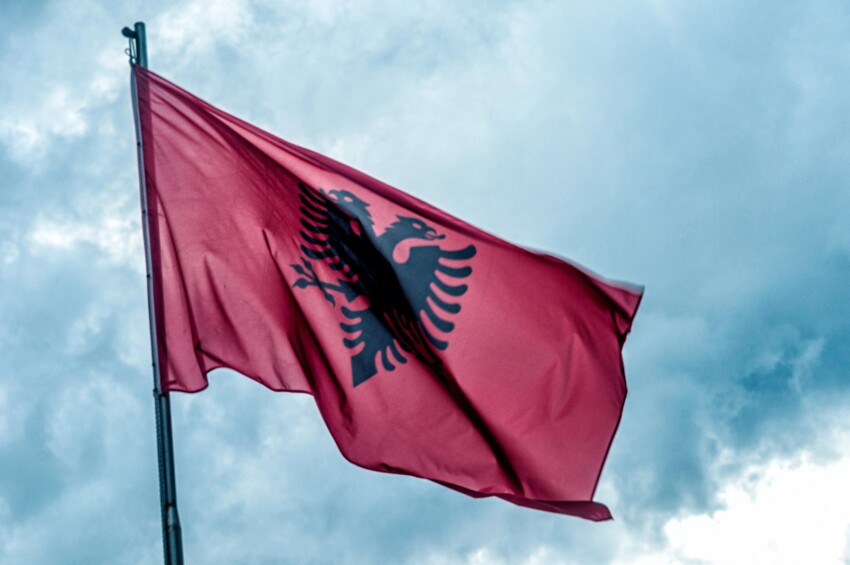
The Albanian flag is one of the most recognisable and historically charged national symbols across the entire Balkan peninsula. It is a rectangular banner with proportions of 5:7, consisting of a red field at the centre of which stands a black double-headed eagle — an eagle with two heads, wings spread and heads facing opposite directions. Its appearance is essential, free from bands, stripes or other decorative elements: only red and black, two colours that speak directly of bloodshed, courage and determination.
What makes this flag extraordinary is its historical continuity. The red field with the black eagle was already the standard of the military commander Gjergj Kastrioti Skanderbeg in the fifteenth century, when on 28 November 1443 he raised his family banner on the tower of Krujë Castle, proclaiming the revolt against the Ottoman Empire. That date — 28 November — remained etched in Albanian collective memory to such an extent that, exactly 469 years later, on 28 November 1912, Albania proclaimed its independence from the Ottoman Empire in Valona, hoisting the same flag once again. Today 28 November is celebrated as Flag Day and Independence Day throughout Albania.
No other modern European flag maintains such a direct and unbroken link with a medieval symbol. Through monarchies, occupations, communist regimes and democratic republics, the red and black with the double-headed eagle have remained unchanged in substance, altering only formal details depending on the government of the time, but never in the fundamental colours nor in the central symbol.
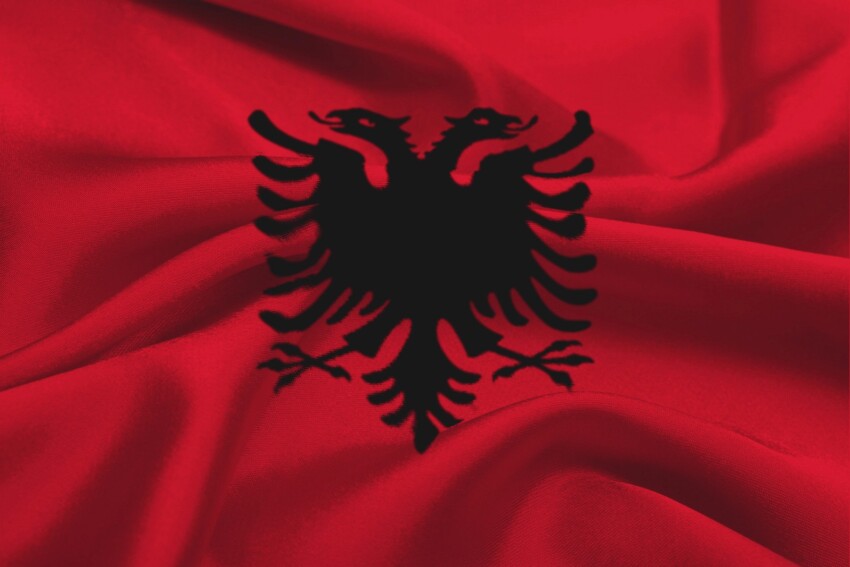
The red that covers the entire background of the flag is not a colour chosen for aesthetic or generic heraldic reasons. In Albanian tradition it represents the courage, strength, valour and blood shed by patriots and martyrs who over the centuries fought and sacrificed their lives for the country’s freedom and independence. It is the colour of identity, of a nation that — as historians recall — never truly completely surrendered to its rulers, not even during four centuries of Ottoman rule.
The black of the eagle represents instead the dignity, determination and strength of the Albanian people in defending their cultural and national identity. Together, the two colours form a powerful and austere colour combination, without nuances or compromise: a flag that does not seek ornament, but expresses everything it wishes to say through the force of contrasts.
The black eagle with two heads — in heraldry called double-headed eagle or bicephalous eagle — is the heart of the Albanian flag and probably the most ancient and layered symbol it contains. Its origins go back to the Byzantine Empire: when Emperor Constantine founded Constantinople in 330 AD, moving the empire’s capital from Rome towards the East, the double-headed eagle became the symbol of the new imperial power. The two heads looked in opposite directions — one towards the West (Rome) and one towards the East (Constantinople) — to represent the dual nature of the Roman Empire, which embraced both shores of the known world.
This symbol was later adopted by the Kastrioti family, the house of Skanderbeg. According to Albanian historian Fan Stilian Noli, the Kastrioti chose the double-headed eagle to assert control over two castles and their respective territories: the two-headed animal represented the ability to govern two distinct possessions simultaneously. Other historians instead emphasise the link with the Byzantine heritage, which Albanian princes loved to claim as their inheritance. In any case, when Skanderbeg raised his banner at Krujë in 1443, the black double-headed eagle on a red field became the symbol of Albanian resistance against the Ottomans, and from that moment on it was never abandoned.
On a deeper symbolic level, the double-headed eagle embodies for Albanians strength, sovereignty and freedom. In antiquity the eagle was considered the king of animals and the messenger of the gods: it was believed to accompany divinities in their celestial movements. For a mountain people who identified themselves with the peaks and the raptors that inhabit them, there could be no more appropriate symbol.
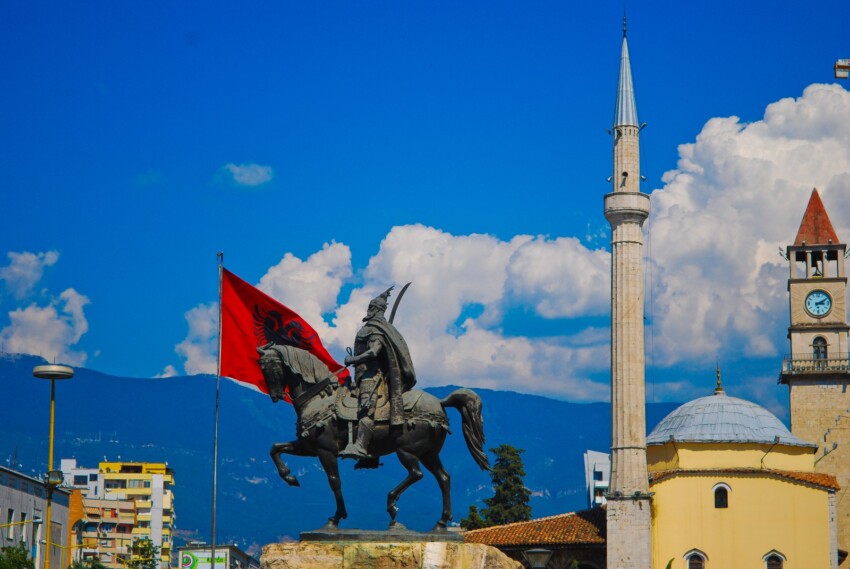
Gjergj Kastrioti Skanderbeg (1405-1468) is the historical figure around whom the entire history of the Albanian flag revolves. Son of an Albanian prince given as a hostage to the Ottoman Empire as a child, Skanderbeg grew up at the sultan’s court, converting to Islam and becoming a brilliant Ottoman military commander. In 1443, after decades in the sultan’s service, he returned to Albania, renounced Islam and embraced Christianity once more, then took the lead of the revolt against Ottoman occupation.
On 28 November 1443, with a handful of 300 faithful followers, he recaptured Krujë Castle and raised his family banner on its highest tower: the black double-headed eagle on a red background. Over the next twenty-five years, Skanderbeg resisted more than twenty Ottoman military campaigns, managing to keep Albania independent until his death in 1468. Upon his passing, Ottoman pressure became unbearable: in 1478 Krujë fell, the eagle disappeared from Albanian towers and Ottoman rule began, lasting over four centuries.
The memory of Skanderbeg never faded. At the end of the nineteenth century, with the Albanian National Renaissance (Rilindja Kombëtare), his banner was rediscovered and reinterpreted as a symbol of national identity. Albanian intellectuals from the diaspora — including Faik Konitsa from Brussels and Querim Panarity from Boston — contributed to bringing Skanderbeg’s flag back to the centre of Albanian patriotic feeling. When on 28 November 1912 Albania finally proclaimed independence, it was natural to raise that same ancient banner: symbolic continuity with Skanderbeg was the foundation of national identity.
The connection between Albanians and the eagle does not end in heraldic history: even deeper roots lie in popular mythology. In Albanian the country is called Shqipëria, which literally means “Land of Eagles” (or “Nest of Eagles”), and its inhabitants define themselves as shqiptar, “sons of the eagle”. These names probably derive from the term shqipe, which indeed means eagle, and their origin is explained by a popular legend passed down orally through generations.
According to the story, a young hunter travelling through Albanian mountains found in an eagle’s nest an eaglet in danger of death, threatened by a serpent that pretended to be dead. The young man saved the small raptor by keeping it with him and raising it to adulthood. The eagle, grateful, never abandoned its saviour: it accompanied him in the forests, guided him in hunts and protected him in moments of danger. The inhabitants of the region, marvelled by the dexterity and courage of the young man guided by the eagle, crowned him king and called him Shqipëtar — “Son of the Eagle”. His kingdom became from then on Shqipëria, the Land of Eagles.
Legend and history thus intertwine in a unique symbol: the eagle is not only a heraldic element imported from Byzantine heraldry, but is part of the soul of a people that for centuries has identified itself with this raptor as a metaphor for freedom, loftiness and independence.
Over its more than one hundred years of history as an official State symbol, the Albanian flag has undergone numerous formal modifications whilst maintaining its essential elements unchanged. When Albania proclaimed independence on 28 November 1912, the flag with the black eagle on a red field was officially adopted for the first time as the symbol of the new State. In the following decades, depending on the regime in power, overlaid elements were added or removed: during the monarchy of Ahmet Zogu (later King Zog I) a crown was inserted above the eagle; during the Fascist Italian occupation and German occupation in the Second World War the flag underwent further modifications imposed by the occupiers.
The most radical period was that of the communist regime of Enver Hoxha (1944-1985): above the eagle a red five-pointed star with yellow border was placed, symbol of international communism, which remained on the flag until the regime fell in 1991. With the transition to democracy, the red star was removed and the flag returned to its essential form. The current version, with the stylised black eagle on a bright red field (a more vivid red compared to previous versions), was definitively established with the new Constitution approved in 1998 and formalised on 22 July 2002. This is the ninth official version of the flag in Albanian history, but the first and last to share the same soul: the red and black eagle of Skanderbeg.
The symbol of the black eagle on a red field is recognisable well beyond Albanian borders. Albanian communities worldwide — in Italy, Germany, Switzerland, Greece, the United States and throughout the diaspora — display it proudly as a sign of identity. In Italy, the Arbëreshë — communities of Albanian origin present in Southern Italy (Calabria, Basilicata, Sicily, Puglia, Molise) for over five centuries, descendants of refugees who fled after Skanderbeg’s death — preserve to this day a version of the banner with the black double-headed eagle superimposed on the Italian tricolour, a symbol of their dual identity.
Even Kosovo, whose population is predominantly Albanian, has chosen to include the double-headed eagle in its national coat of arms, although the Kosovan state flag does not reproduce it directly. Skanderbeg’s eagle is therefore not only the symbol of a State, but the emblem of an entire cultural nation that extends far beyond the political borders of the Republic of Albania.
 Hotel
Hotel  Budget accommodations
  Apartments
  Family Hotel
  Luxury Hotel
  Resorts