Tour of Communist Tirana
92 reviews
On this tour of communist Tirana, travel back in time to learn about the city's history at must-see places like Bunk'Art 2 and the Secret Surveillance Museum. .
Buy now
From 41,25€ per person
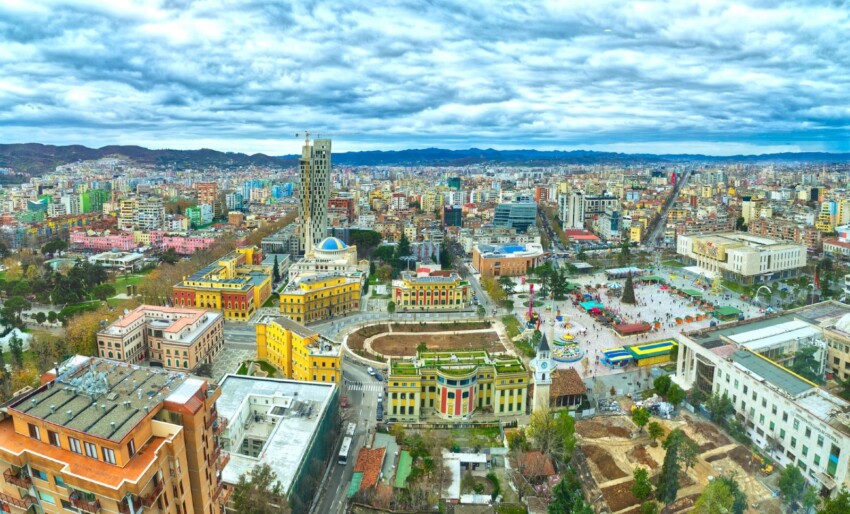
Tirana is the capital of Albania and at the same time its largest and most important city. It is here that Mother Teresa Airport is located, to this day the only international airport in the country, and therefore, anyone arriving in Albania by plane will have to pass through it willy-nilly. Therefore, if you too have chosen to travel by plane, spend some time there, spending a night or two before setting off to explore the rest of the country.
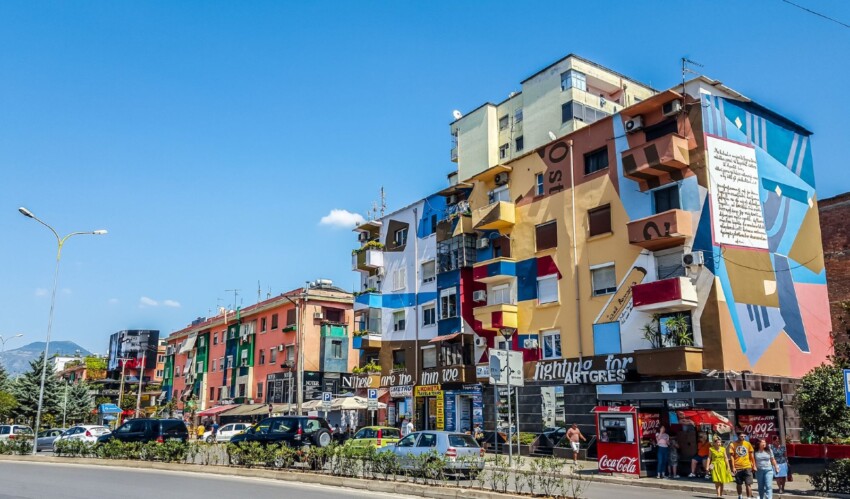
There is an air of change and youth in Tirana. Old Soviet-style buildings have been repainted in bright patterns, others have been demolished and new modern constructions have sprung up in their place. In the city centre, you will be amazed by the number of open-air bars, excellent restaurants and trendy nightlife spots. And finally, spend some time discovering Albania’s sad history of the last century by visiting underground museums and replicas of life during the communist period.
Tirana is a very large city, but fortunately the things to see in the city are all close to the centre. From one attraction to the next you can move around comfortably on foot, breathing in the city atmosphere like a local. If you want, you can also use public transport, as buses and taxis are very cheap. Here are the best things to see in Tirana, to discover all that Albania’s capital has to offer visitors.
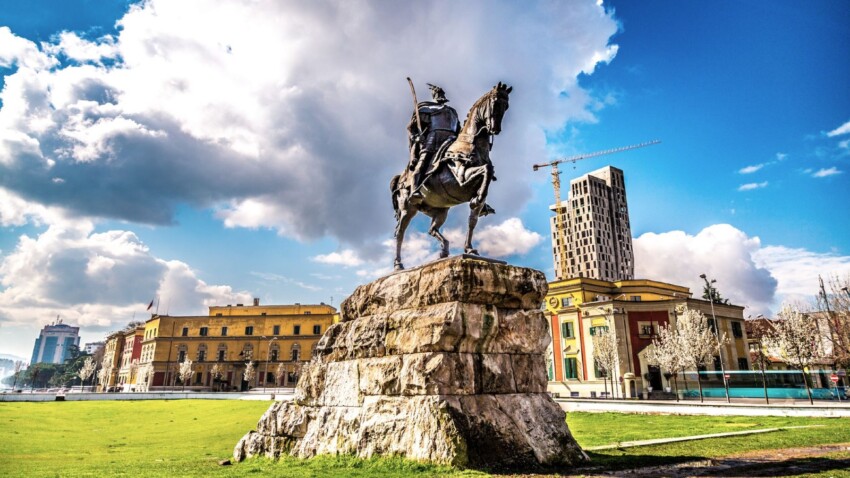
The beating heart of Tirana is the central Skanderbeg Square, or sheshi Skenderbeu in Albanian. This huge square, renovated several times during the 2000s and now completely pedestrianised, is overlooked by most of the city’s historical buildings , as well as a number of institutions.
The first building that catches the eye is the imposing Albanian Folk History Museum, surmounted by a huge mosaic of clear Soviet influence, where inside you can admire the customs and traditions of Albania from antiquity to the present day. Don’t miss the Bank of Albania museum buildings, the ministries of agriculture, finance and tourism, and above all the beautiful Ethem Bej mosque, dating back to 1700. It is small and intimate, not too busy, but can be visited inside.
It is worth mentioning the National Opera and Ballet Theatre of Tirana, housed inside the austere Palace of Culture, where you will also find a series of bars, restaurants, clubs and a huge bookshop where you can buy books in various languages on Albanian history and culture. Also iconic is the silhouette of the Tirana International Hotel, which in communist times was practically the only hotel in the city, a meeting place for international scholars and diplomats.
In the centre of the square stands the statue of Skanderbeg on horseback, Albania’s national hero, credited with halting the Ottoman advance towards Europe in the 15th century.
South of Skanderbeg Square is a second square, this time designed as an enormous 3-hectare garden. It is the parku Rinia, or youth park, a meeting point for couples, teenagers, adults and families with children. You can stroll among the flower beds and rest under the trees, or relax at the beautiful fountain. But the heart of parku Rinia is the Tajvani (or Taiwan) complex, a curious white spider-shaped structure where there are a few restaurants and bars, and a range of entertainment such as a cinema, bowling alley and a casino.
Every year, on 14 March, the summer festival celebrating the end of winter and the rebirth of nature is held on the parku Rinia lawn, with shows, concerts and events.
Next to the park, on the other side of Desmoret and Kombit avenues, you can admire Reja (‘the cloud’), a modern cloud-shaped sculpture designed by Japanese architect Sou Fujimoto and finished in early 2017; it was supposed to be a temporary installation, but thanks to the incredible appreciation of Tirana’s inhabitants, it stayed there. Inside the ‘cloud’ made of white steel poles of different heights, events are organised practically every day: on the official website you can keep an eye on the updated calendar.
We continue along the Desmoret and Kombit boulevards, crossing the course of the small Lana river. We are in the most elegant area of the city, where there are beautiful institutional buildings, ministries, embassies, large gardens and luxury hotels. But the first building you come across stands out sharply from the rest. It is a pyramid about 30 metres high, in an obvious state of disrepair, built of glass and concrete.
We are talking about the pyramid of Enver Hoxha, also known as the ‘mausoleum’ – although it does not fulfil this function, built and opened in 1988 as a museum dedicated to the dictator who had died three years earlier. It then briefly became a conference centre, but after the fall of the regime it was quickly abandoned and left to the elements. Today, despite not being one of the most beautiful buildings in the city, it still remains one of Tirana’s symbols. There has long been talk of demolishing it or restoring it to create space for citizens, but to date no official plans have been presented.
To the west of Enver Hoxha’s pyramid is Tirana’s trendiest neighbourhood. It is the Blloku (which simply means ‘block’), which in the days of the regime was known to be the area of Enver Hoxha’s house, while today, 35 years after the dictator’s death, it has been completely transformed. In fine weather, the streets of Blloku are filled with young people intent on having a good time, as open-air bars follow one another, music plays loudly and tables turn into dance floors.
Blloku is the must-visit area for young people, the nightlife and good life district. There are plenty of restaurants around, almost all of them excellent, with modern and avant-garde offerings inspired by the most important international cuisines. There is no shortage of shops, many of them from large international chains, ideal for an afternoon of shopping in the city.
To the south of the Blloku and Komuna and Parisit neighbourhoods is Tirana‘s enormous green lung, a huge park simply called ‘big park’, parku i madh in Albanian, popular with locals who gather for walks or relaxing bike rides. The park covers an area of about 5 square kilometres, and within it is also the city zoo and botanical garden. The presidential palace is also located there.
The western part of the park is occupied by the artificial lake of Tirana (liqeni artificial i Tiranёs), at the centre of which stands a very tall water jet reminiscent of the much more famous one in Geneva. The lake is obviously neither swimmable nor navigable, but its perimeter is lined by a beautiful pedestrian promenade, very popular especially during the warm season.
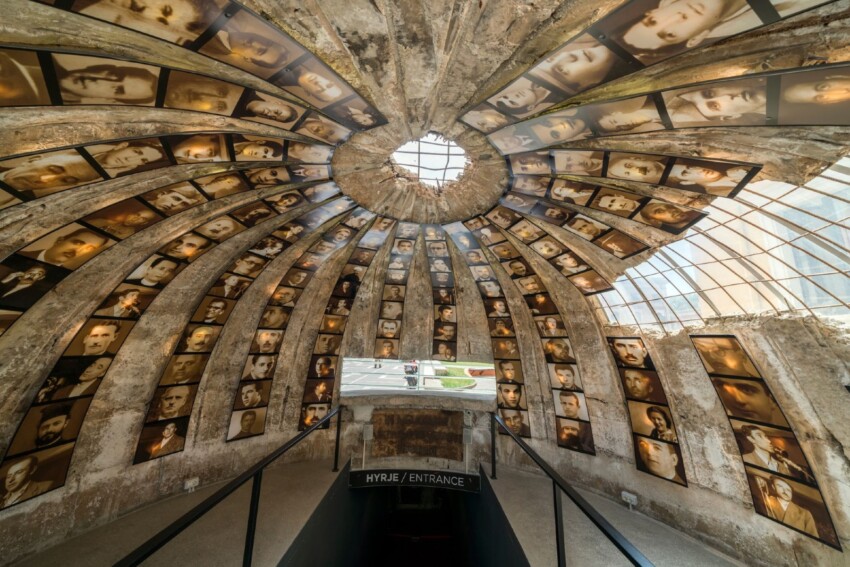
Of the many museums in Tirana, the most interesting is undoubtedly the Bunk’art, which is also the most recent. To be fair, there are two Bunk’art in Tirana, one in the centre behind Skanderbeg Square, the other several kilometres outside the city. Naturally, the one in the central location is the most visited by tourists: built inside an old bunker, a visit to the museum begins by going underground, where a series of rooms have been set up to display the horrors of the dictatorship that shook Albania during the 20th century.
Amidst art installations and video exhibits from the period, a visit to Bunk’art is a blow to the heart, and at the same time an interactive and innovative way to discover the history of this country so close to the Europe that counts but still so unknown to most.
The city of Tirana is dominated to the east by the peak of Mount Dajti, which rises 1600 metres above sea level. Recently, to reach it, the Dajti Ekspres cable car was built, which runs from the eastern outskirts of the city up to the mountain station, where one can take a nice walk or horseback ride to the summit, or simply relax in the fresh air, sipping a drink at the rotating platform bar.
Mount Dajti is part of the national park of the same name, and in winter its summit is often snow-capped. The highlight of the trip is definitely the view from the cable car: on a clear day, you can see all of Tirana.
To get to the bottom station of the Dajti Expres cable car there are no public services, so you’ll have to rely on taxis, or get there by rental car.
In the following map you can see the location of the main places of interest mentioned in this article.
Discover Tirana through the eyes of expert guides who will take you on a tour of the city's hidden treasures. Participating in a guided visit or a free tour will allow you to capture the true essence of Tirana.
The free tours are a viable alternative to traditional guided tours. They work like this: participation is free and at the end of the visit you can leave a tip at your discretion. Below you will find our favourite free tour, otherwise you can see the full list by visiting this page.
Tirana’s hotel offer leaves you stunned. There are plenty of hotels in the city, practically one after the other, both in the centre and in the suburbs. Even on the way to and from the airport, there is no shortage of places to sleep. Room costs are definitely low, and practically always include breakfast. There are plenty of hotels with swimming pools, ideal for enjoying a few cool hours during the summer, while others have features similar to luxury hotels.
Choose without paying too much attention to budget, as, with a few exceptions, prices are more than affordable compared to those in Western Europe. To visit Tirana at its best, however, we recommend sleeping in the centre, as the attractions are all very close together.
Tirana is the capital of Albania and is inhabited by almost 800 000 people. In the city you will find all the services you can expect from a European capital, such as cinemas, entertainment, supermarkets, pharmacies, post offices. There is no shortage of currency exchange offices, to change euros into lek, which almost always offer a more than honest exchange rate, in line with the official one.
To get to Tirana once you get off the plane, you can rely on public transport: the Rinas Express bus operates every day of the week, leaving from the arrivals area at the airport and arriving behind the Palace of Culture in Skanderbeg Square. Rides leave every hour, and tickets are bought directly on board.
Should you have an emergency in Tirana, don’t hesitate to address people in English : many Albanians know the language, or at least will be able to direct you to someone who speaks it. Albanians are always happy to help you, and are honoured that their country is chosen for your holiday: therefore, do not hesitate to ask for help, you will be treated with friendship and respect, and never with any ulterior motive.
Tirana is home to the country’s only international airport, which is perfectly connected to the rest of Europe by a number of low-cost and national airlines.
If you are already in Albania and would like to visit Tirana, it can be easily reached from the south via the A3 motorway coming from Elbasan, or from the coast via highway 2, improperly known as the ‘Tirana-Durrës Highway’. The distance from the port of Durres to the centre of Tirana is about 30-40 minutes, but during rush hour the travel time can even triple.
What's the weather at Tirana? Below are the temperatures and the weather forecast at Tirana for the next few days.
Tirana is located in the heart ofAlbania, not far from the coast as it is only 40 kilometres from Durres.
Compared to Greece, it is about 400 kilometres from Thessaloniki and about twice as far from Athens, travelling in a westerly direction. The journey can be made by international bus companies or by your own vehicle. There are also some air connections, to be checked with the companies.
 Hotel
Hotel  Budget accommodations
  Apartments
  Family Hotel
  Luxury Hotel
  Resorts