Yacht Hotel
Vlorë - Rruga Dhimitër Konomi
Yacht Hotel has a private beach area, restaurant, a bar and tennis court in Vlorë.
Book now
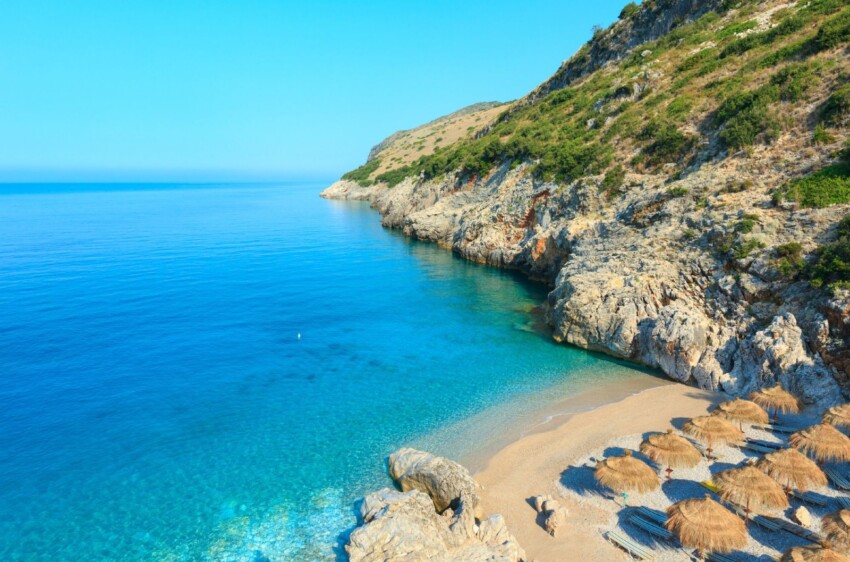
Vlora is the second largest city in Albania. Located in the south of the country, the second national port after Durres, Vlora is the city where modern Albania was born. Indeed, it was here that political leader Ismail Qemali declared independence from the Ottoman Empire in 1912 and established the first parliament.
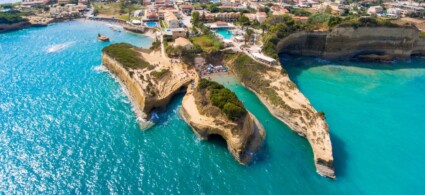
Today, more than 100 years later, Vlora has transformed into a dynamic city that is largely open to tourism. One after the other, hotels, restaurants, bars and shops have sprung up, thanks mainly to the tourist appeal of the sea, which in this part of the Albanian coastline offers its most beautiful colours. Moreover, from 2010 onwards, major renovation and redevelopment works have been carried out, radically changing the urban appearance of Vlora, making it resemble as much as possible a modern European city.
Vlore ‘s expansion is quite recent: in the last 20 years, the old Soviet-style buildings have given way to new constructions and modern buildings. The bulk of old Vlora, by the way, located a couple of kilometres from the coast, has been largely destroyed, so there are not many things to see in the city of historical character. Nevertheless, Vlore retains a unique identity and, above all, an atmosphere of a seaside town waiting to be discovered.
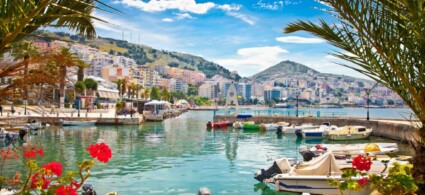
In 2017, work was completed on the entire waterfront, which was completely overhauled and renovated. Today it consists of a very long promenade, which passes by flower beds, lawns and palm trees, and also sports facilities such as tennis courts and five-a-side football pitches. At the same time, one after the other bars, cafés and restaurants have sprung up across the street, which in fine weather set up their tables outside, making the whole area very pleasant for an evening stroll.
Vlora’s promenade starts at the harbour and goes about 3 kilometres further south, running the entire length of the city’s coastline. If you are tired on the way back, take the bus, it only costs a few cents and runs every 15-20 minutes. The promenade is the ‘coolest’ street in town, so in summer it is very busy from late afternoon to the evening after dinner. Don’t drive along it during these hours, unless you like getting stuck in traffic!
Vlora is first and foremost a seaside town, so it is only natural to find out which beaches are the best. The city beach in Vlora is called plazhi i ri (‘new beach’), but objectively it is by no means the most beautiful, besides being the most crowded. North of the port, on the other hand, is plazhi i vjeter (‘old beach’), frequented mainly by locals.
Vlora’s most beautiful beaches, on the other hand, are to the south of the city, beyond the Uji i ftothe tunnel, where there are the most popular bathing establishments and beach clubs among locals and young people, such as Coco Bongo, Bora Bora and Kristal (the latter undergoing extensive renovation).
Along this stretch of coastline, which then reaches the village of Orikum, small pebble beaches alternate with numerous bathing areas with rocks, where concrete platforms have been built to accommodate sunbeds and umbrellas. Whichever place you choose for a day at the beach, you will find crystal-clear water with beautiful colours.
Rruga Vlore-Skele is the name by which Sadik Zotaj Street, Vlora’s main thoroughfare, is known in the city. It starts just outside the harbour and runs all the way to the old city centre, located about 2 kilometres inland. Here are some of the city’s main landmarks and symbols, such as the stadium, the Petro Marko theatre and the rice market. The street ends near the ancient Muradie mosque. The buildings facing rruga Vlore-Skele are the most exclusive and expensive in the city.
Along rruga Vlore-Skele there are all kinds of shops, bars and restaurants. There are also a few supermarkets, modest shopping centres and an almost endless array of fast food outlets. There are also a few small playgrounds, very popular with children who like to be outdoors in fine weather.
The street has recently been renovated, the pavement widened to allow pedestrians to stroll peacefully, but this has resulted in a clear reduction of the driveway lane and the total elimination of parking spaces. The result is that rruga Vlore-Skele is very busy at virtually all hours, so if you are in a car, we recommend avoiding it by finding an alternative route.
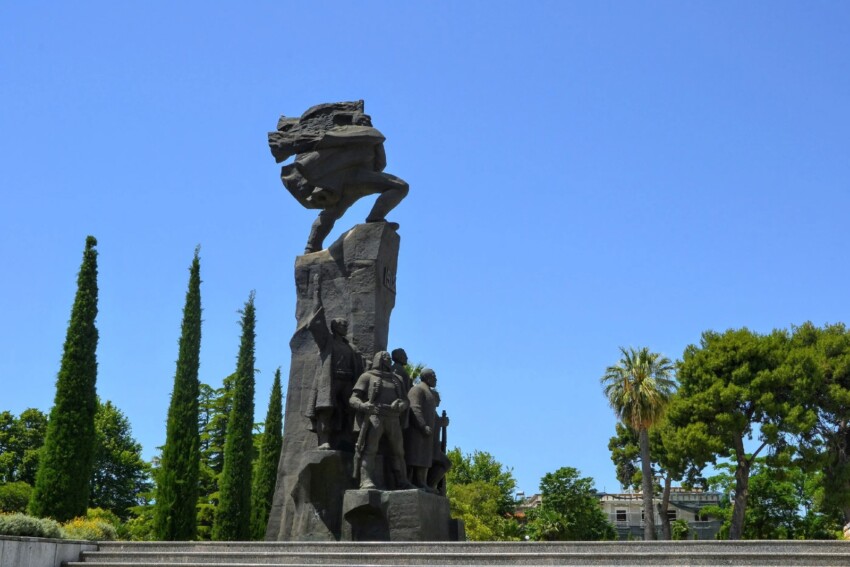
At the end of rruga Vlore-Skele, near the Muradie mosque, is one of the most important squares in Vlora. It is sheshi i Flamurit (‘Flag Square’), where the famous Independence Monument stands: Albania was in fact declared independent in Vlora. Immediately behind, in the beautiful garden, is the tomb of Ismail Qemali, the author of Albania’s independence from the Ottoman Empire, who was elected prime minister in Vlora in 1912.
The square itself is not overly beautiful, but the presence of these two important monuments make it a must-see in the city, in order to learn more about the troubled history of 20th century Albania.
Just north of sheshi i Flamurit is the Vlora City Hall, almost hidden in a small square where the city’s old mosque is also located. We are in the heart of old Vlora, and the buildings still date from the socialist period, some are decadent, others echo Soviet architecture. But the town hall of Vlora stands out because its architecture is familiar. And so it is, since it was built by Italians during the fascist period.
The town hall is a real life centre of the city, as its offices are always open and full of people. This means that you can easily reach it by taxi or by simply asking for a lift: due to the high emigration of Albanians, there is always someone in Vlora who has to go to the town hall to do some paperwork or documents!
Along rruga Vlore-Skele is the old rice market (tregu i orizit in Albanian), a must-see for a glimpse of typical Albanian city life. However, it is very centrally located, so you will find several stalls selling souvenirs, beach items or tourist paraphernalia.
To experience the real Vlora, one must head for the intersection of rruga 8 marsi and rruga Demokracia, where the real city market begins. It occupies the inner streets of an entire block, and is packed with locals every day of the week. It is divided into various sections: there is the area where mobile phones of dubious origin and electronic materials are bought and sold, the clothes area and even an area dedicated to furnishings such as lamps, paintings and carpets. Of course, there is also a large area dedicated to food products, including bakeries, fishmongers, butchers and many stalls selling fresh fruit and vegetables.
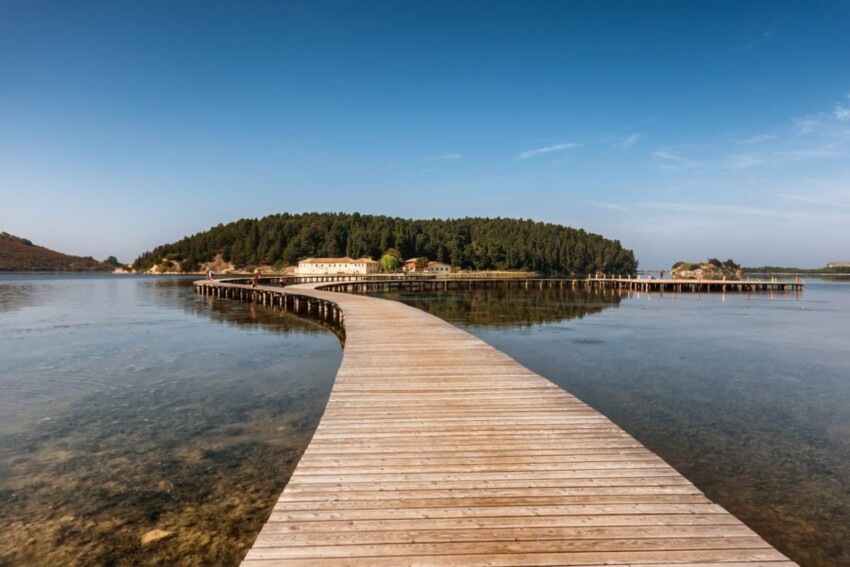
Zvernec is an area located about a 20-minute drive north of Vlora. There is a beach with some waterfront restaurants and a few hotels, but its main attraction is the Narta Lagoon, located just behind the sea, where there is a small islet with a monastery, connected to the mainland by a small wooden bridge, a few hundred metres long, and it is one of the most interesting attractions of the area, the perfect day trip to take a break from city life and the beach.
The monastery, dedicated to St Mary (Manastiri i Shën Mërisë in Albanian) is a medieval Byzantine church, and can be visited from outside and inside, where several icons and the altar in typical Orthodox style can be appreciated. The area is also perfect for animal watching, such as migratory birds, herons and flamingos.
A lot of beachfront hotels have sprung up in Vlora, especially in the last five years. This is the best area to sleep in the city, as it is full of bars and restaurants, the beach is a stone’s throw away, and the centre can be easily reached on foot or by bus.
Hotel prices, with the possible exception of the central weeks of August, are always very low and very affordable. Their quality is excellent and breakfast is always included, so we strongly recommend sleeping in hotels rather than venturing out in search of flats or guest houses, which are not lacking anyway.
Most of the hotels in Vlore are 3- or 4-star, but there is no shortage of high-standard, designer and customer-oriented establishments that have sprung up mainly in recent times. Those looking for more tranquillity can head south of Vlore, to the Uje i ftothe tunnel area, where there are excellent hotels directly overlooking the sea, further away from the city and its noise and therefore decidedly quieter, although you will have to allow for a car or bus ride to get to the centre.
We offer a selection of hotels at Vlora to suit all categories of travellers. The most booked by tourists are the sea-facing hotels, often right on the beach. If you want to play it safe, choose one of the following: they are among the most booked hotels in Vlora, sorted by number of reviews.
If you prefer space, privacy and the ability to prepare your own meals to a hotel holiday, book a holiday home at Vlora. We recommend a few below, but in this case we advise you to book early because houses and apartments for rent at Vlora are in high demand.
If you choose Vlora for a holiday in Albania, you won’t have to worry about finding a place to change money: money changers are practically everywhere, and exchange rates are always the official ones. It is also possible to change euros into lek on the street, or to pay directly in euros and even choose whether to receive change in euros or lek. In short, money is really the least of the problems!
All you need to enter Albania is a valid EU identity card, or of course a valid passport. Carry your documents with you at all times to show them in case of controls, but these are by no means frequent, especially if police officers recognise you as a tourist.
English is widespread among young people, but totally unknown to older people.
Vlora can be reached by land from the capital Tirana, either by public vans or a rented car, via Durres, Lushnje and Fier. Along the way there are some stretches of motorway, some sections of expressway, and others of normal road. The average duration of the route varies from 2 to 3 hours depending on traffic and any road works along the way.
What's the weather at Vlora? Below are the temperatures and the weather forecast at Vlora for the next few days.
Vlora is the main city in southern Albania. It lies directly by the sea, in the middle of a gulf surrounded by the Karaburun peninsula and bordered by theisland of Sazan. The Apulian coast, at Brindisi, is only 90 kilometres away as the crow flies. It is just over two hours' drive from the capital Tirana.
 Hotel
Hotel  Budget accommodations
  Apartments
  Family Hotel
  Luxury Hotel
  Resorts