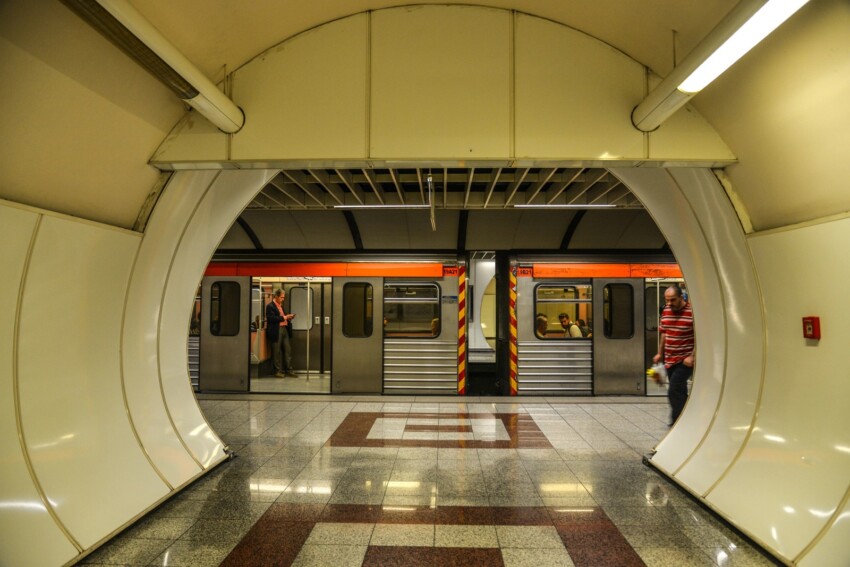
The Athens Metro is one of the most efficient and fascinating public transport systems in Europe. Inaugurated in its modern form in 2000, it is not only an essential means of transport for getting around the Greek capital, but also a veritable underground museum. Thousands of archaeological artefacts have emerged during excavation work, many of which are now on display in the stations themselves, turning the metro journey into a unique cultural experience.
With three main lines covering the most important points of the city, the metro connects the historical centre with the suburbs, the airport and the port of Piraeus. Clean, punctual and air-conditioned, it is an ideal alternative to surface traffic, saving you valuable time during your stay in Athens.
The system is also easy for tourists to use thanks to signage in Greek and English, clear maps and helpful staff at the main stations. Find out in this comprehensive guide everything you need to know to make the most of the Athens metro during your trip.
The Athens metro consists of three main lines, each identified by a different colour, which interconnect at strategic points in the city:
Line 1 (green), the oldest, is also known as ‘ISAP’ (Athens-Piraeus Electric Railway). Inaugurated in 1869 as a steam railway, it was later electrified and integrated into the metro system. It connects Piraeus to Kifissia, passing through the centre of Athens with 24 stations along a route of 25.6 km.
Along this line you will find important stops such as Monastiraki, near the ancient Agora and the characteristic flea market, Thissio, ideal for accessing the archaeological area of the ancient Agora, and Omonia, one of the city’s main transport hubs.
Line 2 (red) covers 17.5 km and serves 20 stations, connecting Anthoupoli to Elliniko. This line is particularly useful for tourists as it passes through Akropolis, the closest stop to the Acropolis and the new Acropolis Museum, and Syntagma, where Constitution Square and the Greek Parliament are located.
Line 3 (blue) is the newest and most modern, with a route of 39 km and 25 stations from Nikaia to Eleftherios Venizelos International Airport. Major stops include Syntagma, an interchange with Line 2, Monastiraki, an interchange with Line 1, and Megaro Moussikis, near the Athens Concert Hall.
The three lines intersect at strategic points, creating an efficient interchange system: Line 1 and Line 3 intersect at Monastiraki, while Line 2 and Line 3 meet at Syntagma, the true heart of the Athens metro system.
You can download the Athens metro map in PDF format below, to print it out or have it with you at all times during your trip to Athens.
Download the mapThe Athens Metro operates every day of the week with timetables that vary slightly between weekdays and weekends:
During thepeak tourist season (May to October), timetables may be extended, especially on the evenings of special events or in the areas most frequented by visitors. For this reason, it is always advisable to check the updated timetables on the official Athens Metro website.
The frequency of trains is very good, with waiting times ranging from 3-4 minutes at peak hours to 7-10 minutes at off-peak times. For the line connecting the airport, trains run about every 30 minutes.
The Athens metro fare system is integrated with the city’s other public transport (buses, trams and trolleybuses) and provides different options depending on your travel needs:
Tickets to and from the airport have special rates.
You can buy tickets at:
Always remember to validate your ticket before starting your journey by inserting it in the validators located at the entrance turnstiles. Checks are frequent and the fines for travelling without a valid ticket are hefty.
Some stations of the Athens metro are particularly relevant for tourists, both for their strategic location near the main attractions and for their architectural and archaeological value:
The Syntagma station is probably the most important of the network, located under the square of the same name where the Greek Parliament is located. This station is a veritable underground museum, with an extraordinary display of archaeological finds discovered during excavations, arranged to illustrate the history of Athens. Particularly impressive is the section showing the geological and archaeological layers of the city, from modern to ancient Athens.
From Syntagma you can easily reach Syntagma Square, the Greek Parliament and watch the impressive changing of the guard of the famous Evzoni. Also within walking distance are the National Gardens and the Presidential Residence.
As its name suggests, the Akropolis station is the closest to the Acropolis and the new Acropolis Museum. This station also exhibits various archaeological finds and reproductions of ancient works of art. Leaving the station, you are a few minutes’ walk from the south entrance of the Acropolis and the entrance to the Acropolis Museum.
Nearby you can also visit the picturesque Plaka district, the Theatre of Dionysus and theOdeon of Herodes Atticus, all included in the Athens sightseeing itinerary.
Monastiraki station serves the square of the same name and the famous flea market. It is an important interchange point between Line 1 and Line 3. From here you can easily reach the Ancient Agora, Hadrian’s Library, the Roman Forum and stroll among the stalls of the Monastiraki market, where you will find souvenirs, clothes, jewellery and antiques.
This station serves the War Museum and is close to the Benaki Museum and the National Gardens. It is also a short distance from the Cycladic Museum and the Byzantine and Christian Museum.
As the name suggests, this station serves the Megaron Music Hall, Athens’ main concert hall. It is located in a prestigious residential area, close to several embassies.
For an optimal experience with the Athens metro, here are some practical tips:
The Athens metro is well integrated with the city’s other means of public transport:
Line 3 (blue) connects the city centre to Eleftherios Venizelos International Airport. The journey from Syntagma to the airport takes about 40 minutes and trains leave every 30 minutes. Keep in mind that not all Line 3 trains run to the airport; check the indications on the electronic scoreboards. For information on flights to Athens, see our guide to flights to Athens.
Line 1 (green) will take you to the Port of Piraeus, the departure point for ferries to the Greek islands. The metro station is about 500 metres from the ferry piers. The journey from Monastiraki to Piraeus takes about 20 minutes.
At the main metro stations you can find connections with:
One of the most fascinating features of the Athens metro is its dual nature as a means of transport and as a widespread archaeological museum. During construction work, which began in the 1990s, more than 50,000 archaeological artefacts were found, many of which are now on display in the stations themselves.
Syntagma station houses the most important archaeological exhibition, with a section of the excavation left visible showing the stratification of the city from antiquity to the present day. Here you can admire a tomb from the 4th century BC, ancient water pipes, mosaics, coins and everyday objects that tell the story of life in ancient Athens.
The Monastiraki station also displays the bed of an ancient river that ran through the city, while the Evangelismos station has remains of an ancient Roman aqueduct.
At the Akropoli station you can admire casts of Parthenon friezes and other exhibits that anticipate a visit to the Acropolis itself and its museum.
It is estimated that about 10 per cent of the total cost of the metro construction was spent on archaeological excavations and the preservation of artefacts, making this project a unique example in the world of how modernity and heritage protection can coexist.
The history of underground transport in Athens has older origins than one can imagine and is closely linked to the urban development of the Greek capital:
The first line (today’s Green Line 1) was inaugurated in 1869 as a steam railway connecting Athens to the port of Piraeus, becoming one of the first underground railways in Europe. In 1904, the line was electrified and gradually extended to its current configuration.
The actual modern metro system was realised much later. Work on Lines 2 and 3 began in the 1990s in preparation for the 2004 Olympic Games. The first section of Line 2 (from Sepolia to Syntagma) was inaugurated in January 2000, followed shortly afterwards by Line 3 (from Ethniki Amyna to Syntagma).
The project represented an unprecedented engineering and archaeological challenge. Excavations had to traverse layers of civilisation accumulated over more than 3,000 years of continuous history, requiring special techniques to avoid damaging the archaeological finds.
In recent years, the system has continued to expand: in 2013, Line 3 was extended to the airport, while in 2022, three new stations were inaugurated, extending the same line to Nikaia in Piraeus. Line 4 (orange) is currently under construction and will connect the northern and eastern districts of the city.
 Hotel
Hotel  Budget accommodations
  Apartments
  Family Hotel
  Luxury Hotel
  Resorts