Discover the must-see attractions of Athens: from the Acropolis to world-famous museums, from ancient theatres to scenic spots, a comprehensive guide to the treasures of the Greek capital.
There are many things to see in Athens, the main one being the Acropolis. In addition to this important archaeological site that towers on top of a hill in the heart of the city, you should visit the Agora, the second most important site in the Attica capital that lies at the foot of the sacred rock.
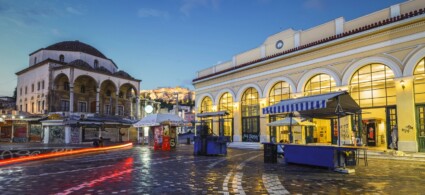
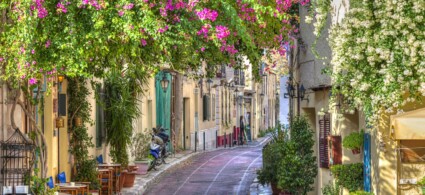
Plaka, Monastiraki and Thisio are the districts of Athens most popular with tourists, while young people congregate in Psiri and Gazi where the nightlife is concentrated. In summer, however, the centre tends to empty out and people flock to the waterfront districts!
To describe in a few lines what Athens has to offer the visitor is impossible: Athens is now a modern capital where ancient art mixes with new architecture and traditional Greek taverns stand side by side with trendy new clubs, all dominated by the Acropolis, the cradle of western civilisation.
This guide takes you on a tour of Athens’ must-see attractions, from the most famous archaeological sites to world-famous museums, and from quaint historical sites to scenic spots offering breathtaking views of the city. Get ready for a journey back in time through one of the oldest and most fascinating cities in the world.
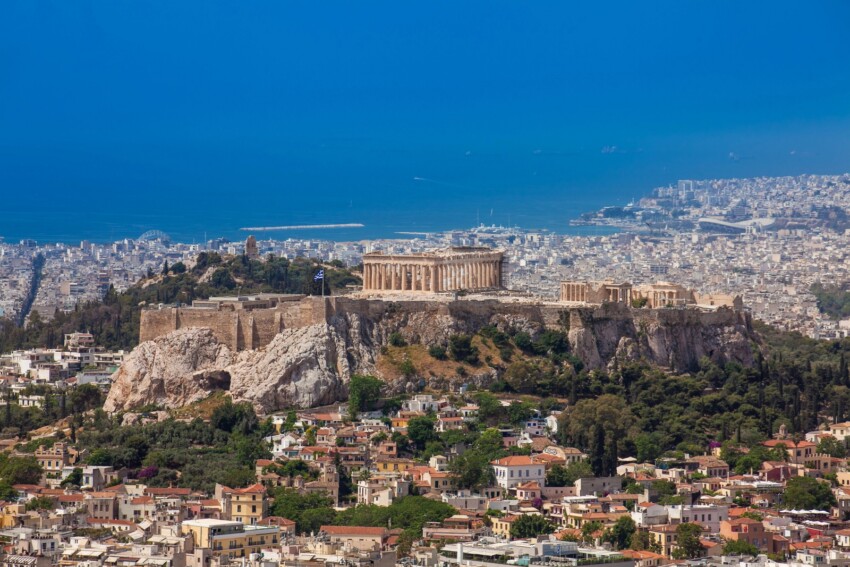
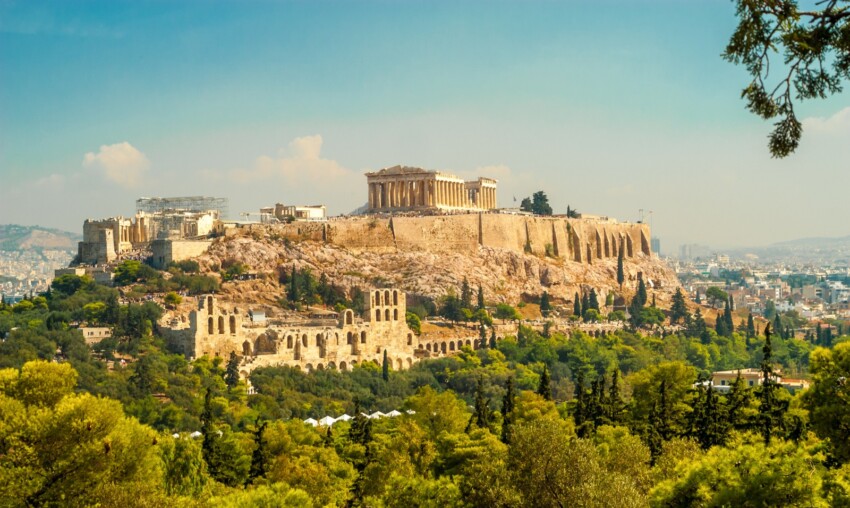
The Acropolis of Athens represents the pinnacle of ancient Greek civilisation and the undisputed symbol of the city. This limestone fortress dominating the city centre houses some of the most important monuments of the ancient world, mostly built during the Golden Age of Pericles in the 5th century BC.
The tour begins at the Propylaea, the imposing marble entrance designed by the architect Mnesicles. Beyond this monumental gateway, the Parthenon stands before you in all its magnificence: dedicated to the goddess Athena Parthenos (the Virgin), this Doric temple represents the perfection of classical architecture, with its subtle optical corrections creating an impression of absolute harmony.
Next to the Parthenon is the Erechtheion, an asymmetrically structured Ionic temple famous for its Portico of the Caryatids, where six statues of maidens replace the traditional columns. On the southwest side of the Acropolis stands the graceful Temple of Athena Nike, dedicated to the goddess of victory.
From the platform of the Acropolis you can enjoy a 360° panoramic view of Athens, from the sea to the mountains surrounding the city. The best time to visit is early in the morning or late afternoon to avoid the heat and crowds, especially in high season.
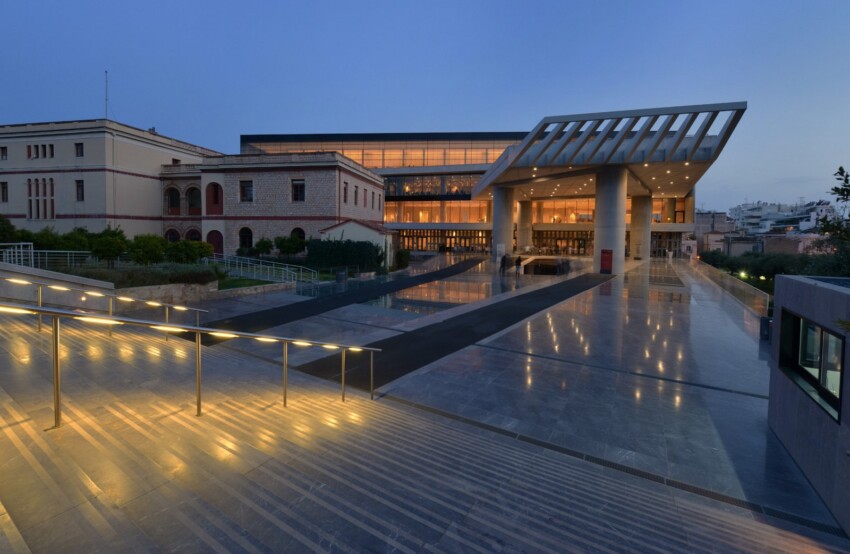
The Acropolis Museum, opened in 2009, is one of the most important archaeological museums in the world and the perfect complement to a visit to the Acropolis. This contemporary building, designed by Swiss architect Bernard Tschumi, houses the treasures from the sacred rock in a bright and technologically advanced environment.
The museum tour is organised chronologically on three levels. On the ground floor, through a glass floor, you can observe the archaeological excavations of the ancient Athenian quarter on which the museum stands. The first floor houses exhibits from the archaic period, among which are the extraordinary korai, female statues with smiling faces and the characteristic ‘Dedalic hairstyle’.
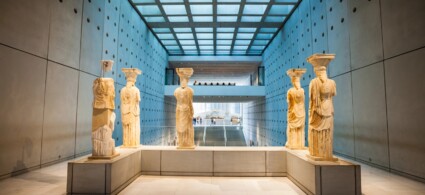
The highlight of the museum is the Parthenon Gallery on the third floor, where the friezes, metopes and sculptures from the temple’s pediments are displayed, arranged according to their original location. Particularly exciting is the Hall of the Caryatids, with the five original female figures from the Erechtheion (the sixth is in the British Museum in London).
The café-terrace on the top floor offers a spectacular view of the Acropolis, perfect for a relaxing break. The museum organises regular guided tours in several languages and educational activities for children.
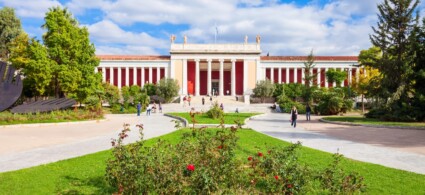
The National Archaeological Museum of Athens is the largest museum in Greece and one of the most important archaeological museums in the world. Housed in an imposing neoclassical building in the city centre, this museum holds an extraordinary collection covering more than 7,000 years of Greek history, from prehistoric to late Roman times.
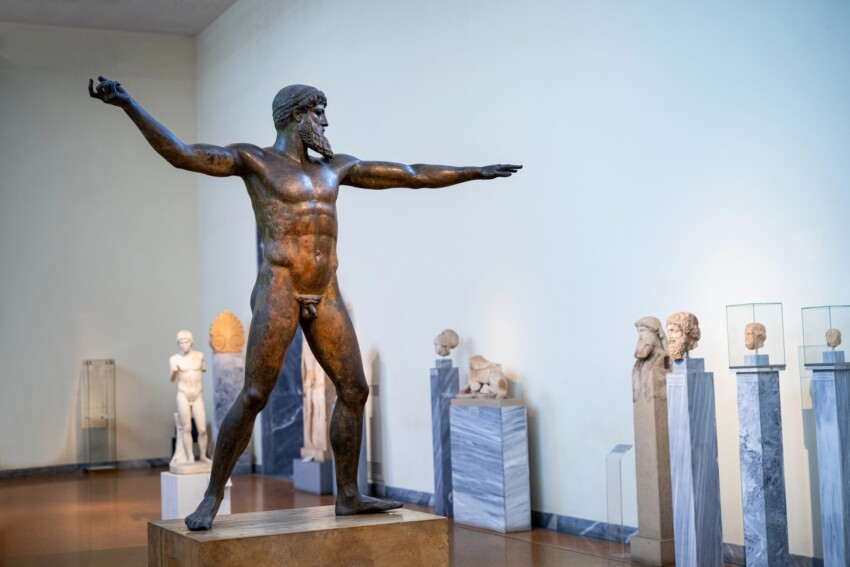
Among the must-see treasures are Mycenaean artefacts discovered by Heinrich Schliemann, including the famous gold ‘Mask of Agamemnon’ and the ‘Treasure of Atreus’. The Cycladic collection includes the enigmatic, stylised marble statuettes dating from 3000-2000 BC, while the sculpture collection features masterpieces such as the bronze of Poseidon (or Zeus) from Cape Artemisius and the Kouros from Sounion.
Equally impressive is the gallery dedicated to Greek vase art, with hundreds of painted vases documenting the evolution of styles from black-figure to red-figure ceramics. The Santorini collection exhibits extraordinarily well-preserved frescoes from the excavations at Akrotiri, including the famous ‘Blue Dames’ and the ‘Spring’.
The museum also houses important collections of ancient jewellery, such as the treasure of Derveni, and of bronzes such as the Antikythera mechanism, a sophisticated astronomical calculator dating back to the 1st century BC. Audio guides available in several languages will help you find your way around this vast collection.
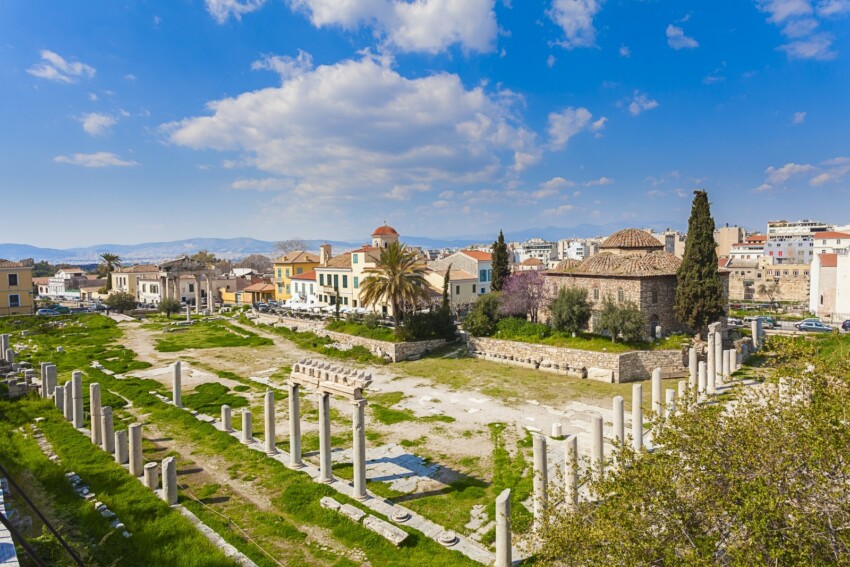
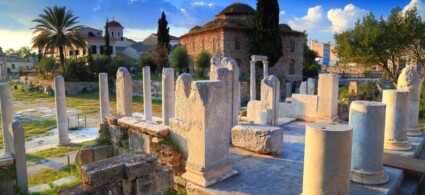
The Ancient Agora was the beating heart of public life in classical Athens, the place where political assemblies, popular courts, commercial activities and where philosophers such as Socrates debated with their disciples took place. This vast archaeological complex, located at the foot of the Acropolis on its north-western side, offers an immersion into ancient Athenian democracy.
The Agora ‘s most impressive monument is the Temple of Hephaestus (or Theeseion), one of the best-preserved Doric temples in the Greek world, built in 449 BC. Equally remarkable is the Stoà of Attalus, a two-storey portico rebuilt in the 1950s thanks to funds from the Rockefeller family, which now houses the Agora Museum.
The Agora Museum, housed in the Stoà of Attalus, displays a rich collection of exhibits illustrating daily life and democratic institutions in ancient Athens. Particularly interesting are the kleroterion (machines for drawing lots for judges), the ostraka (ceramic shards used to vote the ostracism of unpopular politicians) and ancient official measures used in the marketplace.
From the Agora you can follow the ancient Via Panatenaica, the route of the Panathenaean procession, which connected the Ceramics to the Acropolis. The well-kept gardens, dotted with olive and laurel trees, make this site an oasis of tranquillity in the urban centre.
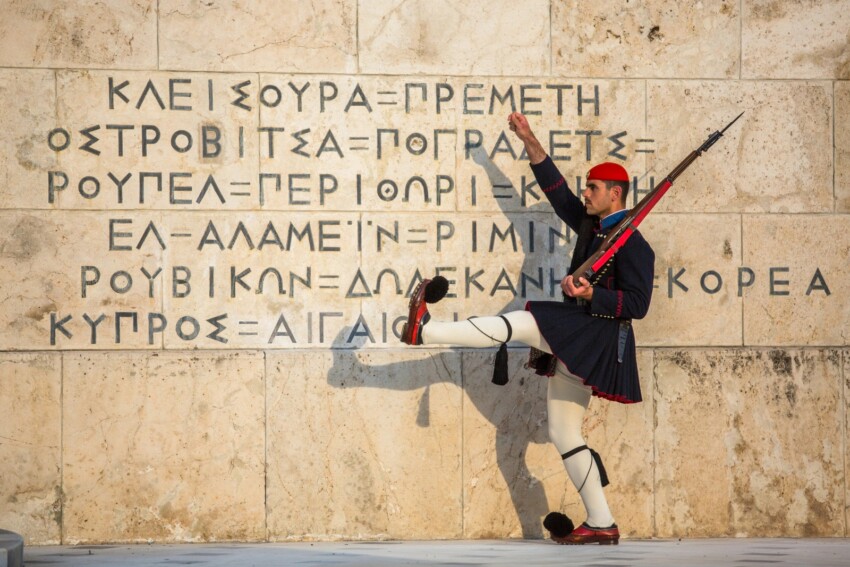
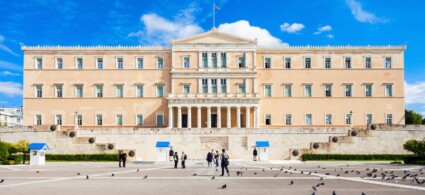
Syntagma Square (Constitution Square) is the political and commercial heart of modern Athens. This vast square in the centre of the city is dominated by the majestic Hellenic Parliament building, a former Royal Palace completed in 1843, which now houses the Greek Chamber of Deputies.
The square’s most famous attraction is the changing of the guard in front of the Tomb of the Unknown Soldier, which takes place every hour. The Evzoni, presidential guards in traditional costume with pleated skirts (fustanella), white stockings and shoes with pom-poms (tsarouchia), perform an extremely precise ritual choreography that always attracts many visitors. The official, more elaborate ceremony takes place on Sunday at 11am.
Important commercial arteries branch off from the square, such as Ermou Street, Athens’ main shopping street. On the eastern side are the National Gardens, a 16-hectare park created in the mid-19th century as a royal garden, where you can relax in the shade of hundred-year-old trees, visit a small zoo or enjoy a coffee at the traditional café-kiosk.
Beneath the square is the Syntagma metro station, which in addition to being an important transport hub, houses an interesting ‘archaeological museum’ with finds discovered during excavations for its construction, displayed in situ behind glass walls.
The square is often the scene of cultural events, national celebrations and occasionally political rallies, historically being the place where Athenian citizens gathered at crucial moments in the country’s history.
The Temple of Olympian Zeus (Olympieion) was the largest temple in ancient Greece, a marble colossus reflecting the grandeur of the king of the gods to whom it was dedicated. Begun in the 6th century B.C. by Pisistratus and completed only 638 years later by the Roman Emperor Hadrian, today 15 of the original 104 Corinthian columns, over 17 metres high, remain, creating an imposing spectacle in the centre of Athens.
Walking among these gigantic columns, you can feel the immensity of the original building, which measured 110×44 metres. An interesting detail is the column that fell to the ground during a storm in 1852, with the marble drums still perfectly aligned, which offers an unusual perspective on ancient construction technique.
Nearby stands Hadrian’s Arch, a monument built in 132 A.D. to celebrate the great Roman Emperor Philhellenes. The arch marked the boundary between the old city of Athens and the new city of Hadrian. Inscriptions on either side of the arch state: ‘This is Athens, the ancient city of Theseus’ and ‘This is Hadrian’s city, not Theseus’.
This area is particularly impressive at sunset, when the golden columns of the temple stand out against the reddish sky, with the Acropolis in the background. The surrounding area, which includes the National Gardens, is perfect for a relaxing stroll after the archaeological visit.
The Hill of Philopappos (or Hill of the Muses) offers one of the most spectacular views of Athens and the Acropolis. This hill, which reaches 147 metres, is covered with Mediterranean pines and lush vegetation, forming a green oasis in the heart of the city. The name comes from the funerary monument dedicated to Gaius Julius Antiochus Philopappus, prince of Commagene and benefactor of Athens, erected in the 2nd century AD.
The route to the top is a pleasant walk along shady paths, dotted with ancient ruins and Byzantine chapels. Along the way you will come across the Church of Agios Dimitrios Loumbardiaris, a small Byzantine building with 16th century frescoes, and you can explore the Prisons of Socrates, caves carved into the rock that traditionally housed the philosopher during his final days.
At the top, in addition to the Philopappos Monument with its well-preserved reliefs, you will find a belvedere offering a 360° panoramic view of the city, from the Acropolis to Piraeus, to the mountains surrounding the Attic plain and the sea. The sunset from Philopappos Hill is particularly impressive, with the Acropolis illuminated by the golden rays of the setting sun.
This area, together with the nearby Pnice Hill (the site of democratic assemblies in ancient Athens) and the Hill of the Nymphs, forms the Archaeological Park of Filopappos, a protected area where you can jog, picnic or simply relax away from city traffic.
An excellent vantage point over Athens, the Acropolis, the Aegean Sea and the port of Piraeus is from Areopagus Hill, a marble outcrop around which a number of myths unfold, including the trial of the council of the gods at Ares for the murder of Alirrotius, son of Poseidon.
Until 462 B.C., the elders of the city gathered on the hill and held their council here, but following a number of reforms, it was stripped of these functions, transforming it into a land of blood. In classical times, death sentences ordered by the court of Athens for the crimes of murder, treason and corruption were carried out here.
We also find the name of St Paul linked to the hill of the Areopagus: from his second missionary journey, which took place between 49 and 52 A.D. and was aimed at bringing public squares to the intellectual metropolis of Hellenism, we can trace the remains of an ancient church where Paul used to speak to his followers.
Today, the Areopagus Hill is a meeting place for young people, especially on warm summer evenings when it is not difficult to meet groups of young people intent on singing and playing the guitar or sipping a couple of beers in the company of a magical view.
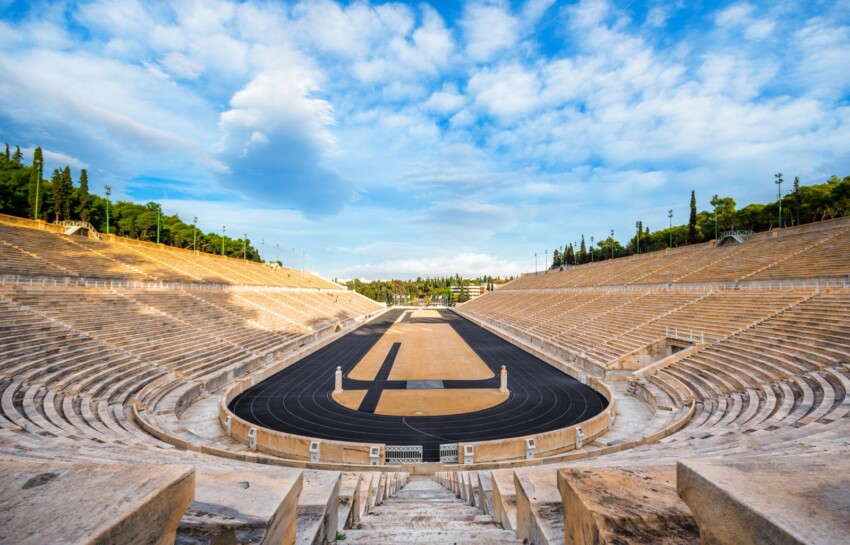
The Panathenaic Stadium (Kallimarmaro, meaning ‘of beautiful marble’) is the only stadium in the world built entirely of white marble and one of Athens’ most emblematic monuments. This extraordinary sports facility, with a capacity of about 70,000 spectators, was rebuilt in 1896 by architect Anastasios Metaxas on the site of the ancient Lycurgus Stadium from the 4th century BC to host the first modern Olympic Games.
The elongated ‘U’ shape of the stadium faithfully follows the model of ancient Greek stadiums. The 47 rows of marble seats glisten in the sun, creating a spectacular visual effect. On the southern side is a vaulted passageway leading to the field, which was used by athletes in antiquity, while on the opposite side a grandstand has been reconstructed in ancient style.
Visitors can walk on the track, sit on the ancient steps and imagine the atmosphere of the ancient games and the first modern Olympics. It is also possible to climb up to the highest seats to enjoy a panoramic view of the stadium and the surrounding city. A small exhibition gallery under the bleachers tells the story of the stadium and the Olympics with period photographs, Olympic torches and other memorabilia.
The Panathenaic Stadium continues to be used for special events: the Athens Marathon ends here, the Olympic flame is lit before each edition of the Games and classical music concerts are occasionally held here. The route to the stadium through the Zappeion Gardens is particularly pleasant, especially on hot Athenian summer days.
The National Gardens represent an oasis of tranquillity in the hectic heart of Athens. Originally created as royal gardens by Queen Amalia in the 1840s, this 16-hectare park is home to over 500 species of plants and trees from all over the world, many artificial lakes, shady paths and decorative statues.
As you stroll through the gardens, you will discover atmospheric spots such as a small zoo with peacocks, goats and other animals, thematic gardens with medicinal plants, a traditional outdoor café, and even ancient ruins and Byzantine mosaics unearthed during the creation of the park. In the centre is an elegant sundial surrounded by flowerbeds, while the numerous old trees offer shelter from the summer heat.
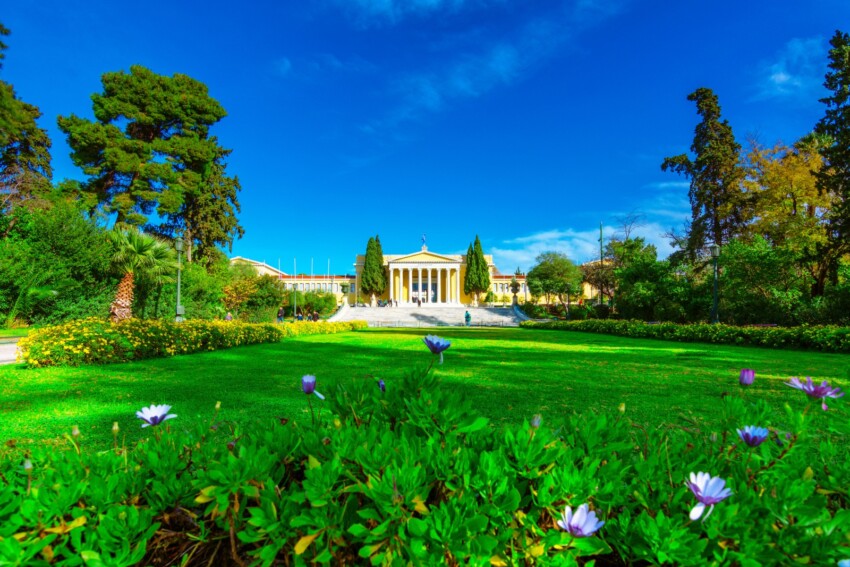
Adjacent to the National Gardens is the Zappeion, a magnificent neoclassical building designed by Theophil Hansen and completed in 1888. This circular structure with a porticoed inner courtyard was built thanks to a donation from the national merchant and benefactor Evangelis Zappas to host events related to the first modern Olympic Games. Today, the Zappeion is used for conferences, exhibitions and cultural events.
Also nearby is the Kalimarmaro, a scaled-down replica of the Panathenaic Stadium built for the 2004 Olympics, and the Temple of Olympian Zeus visible through the southern fence of the gardens. This green complex in the centre of the city offers a pleasant contrast to the surrounding urbanisation and is as popular with tourists as it is with Athenians.
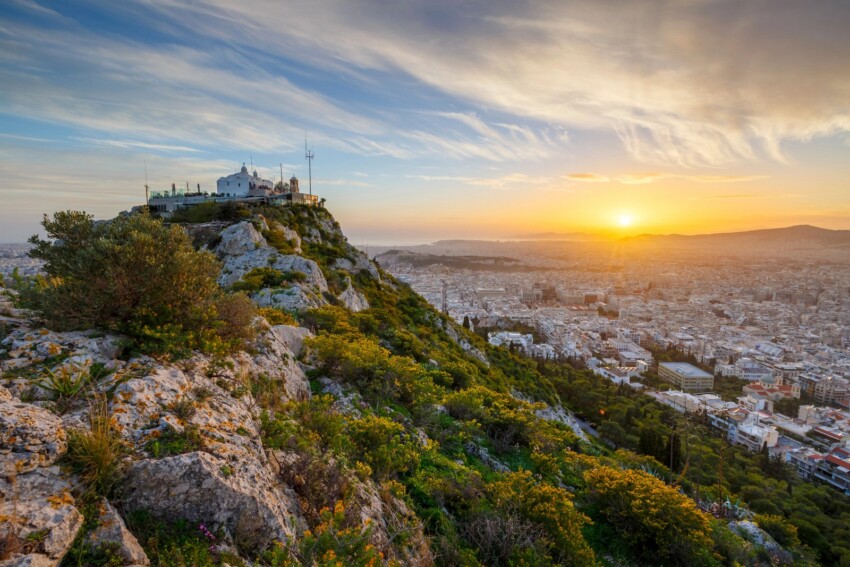
Lykavittos Hill is the highest point in Athens, with its 277 metres dominating the urban skyline. This steep limestone hill offers arguably the most spectacular panoramic view of the Greek capital, extending on a clear day from Piraeus and the Aegean Sea to the mountains of the Peloponnese.
According to mythology, the hill was created when Athena, caught carrying a large rock for the construction of the Acropolis, dropped it after receiving disturbing news. The name ‘Lycabettus’ probably comes from ‘lykos’ (wolf), as it was believed that the hill was once inhabited by wolves.
To reach the top, you can choose between a leisurely walk along winding paths among pine and cypress trees (about a 30-minute ascent from Kolonaki) or the convenient funicular from Aristippou Street. Once at the top, you will find the picturesque Church of St George (Agios Georgios), a 19th century white chapel shining against the blue sky, and a panoramic café-restaurant where you can relax while admiring the view.
Sunset from Lycabettus is a sight not to be missed: the sun setting behind the mountains tinges the Acropolis and ancient monuments pink, while the lights of the city begin to turn on, creating a carpet of light that stretches as far as the eye can see. It is also a great location for photography, offering unique perspectives on the urban structure of Athens.
During the summer, theLycabettus amphitheatre hosts outdoor concerts and performances, allowing cultural events to be enjoyed in an exceptional natural setting. The Lycabettus is also a useful landmark for orientation in the city: it is visible from almost every neighbourhood of Athens and helps visitors maintain a sense of orientation while exploring the capital.
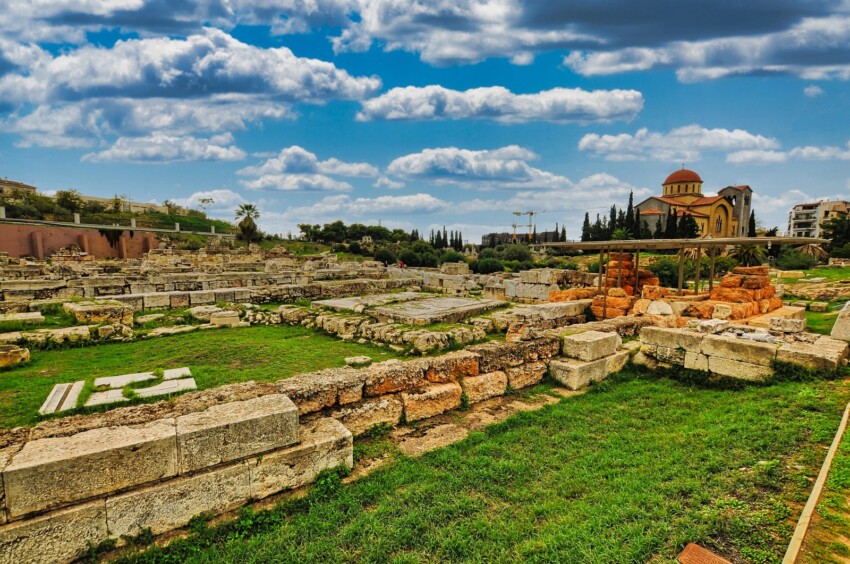
The Keramiko is one of the most fascinating and least crowded archaeological sites in Athens, as well as one of the oldest quarters of the city. It is named after the ceramists (kerameis) who settled in this clay-rich area crossed by the Eridanus River. The site comprises two main parts: the Inner Pottery, which was part of the ancient city, and the Outer Pottery, which became the main necropolis of Athens, offering a unique insight into Greek history and culture.
The ancient cemetery is the most striking area, with its funerary streets lined with monuments and stelae commemorating the dead. The Via delle Tombe and the Via Sacra (the initial route of the procession to Eleusis) offer an extraordinary gallery of Greek funerary sculpture, with monuments ranging from the simple to the sumptuous. Particularly touching are the stelae depicting farewell scenes, such as that of the young Hegeso saying goodbye to her jewellery and, symbolically, to life on earth.
The site also includes remains of Themistocles’ walls (479 BC) and the Dipylon, the main gate of ancient Athens, from which the Panathenaean procession departed. The small Eridano River, channelled through an underground conduit in Roman times, was brought to light by archaeological excavations and still flows through the site.
The Museum of Ceramics, located within the archaeological area, exhibits the most delicate and valuable artefacts from the excavations, including funerary vases, terracotta figurines, jewellery and personal items found in the tombs. Of particular interest is the collection of vases used during funeral ceremonies, some of which feature scenes illustrating burial rituals in ancient Athens.
The Ceramico, with its cypress and olive trees growing among the ancient ruins, offers a contemplative atmosphere, perfect for a quiet break from the busier parts of the city. It is a place that invites one to reflect on the ancient Greeks’ relationship with death and their extraordinary ability to transfigure the pain of loss into works of art of eternal beauty.
Only discovered in 1996 during the construction of the Museum of Modern Art, the Lyceum of Aristotle (Lykeion) is one of the most important archaeological sites for the history of Western philosophy. This complex, which has been open to the public since 2014, was the site of the school founded by the great philosopher in 335 B.C., after his return to Athens, and represents a key piece in the cultural itinerary of Athens.
The Lyceum was one of the main gymnasiums in ancient Athens, both an educational centre and an athletic training ground. Aristotle chose this site for his philosophical school, where he taught while walking among the shaded porticoes (hence the name ‘peripatetic school’, from the Greek peripatein, to walk). Here he developed his method of investigation based on observation and systematic classification, laying the foundations of Western scientific thought.
Excavations have uncovered the foundations of several buildings, including a large gymnasium with a central colonnaded courtyard, lecture halls, changing rooms and baths. Of particular interest is the hydraulic system for water collection and distribution, which includes cisterns, canals and terracotta pipes. Movable exhibits include vases, musical instruments, board games, coins and even remains of ancient meals eaten by the students.
The site has been beautifully integrated into Aristotle Park, a green area with benches arranged to recreate the atmosphere of an outdoor classroom. Information panels explain the history and significance of the site, helping visitors to imagine how lessons and daily life were conducted in this extraordinary institution.
To visit Aristotle’s Lyceum is to literally walk in the footsteps of one of mankind’s greatest thinkers, in the place where he developed his theories on physics, metaphysics, poetics, politics and ethics that profoundly influenced the course of Western civilisation.
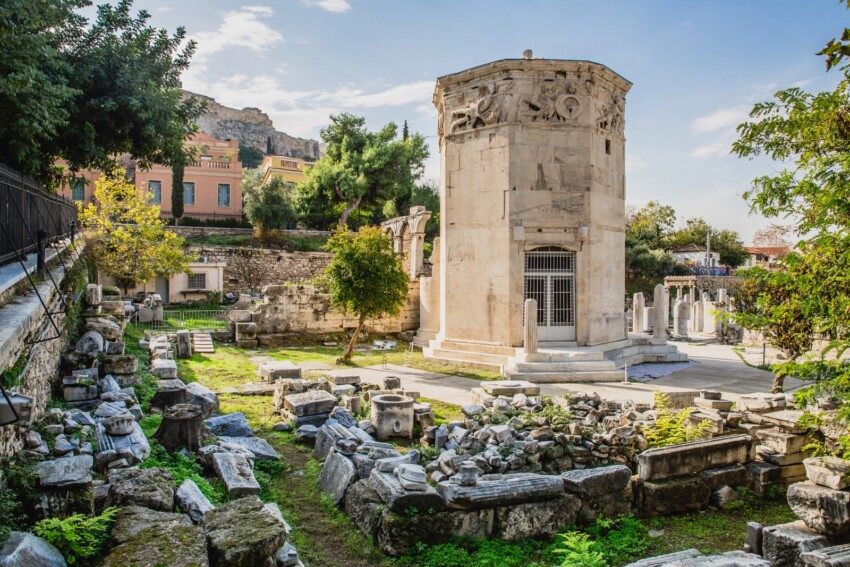
The Tower of the Winds (or Horologion of Andronicus Cirreste) is one of the most distinctive and fascinating monuments of ancient Athens. Built around the 1st century BC by the astronomer Andronicus of Cirrus, this 12-metre high octagonal tower of Pentelic marble served as a weather station, sundial and water clock (hourglass), and is easily accessible from the centre of Athens.
Each side of the tower, oriented towards one of the cardinal points, is decorated with a relief representing one of the eight main winds, personified by winged figures with symbolic attributes indicating their nature (hot, cold, rain-bearing, etc.). Below the reliefs were engraved lines for the sundial, while at the top was a weathervane in the shape of a triton that rotated indicating the direction of the wind.
Inside the tower is the mechanism of the water hourglass (hydrology), fed by a spring on the Acropolis, which allowed time to be measured even on cloudy days and at night. The floor preserves channels and basins that were part of this ingenious system, considered one of the most advanced time-measuring devices in antiquity.
In the Byzantine period, the tower was turned into the bell tower of a Christian church, while under Ottoman rule it became a place of prayer for dervishes. These successive reuses paradoxically contributed to its preservation, making it one of the best preserved buildings in classical Athens.
Located in the north-east corner of the Roman Agora, near Hadrian’s Library, the Tower of the Winds is an outstanding example of the astronomical and engineering knowledge of the ancient Greeks. It also represents a rare example of an ancient monument dedicated to practical and scientific rather than religious or commemorative purposes, testifying to the importance the Greek civilisation attached to understanding and measuring natural phenomena.
Guided and free tours of Atene
Discover Atene through the eyes of expert guides who will take you on a tour of the city's hidden treasures. Participating in a guided visit or a free tour will allow you to capture the true essence of Atene.
The free tours are a viable alternative to traditional guided tours. They work like this: participation is free and at the end of the visit you can leave a tip at your discretion. Below you will find our favourite free tour, otherwise you can see the full list by visiting this page.
 Hotel
Hotel  Budget accommodations
  Apartments
  Family Hotel
  Luxury Hotel
  Resorts