Bestseller
Athens: Acropolis Ticket with Audio Guide
From 39,00 €
Buy the ticket
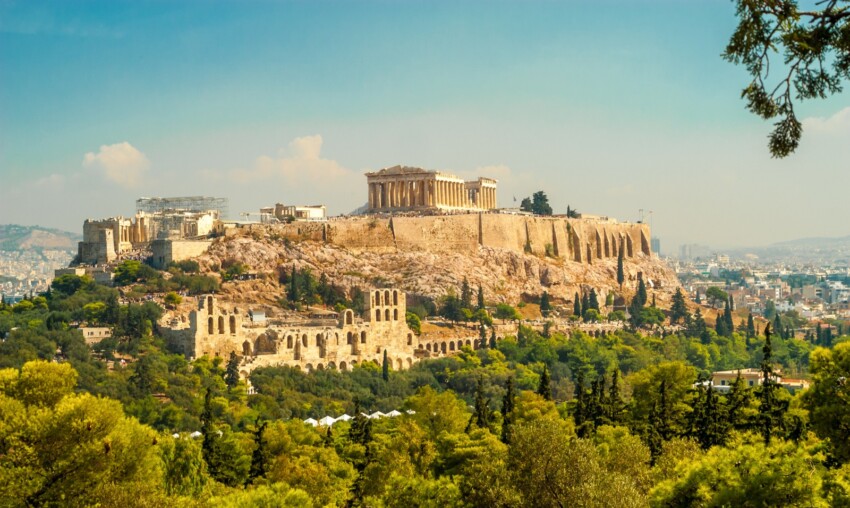
The Acropolis of Athens is the symbol of Greece, of the splendours of its classical civilisation and the most significant landmark of Greek culture. A visit to the ‘upper city’, built on the sacred hill so as to dominate the settlement, is not to be missed.
The sacred city, the Acropolis, the largest architectural and artistic complex that has come down to us from ancient Greece, stands 156 metres above sea level on the flat top of a 140-metre wide and 28-metre long rocky promontory overlooking the valley of Ilissos.
Commissioned in the 5th century B.C. by Pericles in an area where royal palaces and places of worship had been built since the second millennium B.C., it includes the four masterpieces of classical Greek art: the Parthenon, built by Ictinus, the Propylaea, the monumental entrances to the sacred area dedicated to Athena, the Erechtheion and the temple of Athena Nike.
Today, the Acropolis is a Unesco World Heritage Site. The landscape is monumental and consists of massive structures perfectly balanced with each other and with nature, creating a beautiful sight.
Over the centuries, the Acropolis has been damaged numerous times: first the Byzantines converted the temples into churches and plundered the treasures, then in 1456, when Athens was conquered by the Turks, the site became a mosque and the Erechtheion was used as a harem for the Turkish governor.
The episode that most damaged the Acropolis occurred in 1687 when the siege of the Venetian army caused the Parthenon to explode, used by the Turks as a powder magazine. The sacking was completed in the 19th century by Lord Elgin, ambassador of the King of England, who brought back many marbles that are still the pride of the British Museum today.
The best time to climb the Acropolis is at sunset: red and orange envelop the temples and the city of Athens as a light breeze cools the air.
A great vantage point of the city of Athens, stretching endlessly at your feet, is near where the Greek flag flies. Below you can see Plaka and the ruins of the temple of Zeus.
The Acropolis stronghold is filled with temples built in the heyday of Pericles and works by Phidias, the greatest sculptor of antiquity who was commissioned to do the work. Today, only the remains of these works of art can be admired, but the beauty and majesty of the past can still be imagined.
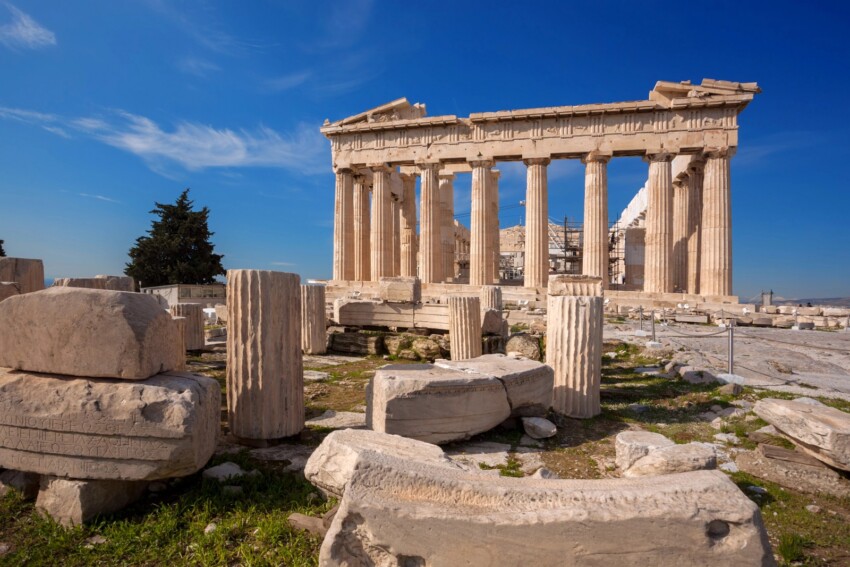
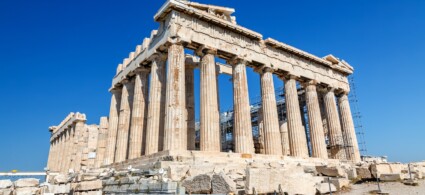
The Parthenon is the landmark monument of the Acropolis of Athens and the whole of Greece.
Its construction is attributed to the architects Ictinus and Callicrates, under the supervision of the sculptor Phidias who was responsible for the entire complex, and is dated back to 447 BC when they wanted to replace an incomplete structure whose typology, materials and plan were copied.
The Parthenon temple is dedicated to Athena Parthenos, the Virgin, protector of the city. The construction of the Parthenon lasted 9 years while the sculptural decoration was completed in 432 BC.
The Parthenon, the main temple of the monumental Acropolis complex, is Doric in style, has 8 Pentelic marble columns on each short side and 17 on the long sides, and conforms to the 09:04 ratio between vertical and horizontal proportions.
The cella is the central part of the temple and the statue of Athena sculpted by Phidias in gold and ivory was kept here. The room at the back of the cella has four columns of Ionic order supporting its roof. The introduction of Ionic order elements into a predominantly Doric temple was rare in Greek architecture but gave the Parthenon a delicate balance between austere and delicate visual characteristics.
Over the centuries, the Parthenon was transformed first into a Christian church and then into a mosque until it was used by the Turks as a weapons and ammunition depot. It was this latter role that led to a deep wound in the building in 1687: a mortar shell fired from a Venetian ship besieging Athens hit the temple, largely destroying it.
To try to remedy the problems of the Acropolis in 1975, an interdisciplinary commission of experts consisting of archaeologists, architects, engineers and chemists was set up by the Ministry of Culture to study and plan the execution of all the works necessary to complete the restoration of the site.
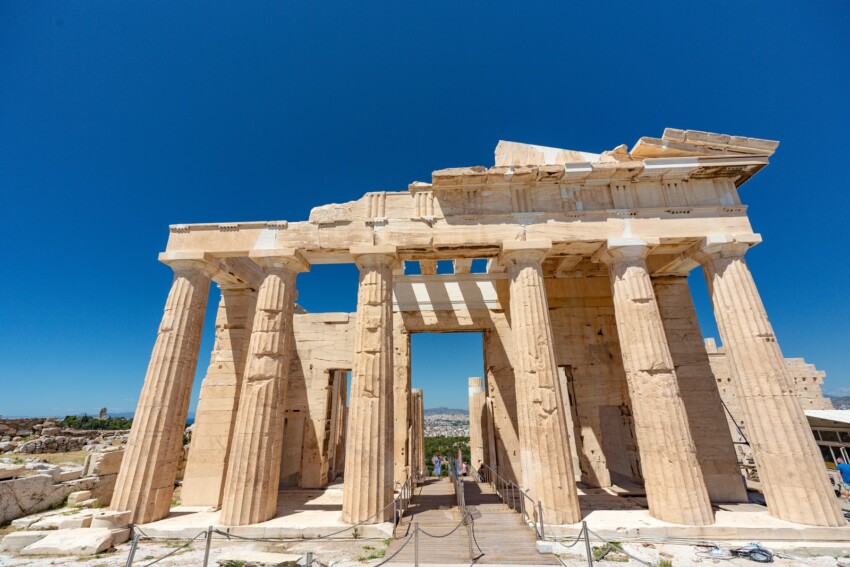
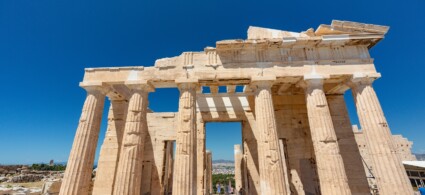
The monumental entrance to the Acropolis is the Propylaea. The entrance, designed by the architect Mnesicles, was built between 437 and 432 BC when its construction was interrupted due to the Peloponnesian War and consists of a central body and two side wings.
Built using white Pantelian marble and grey Eleusinian stone, the Propylaea have a unique appearance and overcome the difficulties of integrating both with the different elevations of the site and with the existing architecture.
The central body features six Doric columns, similar to those of the Parthenon, a corridor with three Ionic columns on either side and six Doric columns on the west exit.
The free-standing wings represent the unfinished part of the original design: in the northern part is the Art Gallery, designed to be an art gallery and banqueting venue, while to the south is a simple portico.
The span of the horizontal roof beams of the Propylaea is particularly impressive and is much longer than the norm in Greek architecture of the time. In front of the Propylaea is a massive 10-metre high grey marble pedestal on which stood a sculpture of a chariot drawn by four horses in honour of the king of Pergamon.
Over the centuries, the building was first converted into a Byzantine bishop’s palace and in the mid-17th century was used as a powder magazine. Unfortunately, it was badly damaged in an explosion, but thanks to restoration work, the Propylaea has regained some of its former glory.
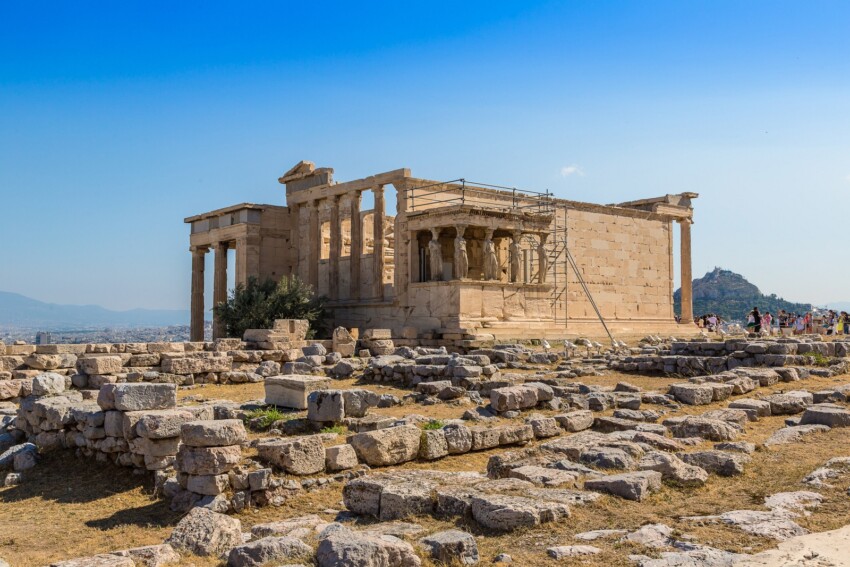
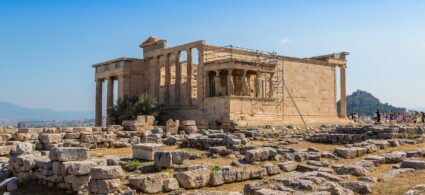
The Erechtheion is a temple with an asymmetrical plan, due both to the uneven terrain on which it stands and to the fact that it has to be integrated with numerous sanctuaries, located within the Acropolis combining the Doric and Ionic styles.
The construction of this building, intended to house religious rituals, began in 42o BC. BC, at the height of the Peloponnesian War, to be finished in 406 BC. Built to replace the old temple, the east side of the Erechtheion was dedicated to Athena Polia while the west side was dedicated to Poseidon.
The Erechtheion has delicate forms in stark contrast to the neighbouring Parthenon. The entrance, facing east, has 6 columns in Ionic style.
The temple is unusual in that it incorporates two porticoes, one at the north-west corner that is supported by tall Ionic columns, and one at the south-west corner that is supported by 6 female statues about 6 metres high, the famous Caryatids. And it is precisely the Caryatids, with their sinuous form that seem to casually support the weight of the entablature on their heads, that have become the main feature of the Erechtheion. These female figures are exact replicas of the originals now housed in the Acropolis Museum.
The temple features an unusual continuous frieze combining white marble figures with a dark grey marble background.
The temple of the Erechtheion has undergone major reconstruction over the centuries: it was first damaged in the Classical period by a great fire, then in the 7th century AD it was converted into a Christian basilica and finally during the Ottoman Empire it was converted into a harem, which involved the walling up of the portico on the north side.
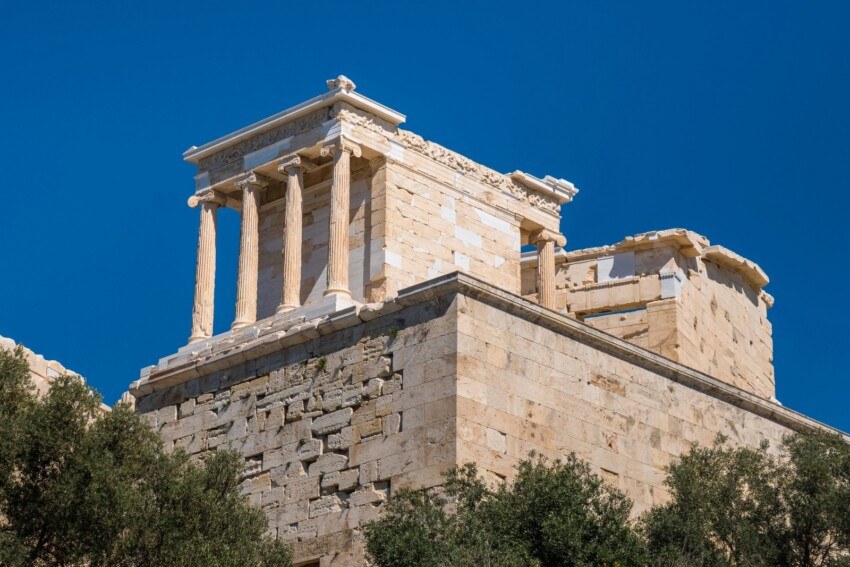
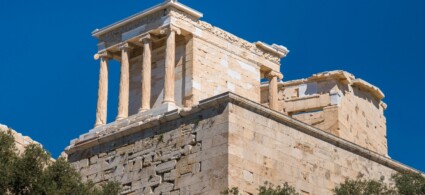
The Temple of Athena Nike, at 27 metres long and 18 metres wide, is the smallest structure on the Acropolis. Built in 420 BC by the architect Callicrates in honour of the goddess of victory, the temple has a row of 4 monolithic Ionic columns at the front and back.
The sculptural frieze depicts on three sides scenes of battles between Greeks and Persians while on the east side the relief is dedicated to the Olympian gods intent on observing these battles.
The temple of Athena Nike stands in the southwest corner of the Acropolis, near the Propylaea, on a rampart built on a rocky outcrop. The structure is built of limestone covered with marble and housed the wooden statue of Apteros Nike or Victory without wings: the goddess deprived of her wings according to the ancients would thus never have been able to leave Athens.
The temple was converted into a church in the 5th century A.D. and in the Ottoman period it was first used for ammunition storage and then dismantled to build a protective bastion near the Propylaea. In 1834 the rampart was in turn dismantled and the temple rebuilt within four years.
In 1998, the temple of Athena Nike underwent an extensive restoration that allowed the concrete floor built in previous years to be dismantled. On that occasion, the frieze was removed and placed inside the Acropolis Museum.
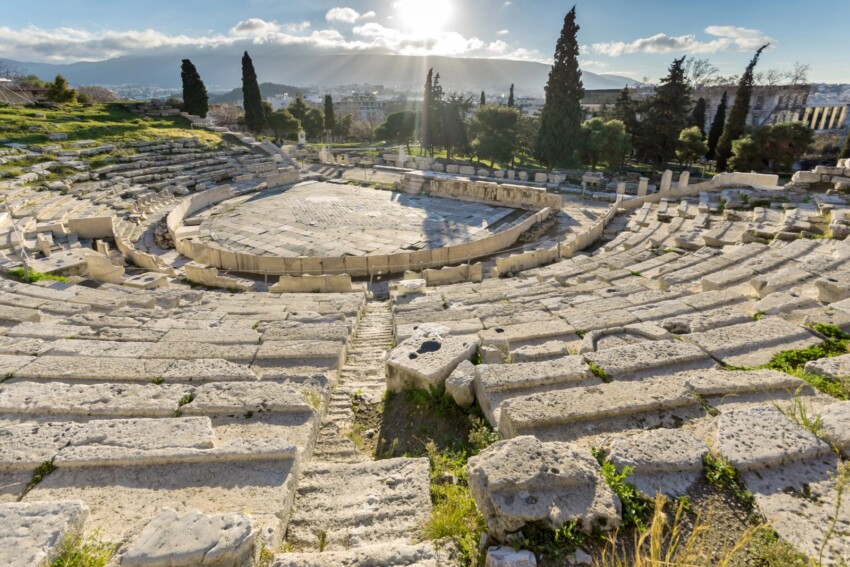
From the Acropolis, one can enjoy a splendid view of the Theatre of Dionysus, perched on the southern slope of the sacred rock of the Acropolis. The theatre, originally built of wood, was the centrepiece of the Great Dionysia celebrations and hosted performances of the tragedies of Aeschylus, Sophocles and Euripides as well as the comedies of Aristophanes.
Dionysus was the Greek god of wine, agriculture and theatre, known to the Romans as Bacchus. The theatre is located in the area of the Sanctuary of Dionysus, which also housed several temples dedicated to the god.
This important archaeological site was rediscovered at the end of the 19th century. The structure that has come down to us is mostly from Roman times, but archaeologists have been able to identify as many as nine different construction phases. The theatre was rebuilt in the 4th century B.C. in stone and marble: only 20 of the 64 rows designed to accommodate the 17,000 seats have survived to the present day intact.
Immediately above the theatre some steps lead to the Sanctuary of Asclepius, built around a sacred spring and dedicated to the god of medicine. The cult of Asclepius was introduced in Athens in 429 BC while a plague epidemic was raging in the city.
Tragedies are still performed throughout the year in the enchanting setting of the Theatre of Dionysus.
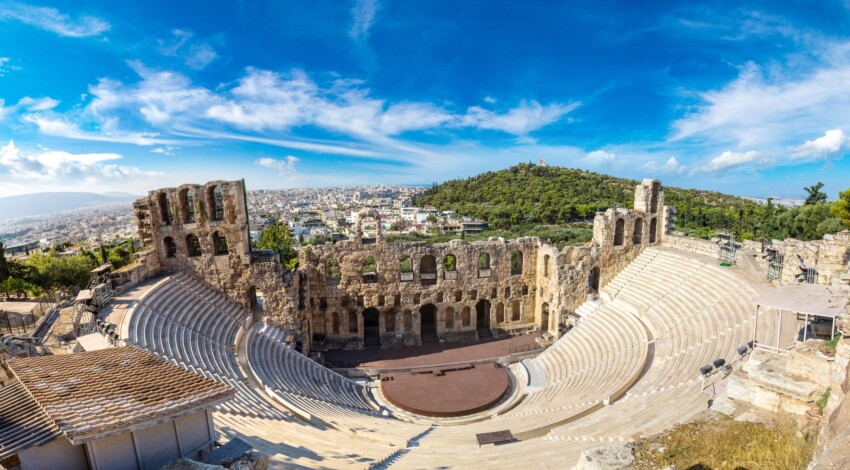
The Theatre of Herod Atticus is located at the base of the Acropolis and is still used today to stage exciting classical plays. To relive the experience of ancient Greek performances, don’t miss the Athens Festival, held every year from June to September in this fascinating venue.
Built by Herod from 161 A.D. in memory of his wife, the semicircular amphitheatre on tiers arranged in 32 rows can seat up to 6 thousand people. A wooden roof covered the 35-metre-wide theatre stage in ancient times.
From the Acropolis, one can admire the spectacle of Herod’s small theatre, which still retains its classical and traditional design. The Odeon has hosted performances by Maria Callas and the Bolshoi Theatre Ballet but also modern artists such as Elton John, Sting and many others.
Children under 6 years of age are not allowed to enter.
The ancient foundations of a temple dating back to the 6th century BC can be seen in the centre of the Acropolis between the Parthenon and the Erechtheion. The ancient Temple of Athena Poliàs was the centre of the cult of the patron goddess of the city of Athens: for the ancient Greeks she embodied wisdom, courage, inspiration, civilisation, law and justice, but also war, mathematics, strength, strategy, arts and crafts.
Built and destroyed several times, the temple was in Doric order and had a marble pediment. In 480 B.C. it was finally demolished and replaced with the Erechtheion, although several sculptures, depicting mythological events, have survived through the centuries.
The ancient temple of Athena was oriented on the west-east axis: the sides measured 21.3 and 43.15 and were adorned with 6 columns on the short side and 12 on the long side. The foundations are composed of various materials and built using different techniques, which makes it difficult to reconstruct the architectural history of the building.
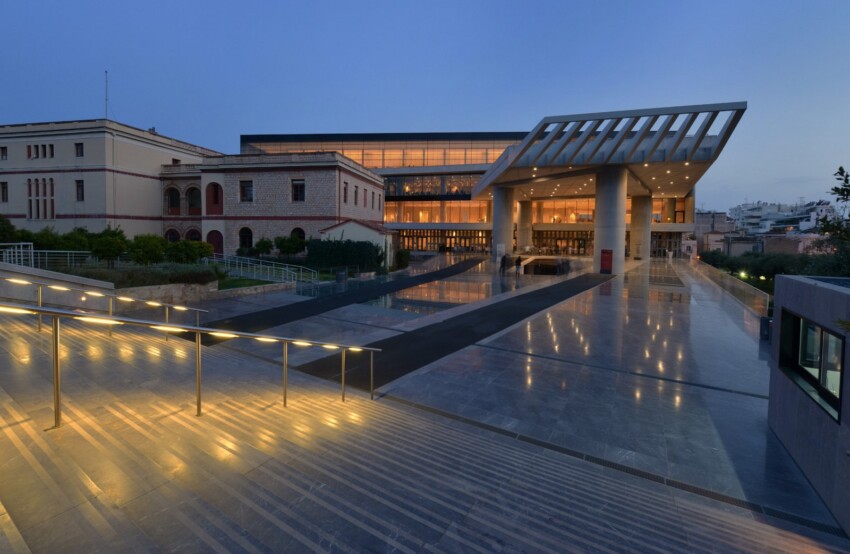
The Acropolis Museum is located about one kilometre away from the Parthenon, in the Makryianni district, among several archaeological sites including the 5th century A.D. ruins visible through the glass floor of the first floor.
The new, modern building, opened in 2009, houses some 8,000 square metres of exhibition space, mainly sculpture.
From prehistoric times to late antiquity, life on the Acropolis is narrated in the Museum: from the sculptural works to the decorative architectural elements of the monuments.
The collection of the Acropolis Museum is installed in a simple manner and the route for the visitor is clear. On the third level is the Parthenon room where the Parthenon sculptures and frieze, brought back to Greece from England after Sir Elgin’s plundering, are exhibited.
The museum also offers some facilities: bar, restaurant and souvenir shop.
In the following map you can see the location of the main places of interest mentioned in this article.
The Acropolis is the most visited attraction in Athens and all of Greece. To visit it, you must buy an entrance ticket online following this link or take part in a guided tour. There are different types of tickets: choose the one that suits you! We recommend that you visit at off-peak times, i.e. early in the morning or late in the afternoon.
Due to the high number of tourists at the Acropolis, it is highly recommended to book your ticket in advance directly online, by clicking on the box below. By purchasing your ticket online, you will be able to avoid the long queues that form every day at the ticket offices.
Alternatively, to discover everything about the marvellous Acropolis you can request an audio guide or have an expert guide accompany you during your visit. The cost is slightly higher than the entrance ticket and even buying these tickets will save you time by avoiding queuing at the ticket office.
If in addition to the Acropolis you also want to visit other Athens attractions, such as the Acropolis Museum or the Agora, the combination ticket is ideal to save money on individual entries and skip the queue at all ticket offices.
Reaching the Acropolis is easy and pleasant: wide pedestrian avenues, bustling with cafés and restaurants, rise from the neighbourhoods of Thisio and Makrianni. From Plaka and Monastiraki the climb is quieter but still surrounded by nature. From the gate at the base of the sacred rock you have to walk up a flight of steps to reach the actual entrance to the archaeological site.

 Hotel
Hotel  Budget accommodations
  Apartments
  Family Hotel
  Luxury Hotel
  Resorts