Bestseller
Athens: Acropolis Ticket & Heritage Sites + Acropolis Audio
From 36,00 €
Buy the ticket
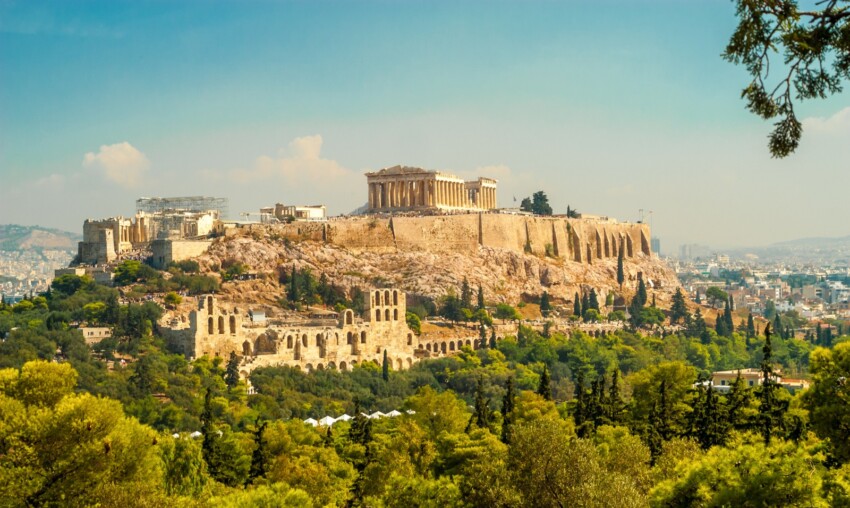
The Acropolis of Athens is the symbol of Greece, representing the heights of its classical civilisation and the most significant landmark of Greek culture. Standing 156 metres above sea level, it crowns a flat-topped rocky promontory overlooking the Ilissos Valley: a visit to this ‘upper city’ is unmissable.
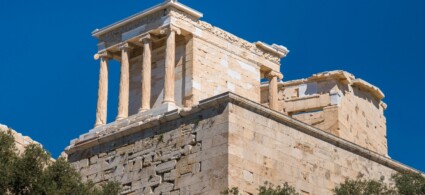
Commissioned in the 5th century BCE by Pericles, the Acropolis encompasses four masterpieces of classical Greek art: the Parthenon, built by Ictinus, the Propylaea, the monumental gateways to the sacred precinct dedicated to Athena, the Erechtheion, and the Temple of Athena Nike. Today the site is a UNESCO World Heritage Site.
Over the centuries, the Acropolis has suffered repeated damage, from Byzantine raids through its conversion into an Ottoman mosque, to the explosion of 1687 and the removal of marble sculptures by Lord Elgin: you’ll find a complete chronology in the Acropolis History section, later on this page.
The best time to visit is at sunset, when red and orange light envelops the temples and a gentle breeze cools the air. An excellent vantage point can be found near where the Greek flag flies: from here you can observe Plaka and the ruins of the Temple of Zeus.
The Acropolis is Athens’s most visited attraction and indeed the entire country’s: to visit it, you’ll need to purchase an online admission ticket on this page or join a guided tour. There are several ticket types available: choose the one that suits you best!
From 1 April 2025, the admission price during high season (1 April – 31 October) is €30 per person, with no discounts available in this period. During low season (1 November – 31 March), prices are lower: we recommend checking the exact amount on the official website, as winter prices have been revised several times over the past year.
Free entry is granted to EU citizens up to 25 years old (with valid ID) and children under 5; discounts are available for students, over 65s and people with disabilities (with relevant certification). Entry is free for everyone on certain fixed dates: 6 March, 18 April, 18 May, the last weekend of September, 28 October and the first Sunday of the month from November to March.
Tickets are allocated a 60-minute time slot, with a 15-minute grace period before and after.
Given the high volume of tourists visiting the Acropolis, it’s highly recommended to book your admission ticket in advance online using the box below. By purchasing your ticket online, you’ll be able to avoid the long queues that form daily at the ticket offices.
Alternatively, to discover everything about the magnificent Acropolis, you can request an audio guide or be accompanied by an expert guide during your visit. The cost is only slightly higher than a standard admission ticket, and by purchasing these tickets you’ll also save time by avoiding the ticket office queue.
If you’d like to visit other Athens attractions alongside the Acropolis, such as the Acropolis Museum or the Ancient Agora, a combination ticket is ideal for saving on individual entries and skipping queues at all ticket offices.
According to the opening hours announced by the Greek Ministry of Culture, the Acropolis follows this calendar: in winter (November-March) it opens from 8:00am to 5:00pm, with last admission at 4:30pm; in summer (April-October) from 8:00am to 8:00pm, with last admission at 7:30pm. From September through late October, closing time reduces by roughly 30 minutes every two weeks as daylight hours shorten.
The site is closed on 1 January, 25 March, 1 May, Orthodox Easter Sunday and 25-26 December. In the last two summers, the Acropolis has temporarily closed at midday for several hours due to extreme heat waves: if you’re travelling in high summer, keep an eye on official notices in the days immediately before your visit.
The Acropolis fortress holds temples built during the Age of Pericles, under the artistic supervision of Phidias, the greatest sculptor of classical antiquity. Today only ruins remain, yet the scale of the monuments and quality of the Pentelic marble still convey a sense of their original splendour.
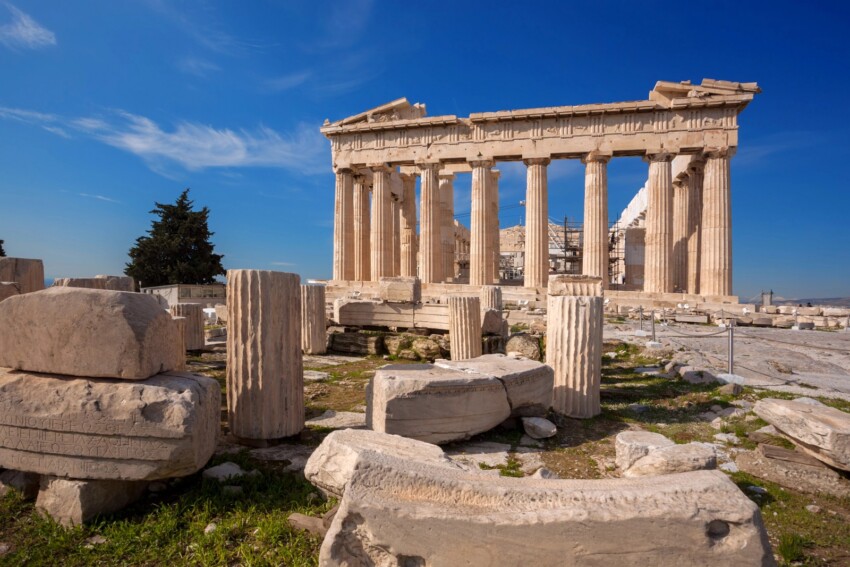
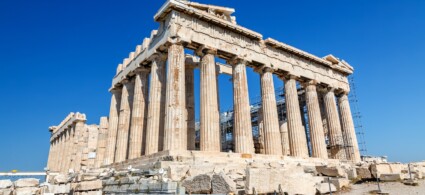
The Parthenon is the iconic monument of the Acropolis and of Greece itself. Its construction, attributed to architects Ictinus and Callicrates under the supervision of Phidias, began in 447 BCE and took nine years; the sculptural decoration was completed in 432 BCE.
The temple, dedicated to Athena Parthenos, is in Doric order: it features eight columns of Pentelic marble on each short side and seventeen on the long sides, maintaining a 9:4 ratio between vertical and horizontal proportions. The central chamber once housed a chryselephantine statue of Athena, crafted in gold and ivory by Phidias himself; at the rear stand four Ionic columns, a rare choice in a predominantly Doric structure.
Over the centuries the Parthenon was converted into a Christian church, then a mosque, and finally an Ottoman ammunition depot: this last use led to its partial destruction in 1687, when a Venetian mortar shell detonated the powder magazine. Restoration work initiated in 1975 by the Ministry of Culture has recently allowed the temple to be freed from scaffolding, now visible for the first time in decades without construction structures.
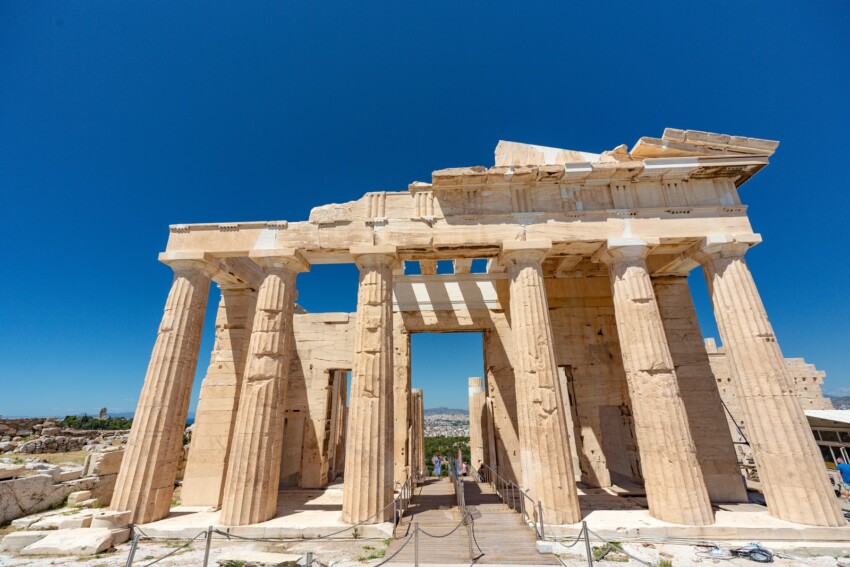
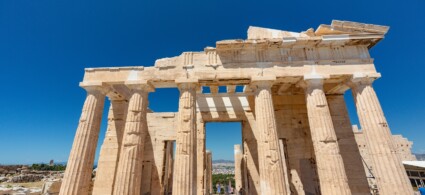
The Propylaea form the monumental entrance to the Acropolis. Designed by architect Mnesicles and constructed between 437 and 432 BCE, work was interrupted by the outbreak of the Peloponnesian War and the building remained incomplete.
The central structure, built in Pentelic marble and grey Eleusinian stone, features six Doric columns similar to those of the Parthenon. The two flanking wings were intended to house to the north the Pinacotheca, an art gallery also used for banquets, and to the south a simple portico, never completed. In front of the building stands a marble pedestal ten metres tall, once crowned by an equestrian sculpture dedicated to a king of Pergamon.
Converted over time into a Byzantine bishop’s palace and later an Ottoman powder magazine, the Propylaea suffered damage from an explosion and were partially reconstructed during modern restoration.
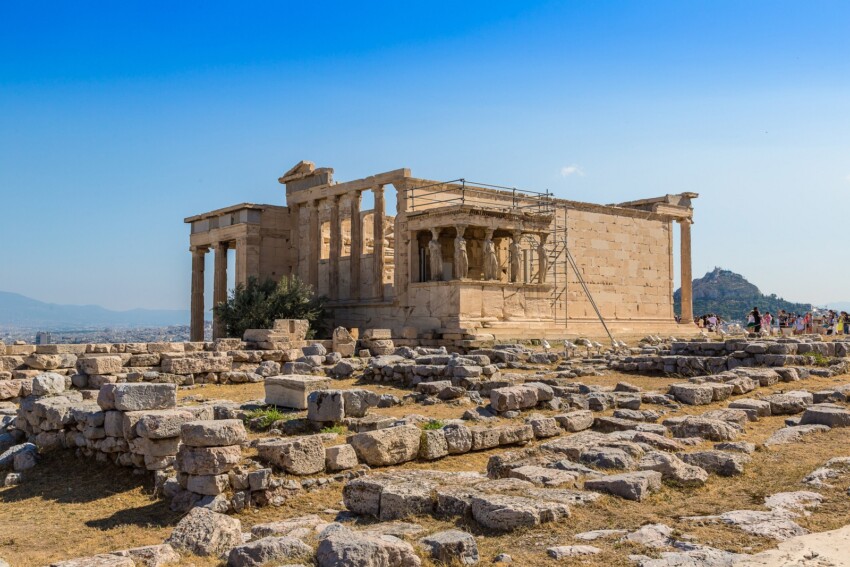
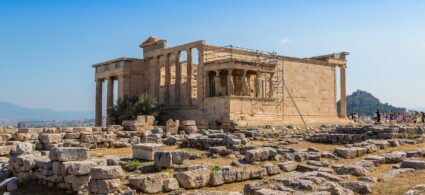
The Erechtheion has an asymmetrical floor plan, imposed by the uneven terrain and the necessity to integrate with pre-existing sanctuaries, combining Doric and Ionic orders. It was built between 420 and 406 BCE during the height of the Peloponnesian War: the east side was dedicated to Athena Polias, the west side to Poseidon.
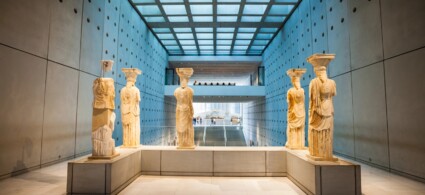
The building’s most celebrated feature is the south-west porch, supported by six female figures roughly six metres tall, the Caryatids. Those visible on site are copies: the originals, except for one taken to London, are housed in the Acropolis Museum. The temple’s frieze unusually combines white marble figures against a dark grey marble background.
Damaged by fire in classical times, the Erechtheion was converted into a Christian basilica in the 7th century and, during the Ottoman period, into a harem: the northern porch was then bricked up.
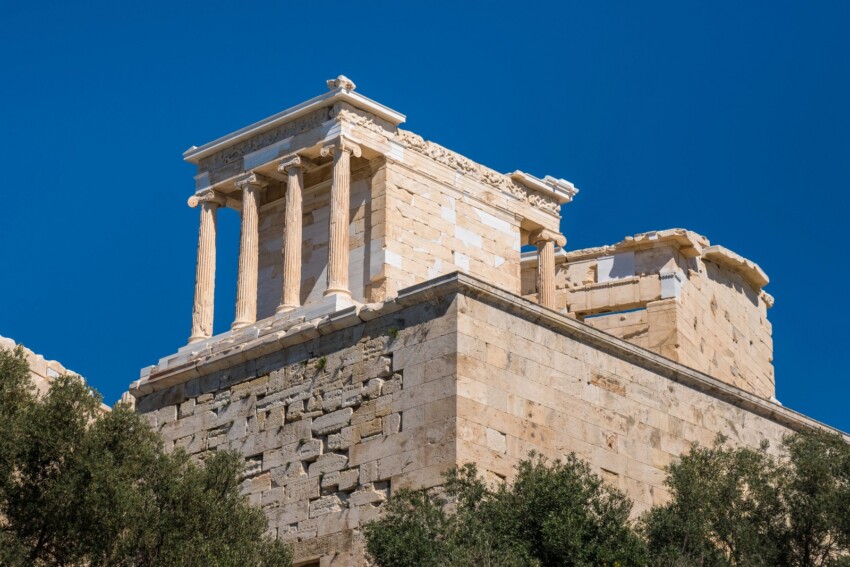
At 27 metres long and 18 metres wide, the Temple of Athena Nike is the Acropolis’s smallest structure. It was built in 420 BCE by architect Callicrates, with four monolithic Ionic columns on the front and rear.
The sculptural frieze depicts battles between Greeks and Persians on three sides, whilst the east side is dedicated to the Olympian deities. The temple stands on a rocky bastion at the south-west corner of the citadel and once housed a wooden statue of Apteros Nike, Wingless Victory: deprived of her wings, according to myth, the goddess could never leave Athens.
Converted into a church in the 5th century and later into an Ottoman ammunition store, the temple was dismantled to build a defensive bastion and only reconstructed in 1834. Further restoration in 1998 removed the modern concrete floor and transferred the original frieze to the Acropolis Museum.
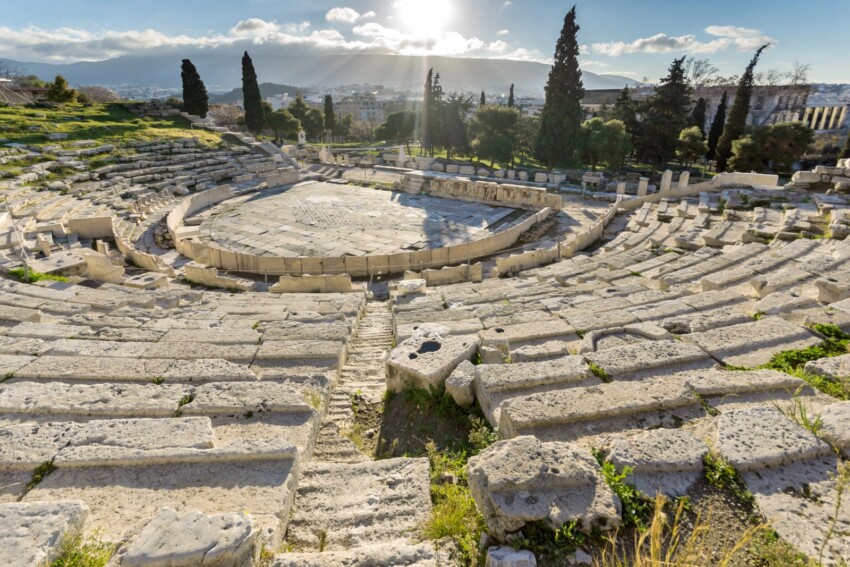
On the southern slope of the citadel stands the Theatre of Dionysus, Greece’s oldest theatre: originally built of wood, it hosted performances of tragedies by Aeschylus, Sophocles and Euripides and comedies by Aristophanes during the City Dionysia, festivals in honour of the god of wine and theatre.
Rediscovered in the late 19th century, the theatre visible today is largely from the Roman period: archaeologists have identified nine distinct construction phases. Of the 64 rows of seating that once accommodated roughly 17,000 spectators, only 20 have survived intact.
A little higher up, a few steps lead to the Sanctuary of Asclepius, built around a sacred spring: the cult of the god of medicine was introduced to Athens in 429 BCE during a plague epidemic.
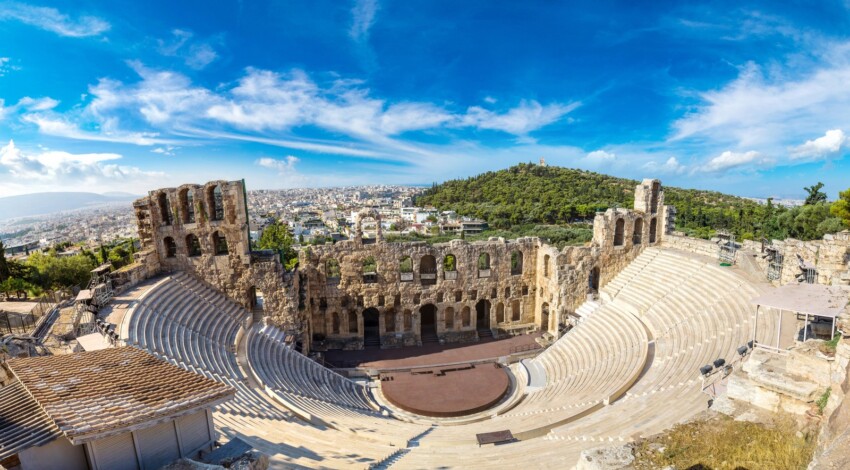
At the base of the Acropolis, the Odeon of Herodes Atticus still hosts theatrical and musical performances today, particularly during the Athens Festival, held annually between June and September. It was built from 161 CE onwards by Herodes Atticus in memory of his wife.
The semicircular amphitheatre, arranged across 32 rows of seating, can accommodate up to 6,000 spectators; in ancient times a wooden roof covered the stage, which was 35 metres wide. During the 20th century it hosted concerts by Maria Callas and the Bolshoi Ballet, as well as contemporary artists such as Elton John and Sting. Entry is not permitted for children under 6 years.
Between the Parthenon and the Erechtheion lie the foundations of the Ancient Temple of Athena Polias, dating to the 6th century BCE and dedicated to the goddess who protected the city. Built and destroyed multiple times, it was definitively demolished in 480 BCE and replaced by the Erechtheion, though some of its original sculptures have survived to the present day.
The building, in Doric order, measured approximately 21 by 43 metres, with six columns on the short side and twelve on the long side. The foundations combine different materials and construction techniques, evidence of the numerous reconstruction phases the building underwent.
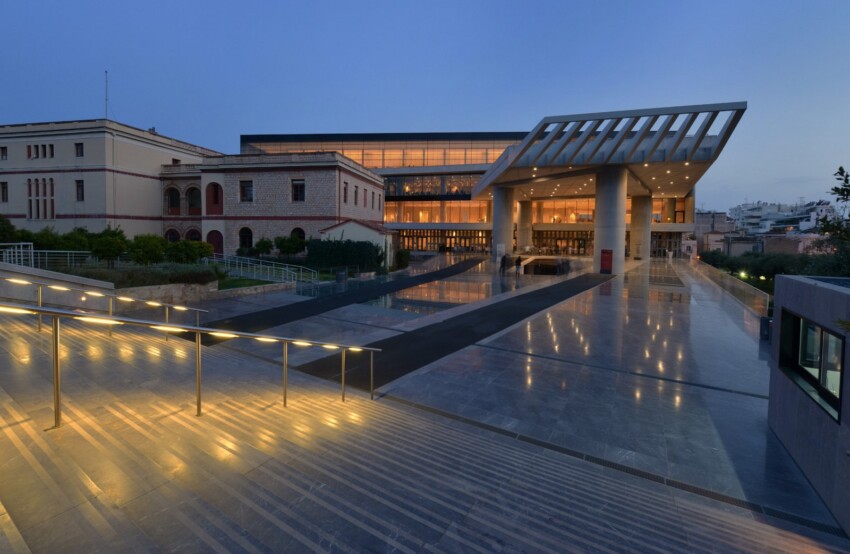
Roughly one kilometre from the Parthenon, in the Makryianni district, stands the Acropolis Museum, inaugurated in 2009: 8,000 square metres of exhibition space, largely featuring sculpture, that chronicles life on the sacred rock from prehistory through late antiquity. On the ground floor, a glass floor reveals excavations of a 5th-century CE neighbourhood uncovered during construction work.
On the third level is the Parthenon Gallery, displaying the temple’s frieze and sculptures returned by the United Kingdom following their removal by Lord Elgin. The museum also features a café, restaurant and bookshop, and requires a separate ticket from the Acropolis.
In the following map you can see the location of the main places of interest mentioned in this article.
There are two entrances. The main one is on the west side, on Theorias Street, accessible on foot from Plaka and Monastiraki Square in about ten minutes, passing by the Hadrian Library. The side entrance, on Dionysiou Areopagitou Street, is a two-minute walk from the metro station Acropoli (line 2) and is generally less crowded, as it’s mainly used by small groups and skip-the-line ticket holders.
From the west entrance on Theorias Street, the path climbs first towards the small Temple of Nike, visible from the opening steps on your right, then passes through the Propylaea, the only monumental gateway to the citadel. Once through this entrance, the Erechtheion with its Porch of the Caryatids lies to your right, often the first monument encountered as it’s closer to the Propylaea exit.
Continuing towards the centre of the plateau, you’ll reach the Parthenon. It’s worth walking along its longer northern side before reaching the south-east corner, the most open point for photographing it without morning backlighting. From here, it’s worth heading towards the north-eastern edge of the citadel, near the Greek flag, for views over Plaka and the ruins of the Temple of Zeus.
Those with time can descend the southern slope, where you’ll encounter the Theatre of Dionysus in sequence, and shortly beyond, the Odeon of Herodes Atticus: a downhill walk of roughly 20 minutes that brings you back towards Dionysiou Areopagitou Street, just steps from the Acropolis Museum. This complete circuit, entering from the west and exiting south, covers the entire site without retracing your steps.
The Acropolis citadel was inhabited from the Neolithic period and fortified in the Mycenaean era, when it housed a royal settlement protected by Cyclopean walls. From 510 BCE the Oracle of Delphi decreed its use exclusively for religious purposes, but in 480 BCE the Persian army of Xerxes razed the existing temples to the ground, including the earlier, still incomplete Parthenon.
The reconstruction, commissioned by Pericles in the mid-5th century BCE and artistically directed by Phidias, gave rise within a few decades to the complex visible today: the Parthenon, Propylaea, Erechtheion and Temple of Athena Nike were realised between 447 and 406 BCE, during the height of Athenian political and cultural supremacy.
Following Greek independence in 1830, the first modern restoration campaigns began, continuing with the establishment in 1975 of an interdisciplinary commission under the Ministry of Culture that continues to work on the site today. The Acropolis was declared a UNESCO World Heritage Site in 1987, the very first inscription on the list.

 Hotel
Hotel  Budget accommodations
  Apartments
  Family Hotel
  Luxury Hotel
  Resorts