Bestseller
Athens: Acropolis Museum Ticket with optional Audio Guide
From 26,00 €
Buy the ticket
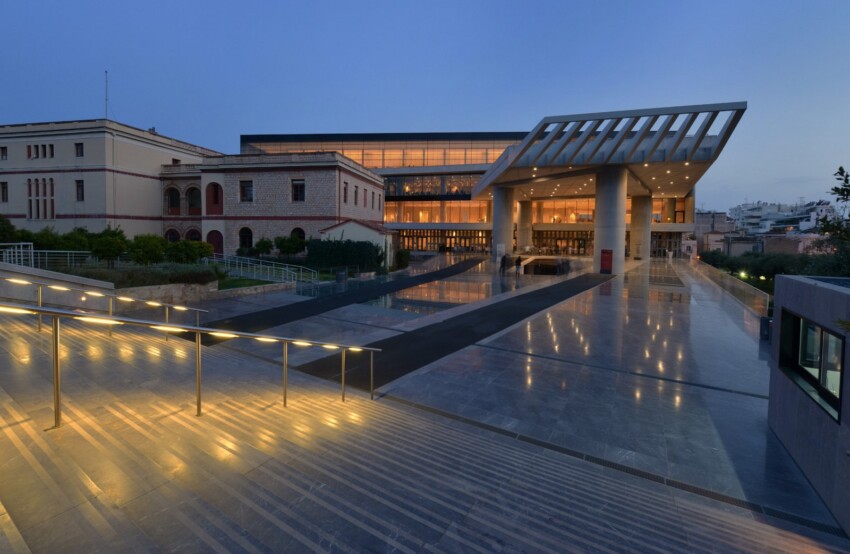
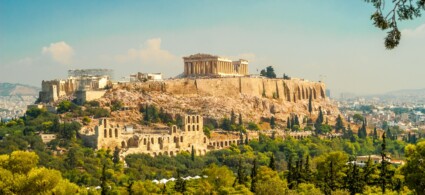
The Acropolis Museum houses over 4,000 artefacts sourced exclusively from the Sacred Rock and its slopes—the world’s only museum dedicated entirely to a single archaeological site. Located at the foot of the Acropolis, roughly 300 metres from the southern entrance, it occupies a striking glass and concrete building designed by architect Bernard Tschumi and opened in 2009.
For many visitors, it’s the most illuminating stop on a trip to Athens: here you can see up close the Parthenon frieze, the original Caryatids of the Erechtheion, and sculptures that have been replaced by copies on the hilltop itself, now protected here from smog and the elements.
This guide takes you through what to see room by room, the building’s history, current prices and opening hours, how to get there, and answers to the most frequently asked questions about a visit that alone justifies half a day in Athens.
The route spreads across four levels, from the basement to the third floor, following a roughly chronological order: from the slopes of the hill in the Archaic period through to the fifth-century BC Parthenon.
Even before reaching the ground floor, the museum reveals an entire ancient Athenian neighbourhood beneath your feet, uncovered during excavation for the foundations and largely incorporated into the structure itself. Walking across the glass floors of the atrium, you can see streets, houses and cisterns dating from the fourth millennium BC through to the twelfth century AD—one of the reasons why construction work, which began in the early 2000s, took considerably longer than expected.
The first exhibition hall displays finds from the slopes of the hill, including votive offerings, ceramics and small sculptures from sanctuaries dedicated to Dionysus and Asclepius. It’s an ideal starting point for understanding just how densely packed religious activity was around the Rock, well beyond the main temples visible today at its summit.
The first floor houses one of the world’s most important collections of Archaic sculpture. The standout piece is the Moschophoros, a statue of a man carrying a calf on his shoulders, dating to around 570 BC, alongside dozens of korai (statues of young women) with colours still partially visible on their garments. Photography is not permitted in this room—a rule designed to protect the remaining polychrome decoration of the sculptures, which remains sensitive to camera flash.
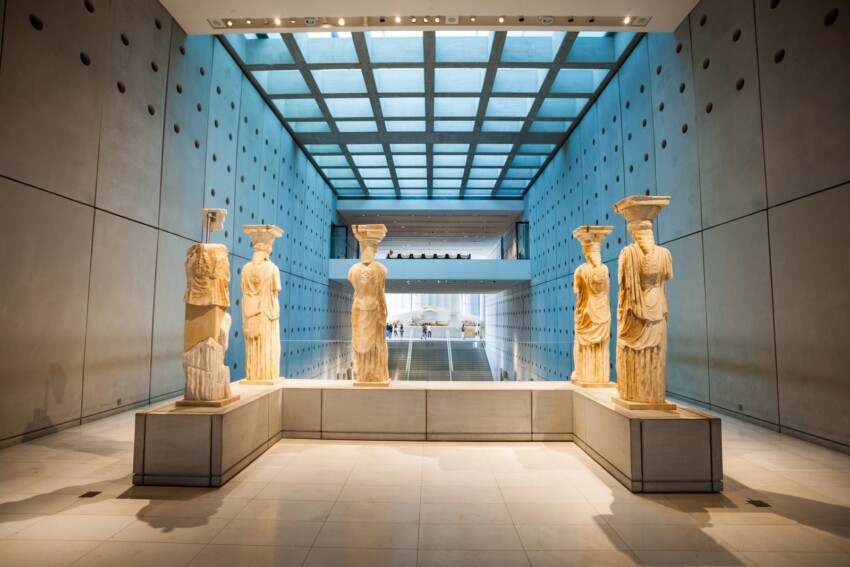
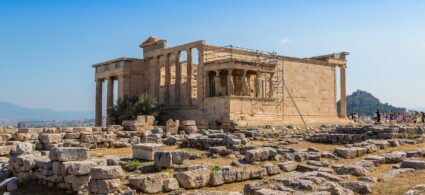
Also on the first floor are five of the six Caryatids that supported the south porch of the Erechtheion: the statues visible on the hilltop today are copies, created to protect the originals from air pollution that was eroding their details during the 1970s. The sixth Caryatid is in the British Museum in London: the empty case beside the other five is a deliberately eloquent curatorial choice.
The top floor, devoted entirely to the Parthenon, is built to the same proportions as the temple itself and rotated 23 degrees from the rest of the building, so it’s oriented exactly like the monument visible in the distance through the glass walls. Here, the Panathenaic frieze, the metopes and surviving fragments of the two pediments are reassembled in their original order: missing sections, now in the British Museum or lost, are marked with white plaster casts, clearly distinguishable from the original marble.
Among the lesser-known but much-loved pieces by discerning visitors is a relief from the balustrade of the Temple of Athena Nike: it depicts the goddess of victory in the act of unfastening her sandal, an everyday, informal detail that deliberately clashes with the solemnity of the museum’s other sculptures.
An earlier museum already stood at the summit of the Acropolis, opened in 1874 to designs by architect Panagis Kalkos: at just 800 square metres, it quickly proved too small to house the finds that ongoing excavations continued to unearth, particularly from 1886 onwards.
The idea of a larger new building positioned at the foot of the hill took shape in the late twentieth century. The project won by Bernard Tschumi in collaboration with Greek architect Michael Photiadis of the Greek Embassy was intended to be ready for the 2004 Athens Olympics, but the discovery of the ancient neighbourhood remains beneath the foundations extended the construction timeline: the museum finally opened in June 2009, five years behind the original schedule.
The building, approximately 14,000 square metres spread across four levels, was conceived from the outset as a political statement too: demonstrating that Greece possessed an exhibition space meeting international museum standards was part of the strategy by which Athens continues to demand the return of the Parthenon marbles currently held at the British Museum.
The Acropolis Museum ticket is independent from the Acropolis archaeological site: there is currently no official combined ticket covering both, so they must be purchased separately.
Several categories are entitled to reduced or free admission (EU citizens under a certain age, students, people with disabilities and one companion), which should be verified and documented directly at the museum’s ticket desk: discounts cannot be purchased online. Entry is free for everyone on four fixed dates: 6 March, 25 March, 18 May and 28 October.
Buying your ticket online, when available, remains the quickest way to avoid queuing at the entrance on Dionysiou Areopagitou Street.
Packages are available to visit both the Acropolis and the Acropolis Museum: these are certainly more convenient, will save you time, and you’ll also have a guide at your disposal.
During high season (1 April – 31 October), the museum is open Mondays 9:00–17:00 (last admission 16:30), Tuesday to Sunday 9:00–20:00 (last admission 19:30), with extended evening hours on Fridays until 22:00 (last admission 21:30).
During low season (1 November – 31 March), hours are Monday to Thursday 9:00–17:00, Friday 9:00–22:00, and weekends 9:00–20:00. The museum is closed on 1 January, Orthodox Easter Sunday, 1 May, and 25–26 December.
Allow 1.5 to 2 hours for a thorough visit: those with less time can concentrate on the Archaic Gallery and the Parthenon Gallery, which alone showcase the most representative pieces in the collection. Late afternoon slots are generally quieter than mornings, especially if you’ve already visited the Acropolis during midday hours.
The late opening on Fridays is probably the best time to visit the museum: as dusk falls, the Parthenon Gallery gradually empties and the glass walls offer glimpses of the illuminated Parthenon on the hilltop, creating a direct dialogue between the original and the casts displayed inside. The second-floor restaurant stays open late, with views across to the Acropolis.
On 18 May, International Museum Day, admission is free and the museum often organises themed activities open to the public. Throughout the year it also hosts temporary exhibitions, generally included in the standard ticket price, focussing on individual monuments or historical periods of the Acropolis.
For families, thematic activity packs and guided trails designed for children are available free on request at the information desk, along with a dedicated audio guide.
The metro is the most convenient option: the Acropoli station on line 2 is just a short walk from the museum entrance on Dionysiou Areopagitou Street. For details on the network and tickets, check our guide to Athens metro.
By bus, the nearest stop is Makryianni, served by numerous urban routes. On foot, the museum is about 300 metres (6 minutes) from the Acropolis’s southern entrance and roughly ten minutes from the Plaka district: most visitors combine both in the same day, typically visiting the hilltop first and then the museum.
The Acropolis Museum is located in the Makrygianni neighbourhood, at 15 Dionysiou Areopagitou Street, approximately 300 metres from the southern entrance of the Acropolis and a stone's throw from Acropoli metro station (Line 2).
 Hotel
Hotel  Budget accommodations
  Apartments
  Family Hotel
  Luxury Hotel
  Resorts