Bestseller
Athens: Acropolis Ticket with Audio Guide
From 39,00 €
Buy the ticket
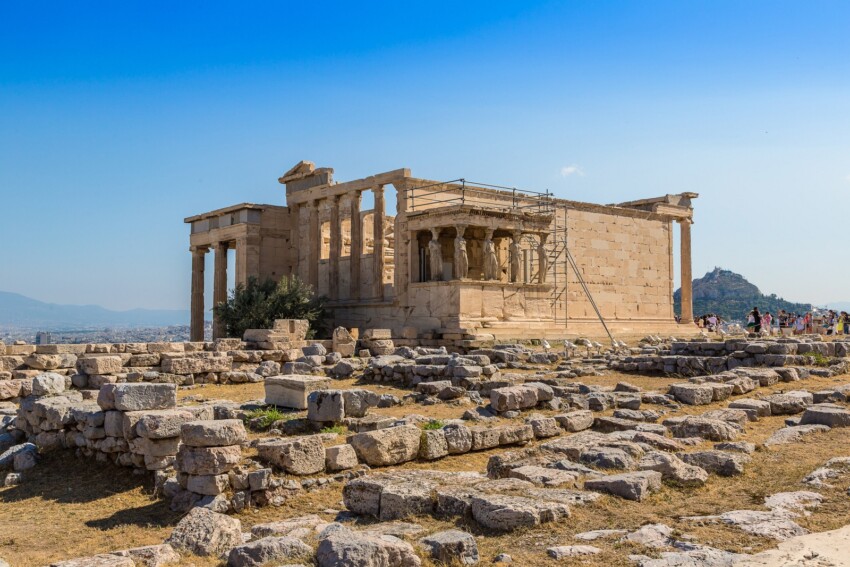
After the Parthenon, the most famous temple in ancient Greece, it is surely the Erechtheion (in Greek Erechthion) that attracts the most attention inside the Acropolis of Athens.
The credit for this fascination goes to the women with their sinuous bodies and unperturbed gaze who support the weight of the building: we are of course talking about the famous Caryatids, the most photographed statues in the Acropolis.
Graceful in their poses, draped in elegant robes, tireless in fulfilling their structural function, for millennia the Caryatids have seemed to stare at a point on the horizon inaccessible to ordinary mortals. One wonders what they are looking at or thinking, as if they were flesh and blood women rather than artistic masterpieces.
Standing in front of the Erechtheion is one of the highlights of a visit to the Acropolis, Athens’ top attraction. It is worth finding out more about this treasure trove of classical architecture and its enigmatic columns.
The Erechtheion is a Greek temple in Ionic and Doric style, made entirely of marble.
It has an unusual shape, due partly to the irregular terrain on which it stands and partly to the need to blend in with the other religious buildings already present within the Acropolis. The asymmetrical plan of the building includes a central body, a northern portico and a southern portico with different heights and roofs.
This ingenious work was built between 430 and 395 B.C. on the spot where Poseidon and Athena fought their battle for the region: the former drove his trident into the ground and gave birth to a horse, the latter drove an olive tree into the ground with a spear and with this she claimed victory.
This is a key episode in Greek mythology, so this was a very important sacred site for the ancients, which explains why they wanted to build this temple at all costs. Despite difficulties with the rocky terrain, high costs and problems arising from an ongoing war, construction work was never interrupted.
The temple was named after Erechtheus, the sixth king of Athens, who was worshipped as a god. The building we see today is partly original, partly reconstructed in Roman times (west façade), and partly replaced by copies (the Caryatids).
The name Caryatids refers to the six maiden-shaped columns supporting the southern portico of the Erechtheion, sometimes referred to in guide books as the Loggia of the Caryatids, sometimes as the Portico of the Korai.
The two different names are quickly explained. The sinuous maidens depicted in the statues were inspired by the korai, young women from Karyai who performed ritual dances in honour of the goddess Artemis. Karyai (hence the name Caryatids) is an ancient city corresponding to present-day Karyes; it is located in Laconia, the southern part of the Peloponnese.
There is actually no agreement on the meaning of Caryatids. Korai dancers is the most credible hypothesis today, but for some these two-metre-high statues depict the women of Karyai enslaved by the Persians in the act of atoning for a fault, while for others they are the six daughters of Erechtheus, one of whom died as a sacrifice to the gods and the others committed suicide out of grief.
The unsolved mystery only adds to their fascination. Unfortunately, however, the statues we admire at the Acropolis are actually copies made using plaster casts to replace the originals in the late 1970s.
In order to protect them from inevitable deterioration, the original statues were taken to the Acropolis Museum, where they can still be admired today; an exception is a Caryatid removed in the 19th century by the Englishman Lord Elgin and now on display at the British Museum in London. Five out of six are in good condition, while one was badly damaged by a cannon shot during the Ottoman rule.
The museum is about 1 km away, but beware: admission is not included in the standard Acropolis ticket.
It should be noted that the Caryatids of the Erechtheion are not the only caryatids found in classical Greek architecture, on the contrary, it was common to use human-shaped columns; they are, however, without a doubt, the most famous.
It is not possible to enter the interior of the Erechtheion, so this monument can only be admired from the outside. However, since it is located inside the archaeological area at the top of the Acropolis, it is still necessary to buy an entrance ticket to see it.
The Acropolis entrance ticket allows you to move freely within the archaeological site and see all its monuments. Combination tickets are available that allow you to visit the Acropolis and other top Athens attractions; also consider having a guide accompany you to better appreciate the ancient monuments you are going to see.
As the Acropolis is the most visited monument in Greece and one of the most visited in Europe, we strongly recommend buying tickets online to skip the long queues at ticket offices. Also try to arrive early in the morning or alternatively after 5pm to avoid the crowds of tourists.
For more information on tickets and guided tours available visit the Acropolis page.
If you are short on time and would like to take part in a complete tour of the Acropolis, we recommend that you choose a guided tour from the ones below.
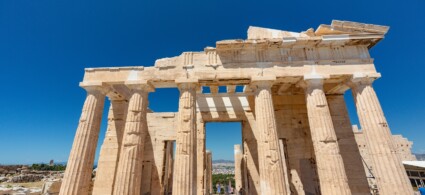
Once you enter the Acropolis from the Propylaea, its monumental ancient entrance, simply continue straight ahead to meet the Erechtheion.
The Propylaea can be reached on foot by walking uphill paths that start from the ticket offices of the Acropolis: there are two of them, located at different points. Resign yourself to walking because there are no shuttles or other means of transport operating from the ticket offices to the Propylaea, and hence not even to the Erechtheion.
The best way to reach the Acropolis ticket offices is to take the metro. The recommended stops are Akropolis and Monastiraki, located about 400 metres from the ticket offices.
The Erechtheion is located in the northern part of the Acropolis of Athens, next to the Parthenon (on the left side coming from the entrance). The Acropolis is located in the city centre.
 Hotel
Hotel  Budget accommodations
  Apartments
  Family Hotel
  Luxury Hotel
  Resorts