Bestseller
Athens: Acropolis Ticket with Audio Guide
From 39,00 €
Buy the ticket
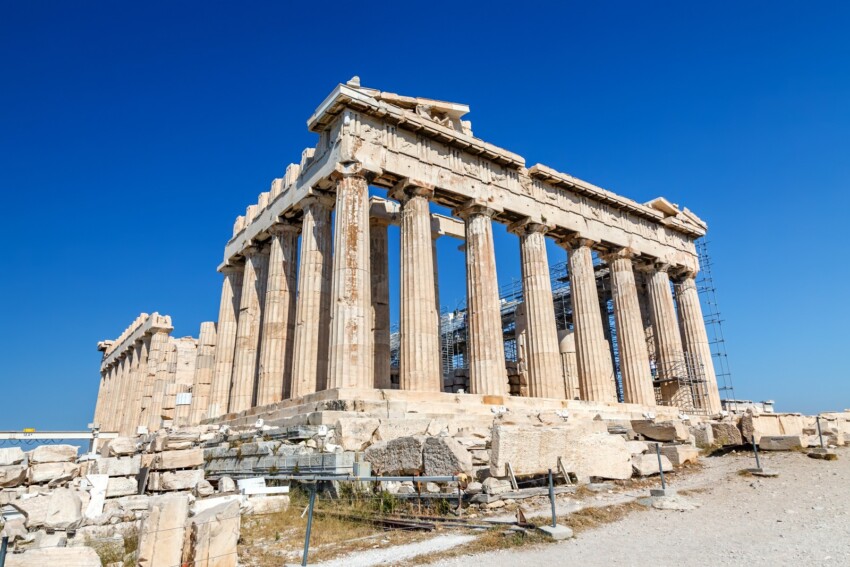
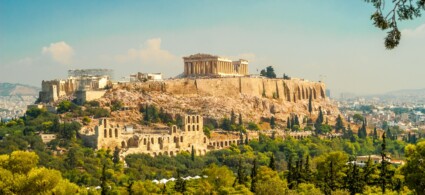
For over two thousand years, the Parthenon has been the landmark building of Athens: the most famous Greek temple in the world was already a star in antiquity, extolled by its contemporaries as an absolute architectural masterpiece. Perched atop the Acropolis, the hill that towers over the centre of the Greek capital and was its beating heart in antiquity, it is a monument in which the classical ideal of beauty and harmony becomes concrete.
Its colossal size and the height at which it stands mean that it can be seen even from several kilometres away, so it is guaranteed that during your walks in the centre of Athens you will see it continually pop up on your visual horizon.
Your eye will immediately fall there, first because you cannot take your eyes off such a marvel, then because the Parthenon changes its appearance depending on the light conditions. By day it is an impressive white giant, at dusk the pink reflections soften its profile and make it romantic, at night, all lit up, it is simply magical.
Needless to say, a visit to the Parthenon is a must, after all, isn’t that the main reason for coming to Athens? But you can enjoy the most famous relic of ancient Greece even more by joining a guided tour that will give you an in-depth insight into the history of this extraordinary building.
If you want to add something special to your Athens holiday, treat yourself to a hotel with an Acropolis view. You will invariably find yourself looking up and trying to imagine the Parthenon in its ancient splendour, a riot of marble, gold and brilliant colours.
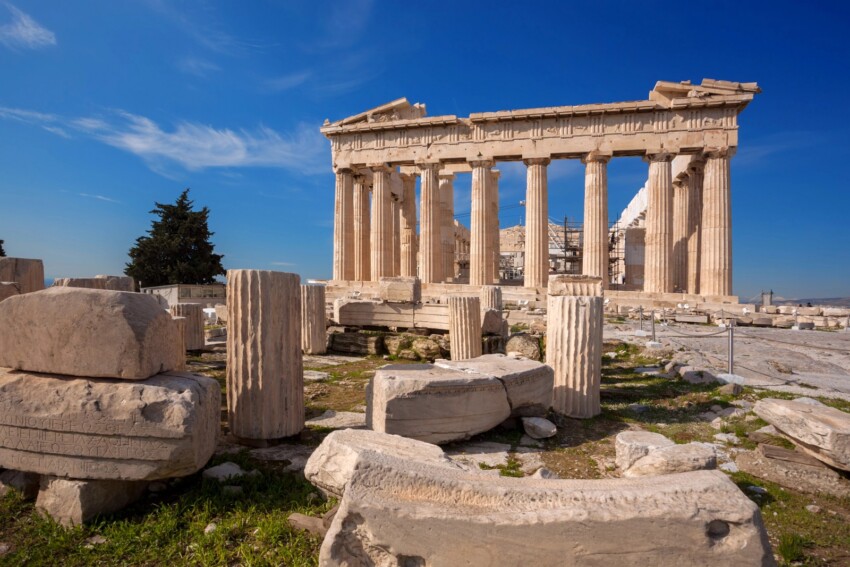
Of the original Parthenon, unfortunately much has been destroyed or stolen. So what can still be seen?
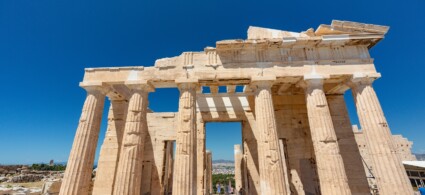
The mighty Doric columns on the outer sides of the temple are the best preserved element: we can still admire their enormous size and convex shape, which together with the curvature of the base creates the optical illusion of absolute perfection. There were 50 in total: some are in good condition, others are almost completely destroyed.
Very little remains of the pediments, the triangular-shaped elements placed atop the columns on the shorter sides. They used to be decorated with elaborate sculptural motifs: one depicted the birth of the goddess Athena from the head of Zeus, the other the famous contest between Poseidon and Athena, won by the latter, to win the honour of having the city dedicated to her.
The term metopes is used in architecture to refer to the stone panels placed on the cornice of the temple, between the pediment and the columns; generally, they are interspersed with triglyphs, stone panels with three vertical grooves.
The metopes of the Parthenon are famous for the marvellous sculptural decorations designed by Frida, depicting well-known scenes from Greek mythology and history: the taking of Troy, the quarrel between the Centaurs and the Lapiths during a wedding banquet, Theseus and the Athenian youths fighting against the Amazons, the gods of Olympus fighting with the Giants. Again, more can be seen in museums than in the Acropolis.
By contrast, the statue of Athena Parthenos, from which the temple derives its name, has not survived to the present day.
It is not possible to go inside the Parthenon: the famous monument is visited by walking around it. To see the Parthenon up close, you need to buy a ticket to the Acropolis of Athens: there are no tickets for the Parthenon alone.
Instead, there are standard tickets for the Acropolis alone or combination tickets or tourist passes with access to several attractions, and the Acropolis is an attraction included in all guided tours of Athens.
Choose what to buy according to your interests and the time you are in town, but whatever you choose, buy online, possibly before you leave. The Acropolis is one of those attractions for which it is strategic to arrive with the ticket in your pocket (or in your smartphone): being a monument visited by thousands of people every day, the queues at the ticket offices are always very long.
For more information on the Acropolis (opening hours, available tickets, tours and other useful info), visit the in-depth page we have dedicated to it.
If you are short of time and would like to take part in a complete tour of the Acropolis, we recommend that you choose a guided tour from the ones below.
There are no buses or shuttles that take you directly to the Parthenon. You can only get there on foot by walking up the paths from the ticket offices of the Acropolis (there is more than one, located at different points) and a steep flight of steps. Access to the archaeological site is through the Propylaea, the ancient monumental entrance.
To reach the ticket offices of the Acropolis, we recommend taking the metro, which is easier and faster than buses. The nearest stops are Akropolis and Monastiraki, located about 400 metres from the ticket offices.
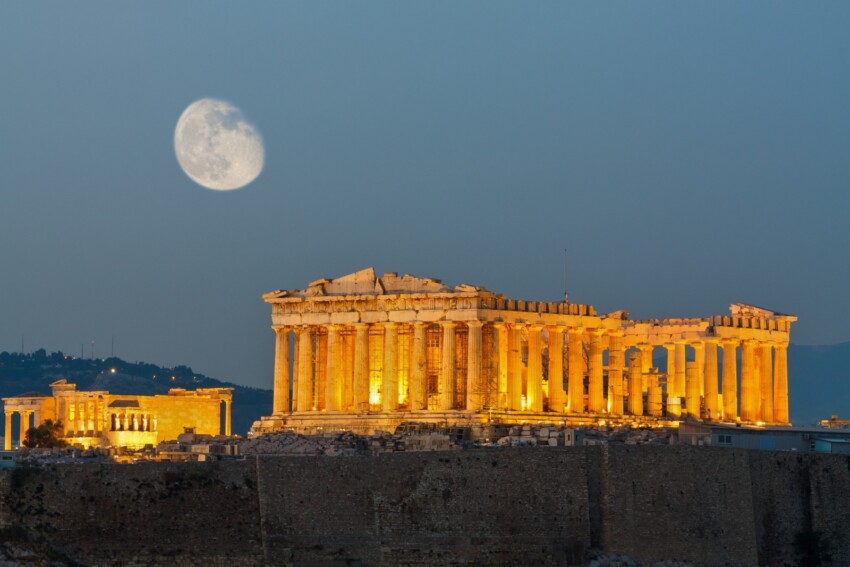
The Parthenon is an ancient temple in Doric style with Ionic elements dedicated to the goddess Athena Parthenos. Entirely built of marble from Mount Pentelos, it was constructed between the mid-5th century and 432 BC to a design by the architects Callicrates and Ictinus, supervised by Phidias, who was also the author of numerous sculptures decorating the temple.
The temple has a rectangular plan and rests on a plinth with three steps. The outer colonnades enclosed a sanctuary originally divided into two sectors: the larger one held an enormous statue of the goddess, some 12 metres high, made of gold, ivory and precious stones.
Today we see it entirely white, but in antiquity the Parthenon, as well as other ancient buildings, had multi-coloured and golden elements.
The Parthenon’s uniqueness, such that it was already considered an unparalleled architectural masterpiece in ancient times, lies in its absolute perfection: it is in fact an apparent perfection, the result of barely perceptible optical corrections that harmonise the overall view of the monument.
Two examples of ingenious solutions that helped create this ingenious optical illusion? The columns at the corners, which are slightly larger and closer together than the others; the column shafts have a slight bulge about 2/3 of their height that compensates for the slightly concave foundations.
Around the 4th century BC, the Parthenon lost its function as a pagan temple: it was used first as a Christian church, then as a mosque and finally as a warehouse. The looting of works of art from the Parthenon began in the 17th century by the Venetians but it was the British in the 19th century who took the largest amount away.
Even today, the remains of the pediments and numerous sculptures from the Parthenon can be admired in the British Museum in London or, to a lesser extent, in the Louvre in Paris and other important European museums.
Fortunately, something has also remained in Greece: what has escaped the spoils of foreigners is on display at the Acropolis Museum, located outside the archaeological site about 1 km away (admission is not included in the standard Acropolis ticket).
The most serious damage was inflicted on the Parthenon by a mortar blast. Restoration work that began in the 1970s is still ongoing and is expected to last for many more years.
The Parthenon occupies the central part of the Acropolis: you will find it on your right after crossing the Propylaea. The Acropolis is located in the centre of Athens.

 Hotel
Hotel  Budget accommodations
  Apartments
  Family Hotel
  Luxury Hotel
  Resorts