Bestseller
Athens: Acropolis Ticket & Heritage Sites + Acropolis Audio
From 36,00 €
Buy the ticket
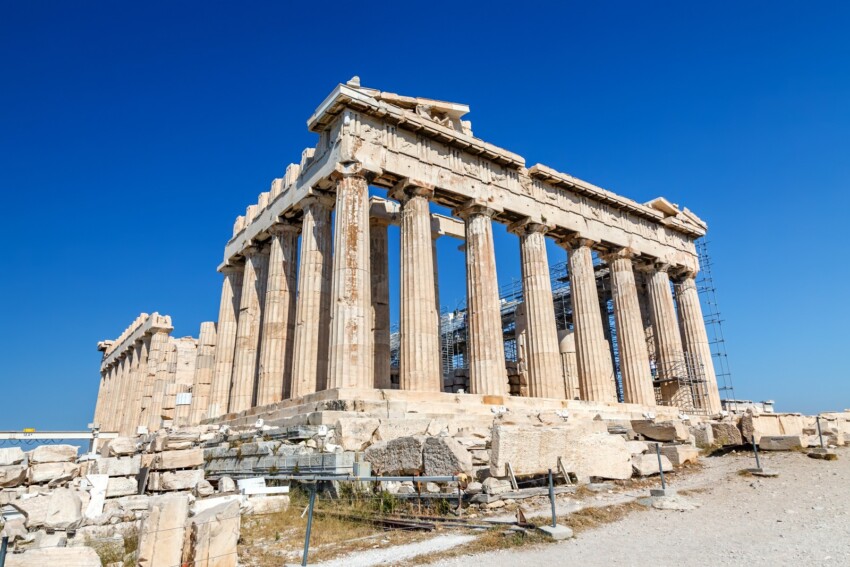
For over two thousand years, the Parthenon has been Athens’ iconic building: even in antiquity, contemporaries considered it a defining example of Greek architecture. It sits atop the Acropolis, the hilltop that dominates the city centre and which in ancient times was its religious heart.
Its scale, combined with its elevated position, makes it visible from several kilometres away: during your walks through central Athens, you’ll spot it repeatedly on the horizon, appearing from different angles depending on which street you take.
The temple’s appearance changes markedly with the light: in the morning the Pentelic marble appears white and solid, at sunset it takes on rosy tones, and in the evening the artificial lighting accentuates its volumes. For this reason, many photographers return at different times of day.
To make sense of the monument’s history, a guided tour or audio guide helps distinguish what is original from what has been reconstructed over the centuries – a detail that isn’t always obvious at first glance.
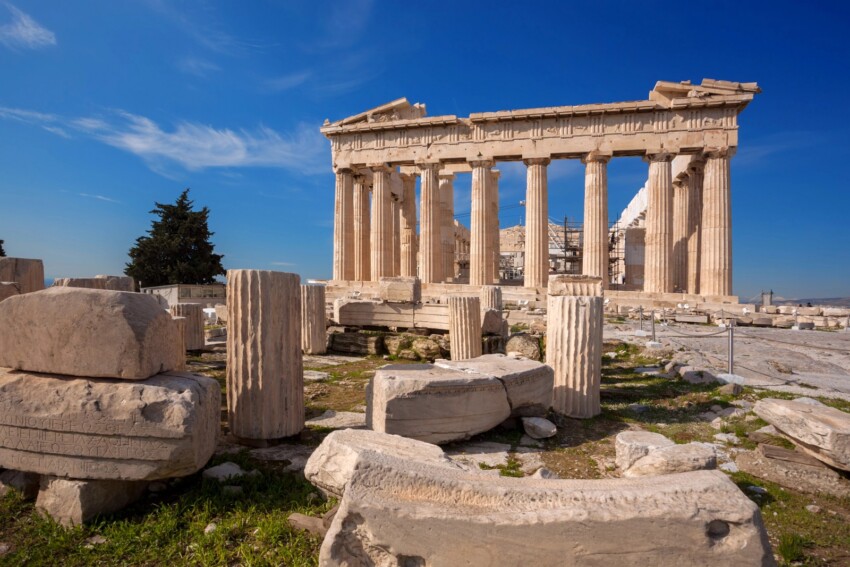
Much of the original Parthenon has unfortunately been destroyed or stolen. So what is still possible to see?
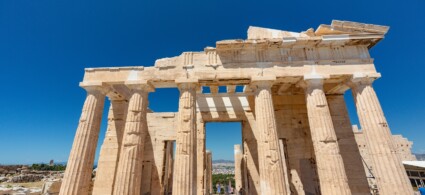
The imposing columns in Doric style positioned on the temple’s outer sides are the best-preserved elements: we can still marvel at their enormous scale and convex form, which together with the curvature of the base creates the optical illusion of absolute perfection. There were 46 in total: some are in good condition, whilst others are almost completely destroyed.
Very little remains of the pediments, the triangular elements placed at the top of the columns on the shorter sides. Once they were decorated with elaborate sculptural motifs: one depicted the birth of the goddess Athena from the head of Zeus, the other the famous contest between Poseidon and Athena, won by the latter, to claim the honour of the city being dedicated to her.
The term metopes refers to the stone panels placed on the temple’s cornice, between the pediment and columns; generally, they are interspersed with triglyphs, stone panels with three vertical grooves.
The Parthenon’s metopes are celebrated for their magnificent sculptural decorations designed by Phidias, depicting famous scenes from Greek mythology and history: the fall of Troy, the quarrel between Centaurs and Lapiths during a wedding banquet, Theseus and young Athenian women fighting the Amazons, the Olympian gods battling the Giants. Again, you can see more of these in museums than on the Acropolis itself.
The statue of Athena Parthenos, from which the temple takes its name, has not survived to our day.
You cannot enter inside the Parthenon: the famous monument is visited by walking around it. To see the Parthenon up close, you need to purchase an admission ticket to the Athens Acropolis: there are no tickets for the Parthenon alone.
There are, however, standard tickets for the Acropolis only, or combined tickets and tourist passes giving access to multiple attractions; moreover, the Acropolis is included in all guided tours of Athens.
Choose what to purchase based on your interests and how long you’re staying in the city, but whatever you decide, buy your ticket online, preferably before you travel. The Acropolis is one of those attractions where it’s strategic to arrive with your ticket in hand (or on your smartphone): as it’s a monument visited by thousands of people every day, queues at the ticket offices are always extremely long.
For more information about the Acropolis (opening times, available tickets, tours and other useful information), visit the dedicated page we’ve created.
Alternatively, to discover everything about the Parthenon, you can be accompanied by an expert guide during your visit. If, besides the Acropolis, you want to visit other Athens attractions, such as the Acropolis Museum or the Agora, choose a combined ticket.
There are no buses or shuttles that take you directly to the Parthenon: you can only reach it on foot by climbing the pathways departing from the Acropolis ticket offices (there are several, located at different points) and a steep staircase. Access to the archaeological site is through the Propylaea, the ancient monumental entrance.
To reach the Acropolis ticket offices, we recommend taking the Metro, which is simpler and faster than buses: Monastiraki station is about 10 minutes’ walk from the west entrance, while Acropoli station (line 2) is about 2 minutes’ walk from the south entrance, on Dionysiou Areopagitou Street.

The Parthenon is an ancient temple in Doric style with Ionic elements dedicated to the goddess Athena Parthenos. Built entirely in marble from Mount Penteli, it was constructed between the mid-5th century and 432 BCE according to designs by architects Ictinus and Callicrates, overseen by Phidias, who was also the author of numerous sculptures that decorated the temple.
The temple has a rectangular floor plan and rests on a base with three steps. The outer colonnades enclosed a sanctuary originally divided into two sections: in the larger one stood a colossal statue of the goddess, approximately 12 metres high, made of gold, ivory and precious stones.
Today we see it entirely in white, but in antiquity the Parthenon, like other ancient buildings, featured coloured and gilded elements.
What makes the Parthenon exceptional – so much so that even in ancient times it was considered an unparalleled architectural masterpiece – lies in its apparent perfection, the result of barely perceptible optical corrections that harmonise the monument’s overall appearance.
Two examples of these solutions: the corner columns, which are slightly larger and closer together than the others; the column shafts feature a slight bulge about two-thirds of the way up their height, which compensates for the slightly concave foundations.
Around the 4th century CE, the Parthenon lost its function as a pagan temple: it was subsequently used as a Christian church, then as a mosque, and finally as a storehouse. The looting of artworks from the Parthenon began in the 17th century by the Venetians, but it was the English in the 19th century who removed the largest quantity.
Even today, the remains of the pediments and numerous sculptures from the Parthenon can be seen at the British Museum in London or, to a lesser extent, at the Louvre in Paris and other major European museums.
Fortunately, some pieces remain in Greece: what escaped the plundering of foreigners is on display at the Acropolis Museum, located outside the archaeological site approximately 1 km away (admission is not included in the standard Acropolis ticket).
The most serious damage to the Parthenon was inflicted by an explosion caused by a Venetian mortar shell during the siege of 1687. Restoration work, which began in the 1970s and is still ongoing, has recently allowed the scaffolding that covered the temple for decades to be removed: today the Parthenon is visible without construction structures for the first time in a very long while, although targeted interventions continue in certain areas of the site.
The Parthenon occupies the central part of the Acropolis: you'll find it to your right after passing through the Propylaea. The Acropolis is located in central Athens.

 Hotel
Hotel  Budget accommodations
  Apartments
  Family Hotel
  Luxury Hotel
  Resorts