Bestseller
Athens: Acropolis Ticket with Audio Guide
From 39,00 €
Buy the ticket
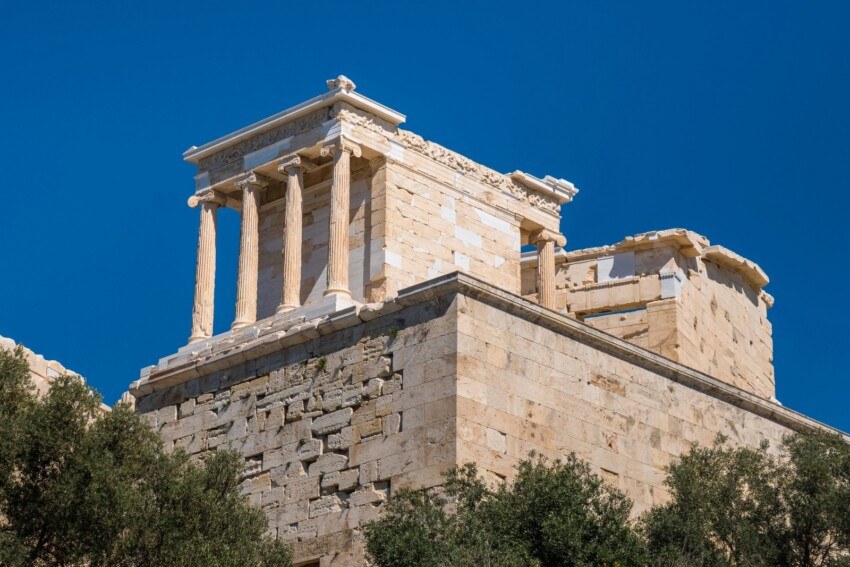
The Temple of Athena Nike is the smallest of the temples on the Acropolis of Athens but manages to stand out all the same.
While it cannot compete with other constructions at the world’s most famous archaeological site in terms of size or richness of decoration, the small temple remains imprinted on visitors due to its position overlooking the rock.
Moreover, its author is the same as the Parthenon, and its structure is due to a mix of historical events and personal envy. There is enough to want to know more about this temple too.
You see it immediately, even before you cross the Propylaea, the monumental entrance to the Acropolis, and you don’t even need to reach the top to see it. Clinging to the edge of the hill, it is clearly recognisable even from afar: a point to which one can turn one’s gaze, dreaming or remembering a full visit to the Acropolis, one of the great wonders of humanity.
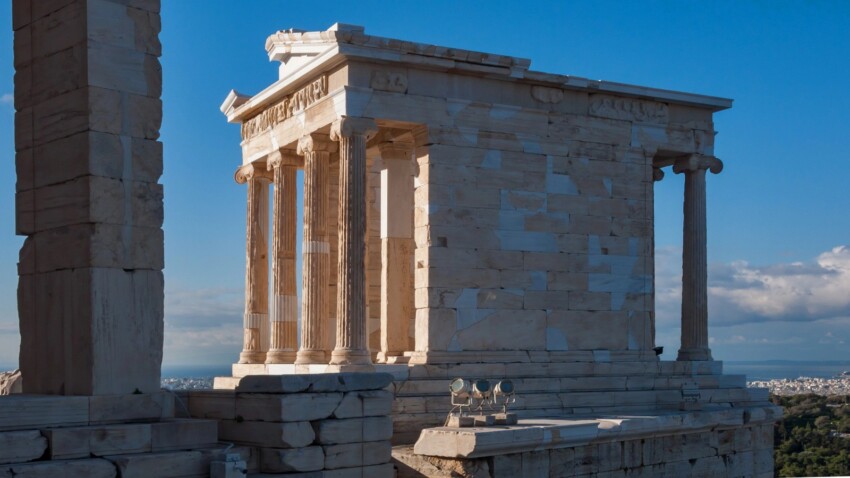
The Temple of Athena Nike, also known as the Temple of Nike Aptera, is an amphiprostyle tetrastyle temple, i.e. with four free standing columns at the front and another four at the back, made of white marble from Mount Pentelos. It measures approximately 8 x 5 metres, but some construction tricks make the temple look larger than it actually is.
It was built around 425 BC by Callicrates, the famous architect who co-authored the Parthenon. In the original plan it was supposed to be larger, but the construction of the Propylaea, the monumental entrance to the Acropolis, made it necessary to limit its size.
It stands on the site of an earlier temple, probably destroyed by the Persians in 480 BC, which in turn replaced an even older temple. The unusual orientation of the temple of Athena Nike, with the entrance facing a wall a short distance away, may be due to a desire to maintain the orientation of the earlier temple; the reason, however, is unclear.
This temple is the first in the Ionic style built within the Acropolis and is dedicated to the goddess of victory, depicted as a winged woman. The original votive statue of the goddess, made of wood and deprived so that victory could not leave the city of Athens, has been lost.
Instead, the sculptural elements that decorated the frieze are on display at the Acropolis Museum; the museum is located about 1 km from the archaeological site and is accessed with a separate ticket.
In the Ottoman period, the stones of the temple were used to build a defensive bastion. A first symbolic reconstruction of the temple dates back to the 19th century, two restorations were carried out in the 20th century and a final restoration was completed in 2013.
Although the Temple of Athena Nike is located on the outer edge of the rock, and is therefore visible from outside the Acropolis, in order to admire it up close you must enter the paid area.
If you want to visit the Acropolis on your own, you can opt for the standard ticket or a combined ticket that includes several attractions; alternatively you can join a guided tour and visit the Acropolis accompanied by an expert guide.
In all three cases, it is strongly recommended that you think about it before your departure and buy your tickets online. The Acropolis is the most visited monument in Greece and one of the most visited in Europe, so the queues at the ticket offices are long every day. Skip-the-line tickets bought online save you a lot of time and stress.
For more information on tickets and guided tours available visit the Acropolis page.
It is not possible to get to the Temple of Athena Nike by car or public transport. Like all the buildings inside the Acropolis, it can only be reached on foot by walking along the paths that start from the Acropolis ticket offices and up a steep flight of steps.
There are several ticket offices, located at different points not far from each other, but from the ticket offices you have to walk because there are no shuttles or other means of transport leading to the Propylaea, which is the entrance to the archaeological site.
The quickest and most convenient way to reach the ticket offices at the Acropolis is to take the metro and get off at Akropoli or Monastiraki.
The temple of Athena Nike is located in the southwest part of the Acropolis of Athens, next to the Propylaea (on the right side). The Acropolis is located in the city centre.


 Hotel
Hotel  Budget accommodations
  Apartments
  Family Hotel
  Luxury Hotel
  Resorts