Bestseller
Athens: Ancient Agora E-Ticket and Audio Tour
From 26,00 €
Buy the ticket
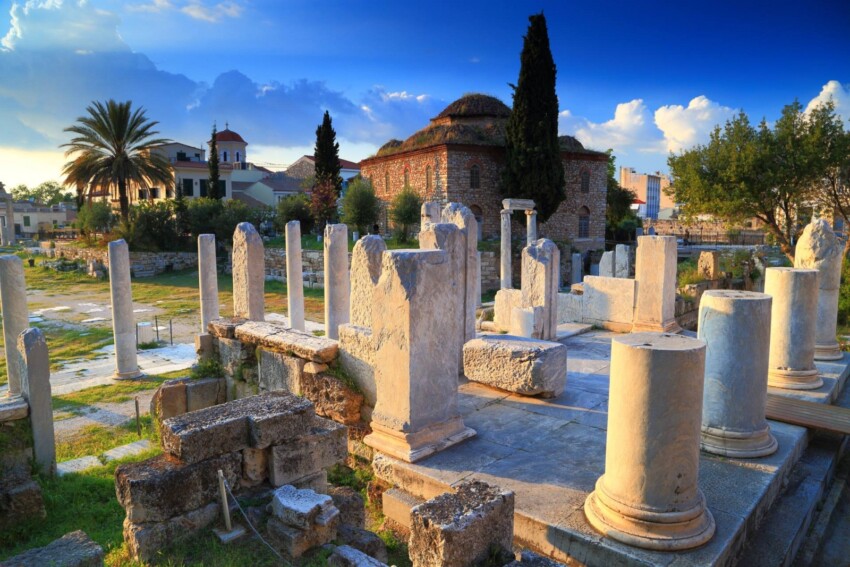
The centre of political, commercial, administrative, social, cultural and religious activity as well as the seat of justice in ancient Greece was the Agora. Archaeological excavations at the foot of the Acropolis have unearthed this rectangular-shaped area dating back to the 2nd century B.C. thanks to the demolition of some 400 modern buildings.
The large open square of the Agora, where citizens could gather to perform a wide range of actions, shows buildings, monuments and small objects that illustrate the importance of this space.
The use of the area as a market place is indicated by the numerous shops where potters, shoemakers, bronze workers and sculptors could be found, while the long colonnades testify to a stroll aimed at meeting friends, doing business or philosophizing. The numerous small shrines and temples tell of the religious role of the Agora while the library tells of its cultural vocation.
After the total destruction of Athens at the hands of the Persians in 480 B.C., the city was rebuilt during the 5th and 4th centuries B.C. and it was during these years that the Agora and its buildings were frequented by statesmen such as Themistocles, Pericles and Demosthenes, by the poets Sophocles, Euripides, Aristophanes and the writers Thucydides and Herodotus, and by philosophers such as Socrates, Plato and Aristotle. The Agora was the focal point of their various activities and it was here that the concept of democracy was developed and practised.
The real work of excavation, to bring the Agora back to light, began in 1931: first the green light had to be obtained on the area in question, which covers 24 hectares occupied by 365 modern houses, each of which had to be bought and demolished.
Although most of the buildings in the Agora have not come down to us in good condition, we can still admire buildings such as the Stoa of Attalus, the only restored structure that was once a former shopping centre and now houses the Agora Museum, and the Temple of Hephaestus, one of the best-preserved Doric temples in the world, which is located on the high ground overlooking the western end of the Agora.
The Temple of Hephaestus is situated on the high ground dominating the western end of the Agora and is one of the best preserved Doric temples in the world. Around 1300 the temple was converted into a church dedicated to St George.
Designed in 449 B.C. by Ictinus, one of the architects of the Parthenon, in honour of the god of fire and engineering, the Temple of Hephaestus features 34 columns, 6 on the short side and 13 on the long sides, and a frieze on the eastern side depicting nine of the 12 Labours of Heracles.
To the north-east of the temple are the foundations of the Stoa of Zeus Eleutherios, one of the places where Socrates used to debate.
The Stoa of Attalus is located at the far end of the Agora and is the only restored ancient building in Athens. The Stoà must have constituted a kind of ancient commercial centre with 21 shops on each floor.
The arcaded palace has two floors and dates back to 138 BC when it was built by the king of Pergamon as a gift to the city of Athens.
The building, 116.50 metres long and 20.05 metres wide, has 45 columns in Doric style on the ground floor and the same number in Ionic style in the upper gallery and today houses the Agora Museum where artefacts from excavations on the site are collected: ceramics, bronzes, sculptures, coins, inscriptions and many everyday objects.
Between 1953 and 1956, the Stoà was faithfully reconstructed by the American School of Archaeology with one difference: the façade was left in natural Pentelic marble, whereas it was originally painted red and blue.
Built in the 2nd century AD a short distance from the Agora by the Emperor Hadrian after whom it was named, the Library of Athens contained a cloister surrounded by 100 Corinthian columns with a pool of water in the centre.
In addition to books, the Library housed reading rooms, music rooms and a theatre.
The building had a very troubled history: built in 132 B.C., it was destroyed by the Heruli in 267 A.D. and then rebuilt in 412. In the 5th century AD, the courtyard housed a Christian basilica, which was destroyed and rebuilt in the 7th century.
Finally, during the Turkish occupation, the building was the seat of the city governor.
Today, the library is accessible to the public, who can admire the niches in the stone, in which parchment scrolls were stored.
The library is open from 8 a.m. to 3 p.m. and access is included in the Acropolis ticket.
Inside the Agora you can also admire the Tower of the Winds, an octagonal marble building. The structure has a diameter of almost 8 metres and is over 12 metres high.
At the top of the structure, on each of the sides, one can see representations of 8 winds depicted by a male figure.
The Tower, built in the first half of the 1st century B.C. to measure time , consists of an octagonal base with 3 steps and two porticoes of Corinthian columns in addition to a conical roof.
This structure was together a sundial, a weather vane, a water clock and a compass. For the ancients, the winds had divine powers and they believed that through them they could peer into the future.
Brought to light between 1837 and 1845 by the Greek Archaeological Society, the Tower of the Winds was renovated a first time in 1916 and a second time in 1976.
In the following map you can see the location of the main places of interest mentioned in this article.
Tickets for the Agora in Athens can be purchased at the ticket offices at the entrance. However, it is advisable to buy tickets online following questo link: it allows you to skip the queues at the ticket offices and is generally cheaper.
You can choose to buy a ticket for the Agora alone or a combination ticket that gives access to several attractions. Both single and combination tickets provide reductions for children, students and senior citizens.
You will certainly visit, besides the Agora, other attractions such as the inevitable Acropolis. By purchasing the combined ticket you can save money on admission to the individual attractions.
In the summer months the Agora is open from early morning until evening; in winter the closing time is earlier.
There are two entrances, located within walking distance of each other: the main one, which is always open, is on Adrianou; the other, to the south, is only open during the high season.
The best way to get to the Ancient Agora is to take the metro and get off at Monastiraki (blue and green lines) or at Thisio (green line): both stops are about a 5-minute walk from the entrances of the Agora.
It is possible to walk to the Agora from the Acropolis (allow about ten minutes), but if you have enough time, we recommend splitting your visit to the Acropolis and the Agora into two separate days.
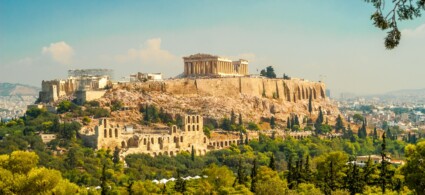
The Agora of Athens (or Ancient Agora) is located in the heart of the city, south of the central Monastiraki Square and at the foot of the Acropolis. Be careful not to confuse it with the Roman Agora, located about 300 metres away.
 Hotel
Hotel  Budget accommodations
  Apartments
  Family Hotel
  Luxury Hotel
  Resorts