Bestseller
Athens: National Archaeological Museum Ticket & Audio Guide
From 29,00 €
Buy the ticket
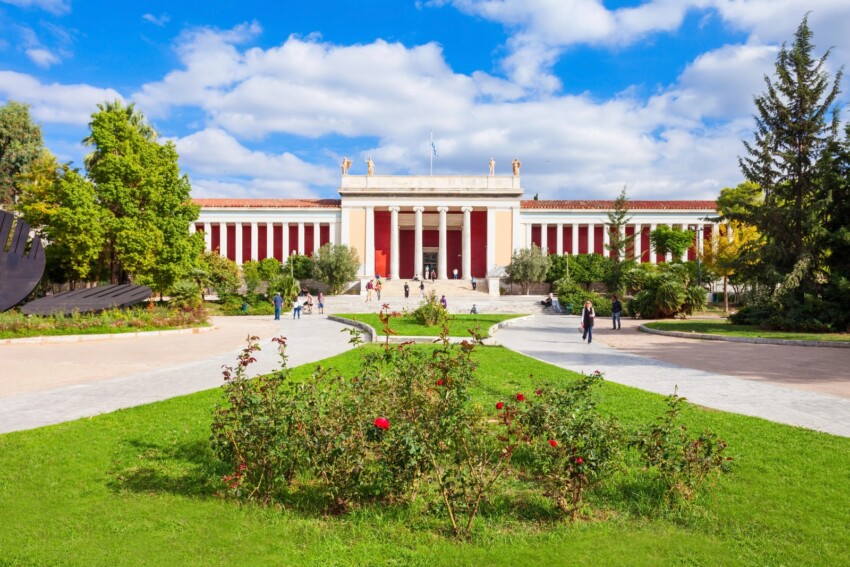
The National Archaeological Museum in Athens represents one of the most important cultural treasures in Greece and the whole of Europe. Founded in the late 19th century, this majestic neoclassical building houses the largest and most significant collection of Greek antiquities in the world, with exhibits spanning over 7,000 years of history. Its rooms house priceless masterpieces that tell the story of the evolution of Hellenic civilisation, from the earliest Cycladic cultures to the Hellenistic and Roman eras.
The richness of the collections will allow you to admire iconic works such as the Mask of Agamemnon, the Kouros of Sounion and the enigmatic Antikythera Mechanism, considered to be the first analogue computer in history. Recent renovation and reorganisation works, completed in 2023, have significantly improved the visitor experience, with new exhibition areas and modern multimedia technology enhancing the enjoyment of the exhibits.
Located in the district of Exarcheia, within walking distance of the historic centre of Athens, the museum is not only a key tourist attraction, but also a world-class archaeological research centre. With over 11,000 artefacts on display out of the 8,000 available in the permanent collections, it is a must-see for understanding the roots of Western culture and the extraordinary artistic legacy of ancient Greece.
The National Archaeological Museum houses such a vast collection that it deserves several days’ visit. We recommend that you dedicate at least 3-4 hours to appreciate its most significant treasures. The chronological and thematic organisation of the rooms will allow you to embark on a fascinating journey through millennia of Greek history and art, from the earliest prehistoric civilisations to the Roman era.
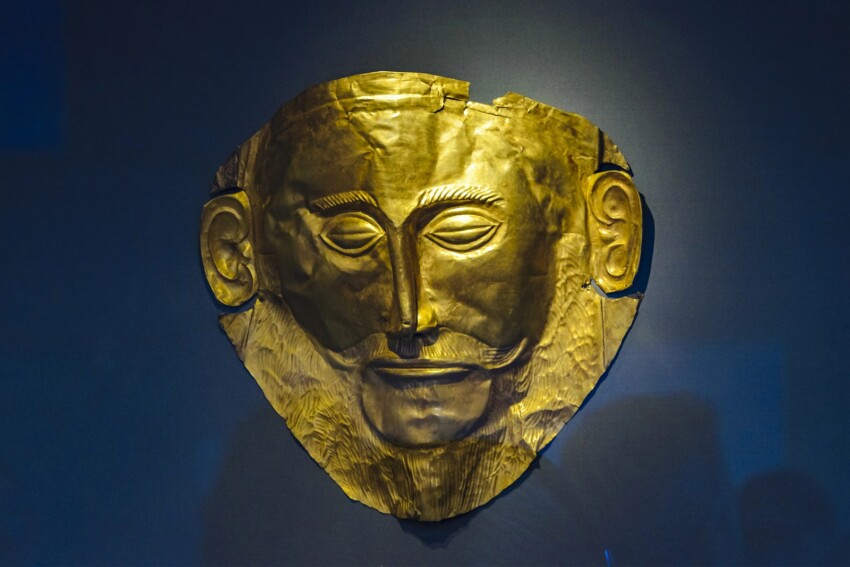
The Prehistoric Collection is one of the museum’s flagships, with exhibits covering the period from the Neolithic to the end of the Bronze Age (6800-1050 BC). In these rooms you can admire the famous treasures from Mycenae, discovered by the archaeologist Heinrich Schliemann in 1876.
The Mask of Agamemnon, made of wrought gold around 1500 BC, is undoubtedly the most emblematic work in this section. Despite the name assigned to it by Schliemann, scholars today believe that the mask represents a Mycenaean ruler who lived centuries before the hypothetical period of the Trojan War.
Equally impressive are the jewellery and weapons from the Mycenaean royal tombs, including gold cups, finely crafted diadems and daggers with inlays showing hunting scenes. The refinement of these artefacts testifies to the high artistic and technological level reached by the Mycenaean civilisation.
Don’t miss the Cycladic collection, with its characteristic marble figurines in stylised, geometric shapes, created between 3200 and 2000 B.C. in the Cycladic islands. These enigmatic figures, mostly female, have influenced modern artists such as Picasso and Modigliani.
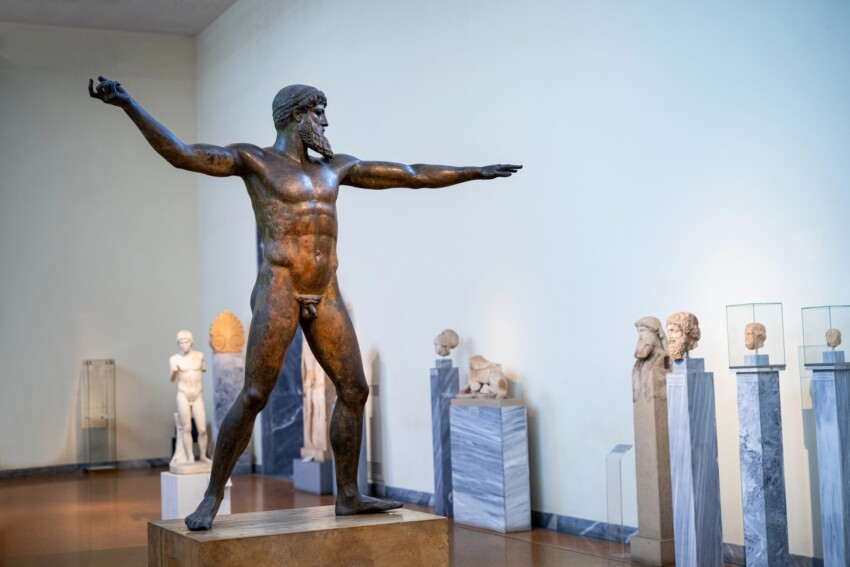
The Sculpture Collection occupies several rooms on the ground floor and exhibits the evolution of Greek statuary from the 7th century B.C. to Roman times. Here you can observe the extraordinary technical and stylistic evolution of Greek sculpture.
The Kouroi and Korai (statues of young men and women) from the Archaic period show the progressive quest for naturalism that characterised Greek art. Particularly remarkable is the Kouros of Sounion, almost 3 metres high and dated around 600 BC, which represents an important example of Attic archaic sculpture from Cape Sounion.
Proceeding to the rooms dedicated to the Classical period (5th-4th century BC), you can admire masterpieces such as the Poseidon of Cape Artemision (also known as the Chronides of Cape Artemisio), a majestic bronze statue 2.09 metres high, recovered from the sea in 1928 and considered one of the most impressive surviving Greek bronze sculptures.
Don’t miss the Jockey of Artemision, another exceptional bronze work depicting a young rider on a running horse, remarkable for its dynamism and anatomical precision.
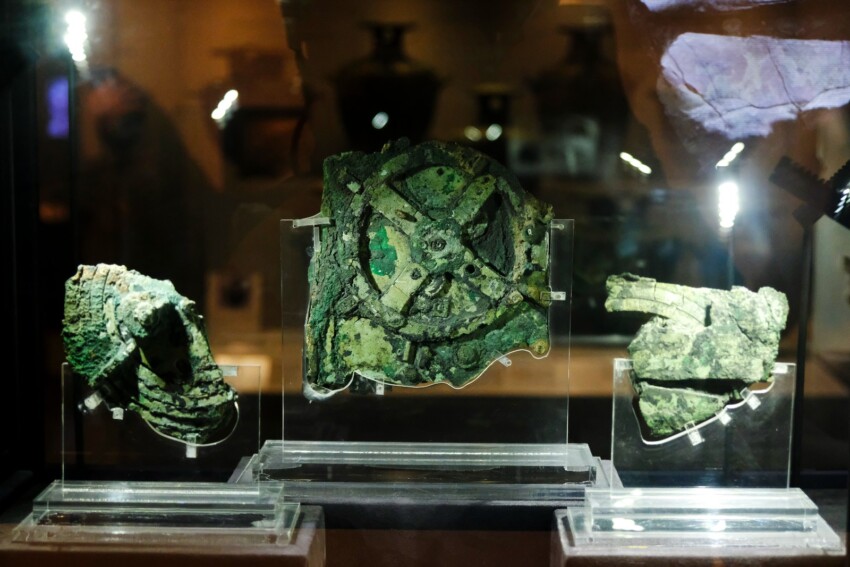
The Bronzes Collection houses some of the museum’s most extraordinary exhibits. On display here is the famous Antikythera Mechanism, found in 1901 in a shipwreck off the island of Antikythera. Dated between 150 and 100 BC, this incredibly complex mechanical device was used to calculate astronomical positions and predict eclipses with astonishing accuracy.
Recent studies conducted in 2022 using advanced technology have enabled a better understanding of the workings of this ancient ‘analogue computer’, revealing previously unknown details of its gears and the inscriptions that decorate it.
In this section you will also find the Young Girl of Antikythera, a refined bronze statue dating back to the 4th century B.C., remarkable for the elegance of its pose and the expressiveness of its face, characteristic of Hellenistic art.
The Museum’s Ceramics Collection is one of the most important in the world, with over 2,500 vases on display illustrating the evolution of techniques and decorative styles from prehistoric times to Roman times.
Particularly significant are the black-figure and red-figure vases from the Classical Athenian period (6th-5th century B.C.), which offer valuable insights into the daily life, mythology and rituals of ancient Greece. Take a close look at the Vase of Dipylon, a monumental geometric funerary amphora from the 8th century BC, decorated with scenes of funeral processions.
The Collection of Boeotic Ceramics includes unique pieces such as the famous skyphos from Thebes, decorated with scenes of athletes at the Olympics, while the Athens Pottery vases offer a comprehensive overview of Attic productions.
In 2023, the section was enriched with new exhibits and multimedia aids to explore the details of decorations and understand production techniques.
The museum’s Egyptian Collection, although less extensive than other sections, offers an interesting selection of artefacts testifying to contacts between Greece and Egypt in antiquity. Sarcophagi, statues, amulets and everyday objects illustrate the mutual influences between these two great civilisations.
Particularly remarkable is the mummy from the Ptolemaic period (3rd-1st century BC), exceptionally preserved together with its decorated sarcophagus, which represents an example of Greek-Egyptian cultural syncretism during the Hellenistic period.
The Cypriot Collection includes important finds from the island of Cyprus, a crossroads of cultures in the eastern Mediterranean. Here you can admire votive statuettes, ceramics and jewellery showing the fascinating fusion of Greek, Phoenician and Egyptian elements characteristic of Cypriot art.
The Frescoes of Akrotiri (ancient Thera on the island of Santorini) represent one of the museum’s most precious treasures. These extraordinary wall paintings, dating from the Minoan period (17th century BC), were preserved from the volcanic eruption that destroyed the settlement around 1600 BC.
The frescoes show scenes of daily life, religious ceremonies and natural landscapes with a vividness of colour and a wealth of surprising detail. Particularly famous are the paintings of ‘Spring’ (with lilies in bloom and swallows in flight), ‘Fishermen’ and ‘Child Boxers’.
Recent restoration techniques, implemented during the 2021-2022 works, have made it possible to recover previously invisible details, further enriching the value of these exceptional exhibits.
The Jewellery Collection displays artefacts ranging from the Mycenaean period to the Byzantine era, illustrating the exceptional craftsmanship of Greek goldsmiths. Gold crowns, diadems, earrings, rings and necklaces testify not only to the luxury of ancient elites, but also to the evolution of goldsmithing techniques.
Of particular interest is the Derveni Treasure, a collection of precious objects found in a 4th century BC Macedonian tomb, including the famous Derveni Krater, a bronze vase masterfully decorated with Dionysian scenes.
Also admire the fine collection of cameos and carved gems from the Hellenistic and Roman periods, representing miniature works of art of extraordinary precision and beauty.
The National Archaeological Museum of Athens is one of the most visited attractions in Athens and to visit it you need to buy an entrance ticket. You can purchase it online by following this link or by filling out the form below.
The National Archaeological Museum is located at 44 Patission Street (officially 28 Oktovriou Street), in the centre of Athens, and is easily accessible by public transport from most parts of the city. Its central location makes it an easily integrated stop on any itinerary for visiting the Greek capital.
The nearest metro station is Victoria (Line 1, green), about a 5-minute walk from the museum. You can also get off at Omonia (Lines 1 and 2), which is about a 10-minute walk away.
Several city bus lines stop near the museum, including lines 022, 060, 235, A5, B5 and others. The most convenient stop is ‘National Archaeological Museum’ on Patission Street.
The National Archaeological Museum is located in the centre of Athens, precisely at 44 Patission Street (28is Oktovriou), in the district of Exarcheia. It is about 1.5 km from Syntagma Square and 2 km from theAcropolis. It is well connected to the rest of the city by the nearby Victoria metro station (Line 1) and numerous city bus lines.

 Hotel
Hotel  Budget accommodations
  Apartments
  Family Hotel
  Luxury Hotel
  Resorts