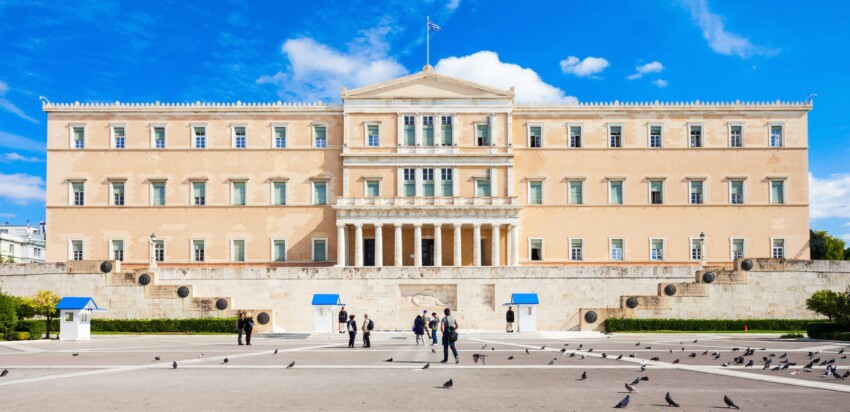
An indispensable landmark and the beating heart of modern Athens, Syntagma Square (Πλατεία Συντάγματος in Greek) is the nerve centre of the Hellenic capital. Also known as ‘Constitution Square’, this vast urban space is more than just a place to pass through: it is the hub of the city’s political, social and tourist life, a meeting point where history, culture and everyday life intertwine in a fascinating mosaic.
Strategically located in the centre of the city, Syntagma Square is surrounded by some of the most important buildings in Athens and is a crucial junction for public transport, being served by the metro station of the same name that connects directly to Athens Airport and other key areas of the city.
Whether you are visiting Athens for the first time or are already familiar with the city, Syntagma Square will almost certainly be a landmark during your stay. In this article, we explore the history of the square, its monuments and sights, the most important events that take place there and everything you need to know to fully appreciate this landmark of the Greek capital.
The most impressive and significant building overlooking Syntagma Square is undoubtedly the Hellenic Parliament (Βουλή των Ελλήνων). This majestic neoclassical palace was originally built between 1836 and 1842 as a royal residence for Otto I, the first king of modern Greece. Only in 1935 was the building converted into the seat of the Greek Parliament.
The façade of the Parliament is characterised by austere and elegant neoclassical architecture, with Ionic columns emphasising its institutional importance. The interior, not always accessible to the public, houses the hall of the National Assembly, government offices and a library with important historical documents.
In front of the Parliament is the Tomb of the Unknown Soldier (Μνημείο του Αγνώστου Στρατιώτη), a memorial dedicated to Greek soldiers who fell in battle. The monument, inaugurated in 1932, is decorated with a bas-relief depicting a dying Greek soldier, inspired by an ancient funerary stele. On the sides are engraved the names of places where the Greek army has fought significant battles throughout modern history.
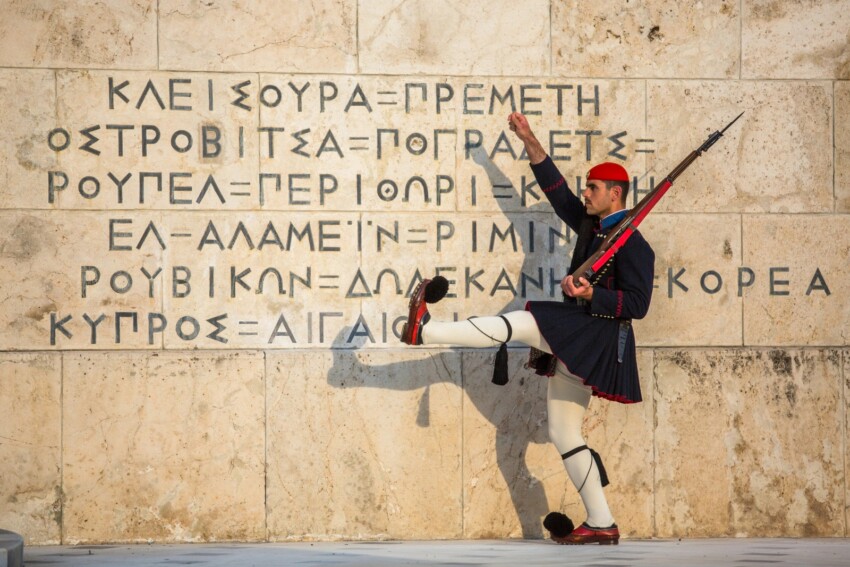
One of the most striking and photographed moments in Syntagma Square is undoubtedly the changing of the guard of the Evzones in front of the Tomb of the Unknown Soldier. The Evzones, also known as Tsoliades, are a ceremonial elite corps of the Greek army whose task is to guard the Parliament and the Tomb of the Unknown Soldier.
The changing of the guard takes place every hour, with a more elaborate and solemn ceremony on Sundays at 11am. During this ritual, the Evzones perform a series of precise and slow choreographic movements, raising their legs and stamping their feet on the ground with their characteristic hobnailed boots (tsarouchia).
The Evzones wear a very distinctive traditional uniform, which includes:
This uniform has a deep historical significance, recalling the traditional dress of the kleftes, the Greek warriors who fought during the War of Independence against the Ottoman Empire.
The changing of the guard ceremony is a must-see attraction for visitors to Athens, who gather in large numbers to witness this spectacular ritual. It is advisable to arrive a little early to ensure a good vantage point, especially for the Sunday ceremony.
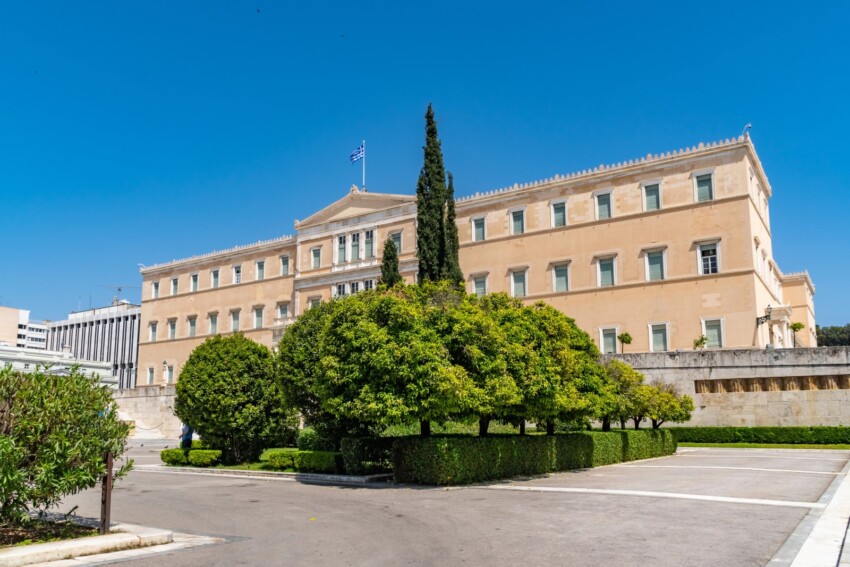
Syntagma Square owes its name to the Greek word ‘Σύνταγμα’ (Syntagma), meaning ‘constitution’. This toponym is not accidental, but has deep roots in the modern history of Greece. In fact, the square was named after the constitution that King Otto I was forced to grant following the popular uprising on 3 September 1843, when Athenian citizens and the military garrison gathered there to demand the establishment of a representative government.
Before then, the area was known as ‘Palace Square’, as the Royal Palace (today’s Parliament building) overlooked it. The square witnessed many significant historical events: demonstrations, celebrations, protests and political changes that marked the course of modern Greece.
Over the centuries, Syntagma has undergone several urban transformations. Its current appearance dates mainly from the major renovation that took place for the 2004 Athens Olympics, when the square was redesigned with new paving, green areas, fountains and an underground access connecting it directly to the metro station.
During the excavations for the construction of the metro, important archaeological finds were discovered that testify to the fact that this area had been inhabited since ancient times. Some of these finds are now on display in the Syntagma metro station, which has been transformed into a veritable underground museum.
Given its symbolic importance and central location, Syntagma Square has historically been the scene of numerous public events, celebrations and political rallies. During Greek national holidays, such as Independence Day (25 March) and ‘No’ Day (28 October), military parades and official ceremonies take place here.
The square has also hosted major celebrations during significant events, such as Greece’s victory at the European Football Championship in 2004 or the inauguration of the Athens Olympics in the same year.
On the other hand, Syntagma has also been the scene of major protests and political demonstrations. During the Greek economic crisis, between 2010 and 2015, the square became the focal point of popular discontent, with massive demonstrations against austerity measures. These images went around the world, underlining once again the central role of Syntagma in Greek political and social life.
During the Christmas period, Syntagma Square is transformed with bright decorations and a large Christmas tree. The festive atmosphere attracts families and visitors, and concerts and special events are often organised.
In summer, the square occasionally hosts open-air concerts and film screenings, providing free entertainment for citizens and tourists.
Reaching Syntagma Square is extremely easy, given its central location and numerous public transport connections:
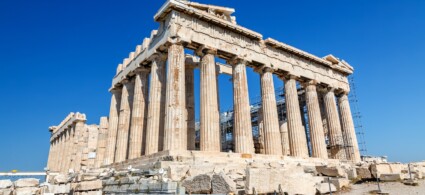
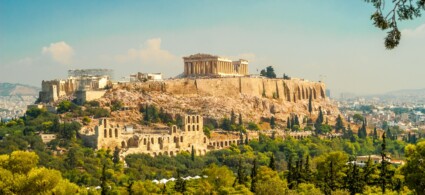
The square is a great starting point for exploring the main attractions of Athens. The Acropolis and its museum can be reached with a walk of about 15-20 minutes, passing through the picturesque district of Plaka. The National Garden and the Panathenaic Stadium are even closer.

 Hotel
Hotel  Budget accommodations
  Apartments
  Family Hotel
  Luxury Hotel
  Resorts