Royal Sun
Chania Town - G. Paizi 36
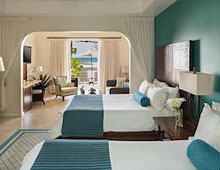
Featuring a restaurant and a pool with sun terrace amidst its palm-tree garden, Royal Sun lies within 3 km from the centre of Chania Town.
Book now
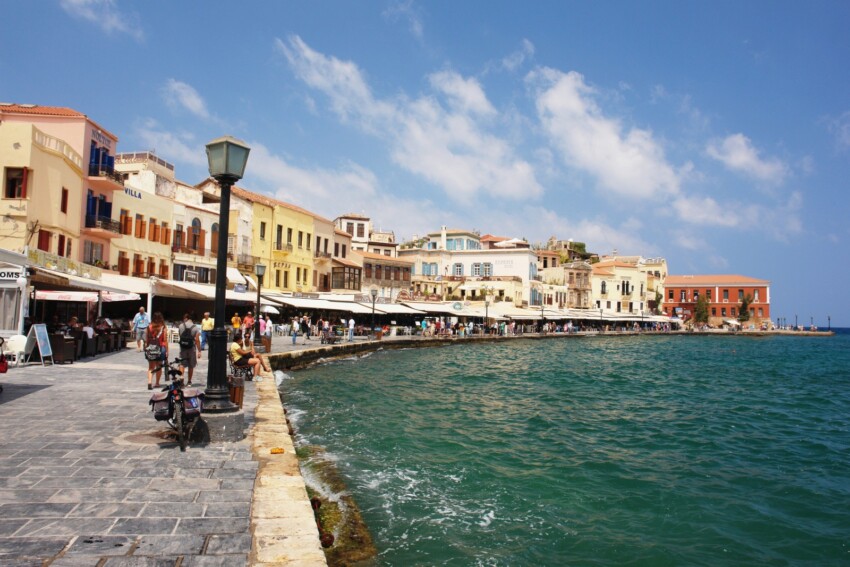
Nicknamed the Venice of the Orient, Chania is a beautiful town located on the north coast of the island of Crete. The city presents itself as one of the most desirable destinations in this area due to its beaches, historical centre and architectural heritage. Chania also served as the capital of Crete, from 1847 to 1972, while today it is the second largest city on the island after Heraklion.
A truly picturesque town that bears witness to the different civilisations that have followed one another here over the centuries. In fact, after being an important centre for the Minoan civilisation, the city first became a Roman colony and, in later centuries, the domain of the Venetians, Genoese and finally the Ottomans.
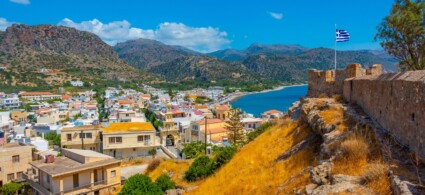
The historical centre is built around the harbour and is a well-preserved area where Venetian and Turkish buildings create a unique and original ambience. A lively, multicultural city whose past can be seen walking through its alleys where churches and beautiful fountains coexist with mosques and splendid Italian-style palaces.
Chania (also known as Haniá) is a town that developed around the port and now consists of its old centre and new settlements. The older part is surrounded by walls of Byzantine origin that define its boundaries and have protected and preserved it over the years. Chania is a must-visit town on a trip to Crete as it will surely captivate you not only with its charm and beaches but also with its culinary tradition.
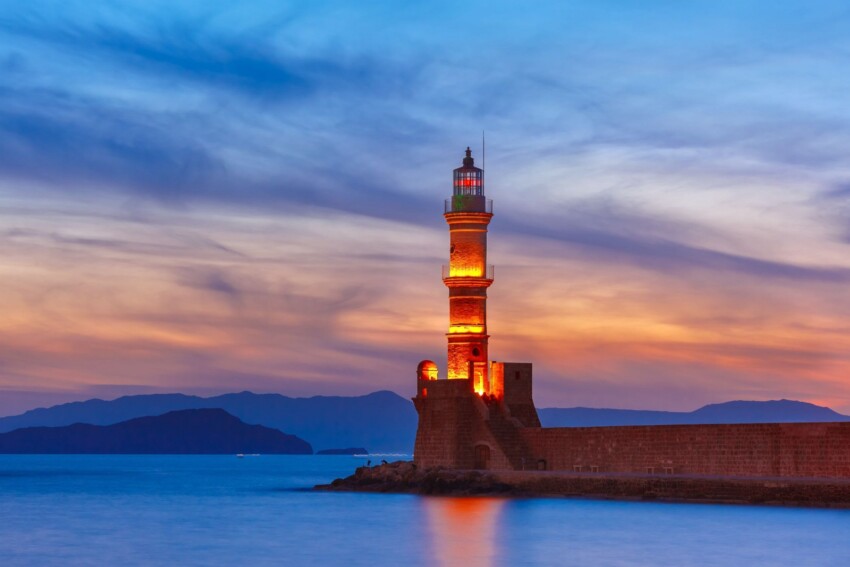
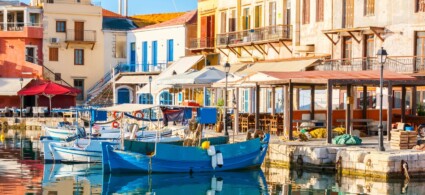
The town’s harbour is a very characteristic and at the same time very lively area of this town. It was designed by the Venetian engineer Michele Sammichelli, the same man who also designed the city walls of Heraklion. At the entrance to the harbour you can see a picturesque and imposing lighthouse that was originally built by the Venetians and later renovated in the 19th century by the Egyptians.
Along the half-moon shaped dock there are several bars and restaurants with outdoor tables that are very popular with tourists due to the excellent view and lively atmosphere.
Also at the harbour you can find the beautiful Yali Tzamisi, the oldest mosque on Crete. The building dates back to the mid 17th century when it was built on the foundations of an earlier church of Byzantine origin to pay homage to the city’s governor at the time.
Today it is known as the ‘Mosque of the Janissaries‘, a name given in homage to the Janissaries who are buried in the building’s courtyard. The mosque, consisting of a large main dome and seven smaller domes, is currently no longer a place of worship but a space that hosts exhibitions, events and temporary displays.
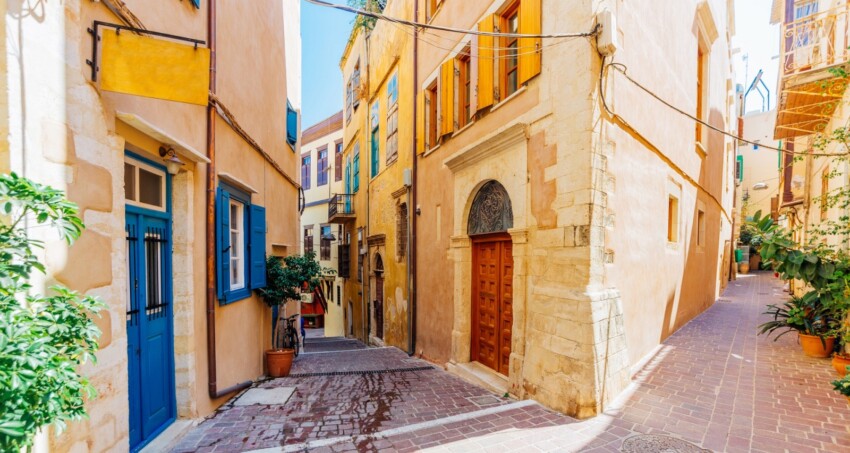
Old Chania is the place to get lost in the alleys characterised by taverns, churches, artisans’ workshops and small shops. Narrow streets surrounded by Venetian-style buildings where, looking up at the doorways of many houses, you can still see the coats of arms of the Venetian Republic.
The main square Eleftherios Venizelos, once known as Santrivani, was the place where students, philosophers and politicians gathered to debate and discuss. Now in the centre of this square is a beautiful white marble fountain while all around it are bars and tavernas, making it a favourite haunt for tourists.
The Archaeological Museum of Chania is located inside the old Venetian church of St Francis (Aghios Fragkiskos) and houses artefacts ranging from the Neolithic period to Roman times. Among the best known finds is the Master Impression (the imprint of a very large signet ring) as well as a rich series of tablets and amphorae with inscriptions in Linear B.
The building has retained its original architecture with three naves and a central stone vault, while the floors feature beautiful mosaics of Byzantine origin.
One of the most picturesque areas of the city is certainly Tabakaria, the district where the city’s most famous tanneries built between 1820 and 1830 were once located. These handicrafts were active until the late 1850s, when the arrival of technology left less and less room for leather craftsmanship.
Now a few workshops and shops selling leather goods and souvenirs remain, while some former buildings have been converted into taverns or restaurants.
The Firkas Fortress currently houses the Naval Museum and a small open theatre. The fortress is located in the Topanas district, which was inhabited by the wealthiest families of the city in the days of Turkish rule. The museum houses exhibits that narrate the maritime traditions of Crete and Chania through a large collection of nautical charts, ship models, naval instruments and other memorabilia.
The western side of Crete, where Chania is located, is home to some of the most beautiful beaches in Greece. Among the beach areas closest to the city centre, and therefore most popular, is Nea Chora Beach7, characterised by a long, sandy beach. It is a well-equipped area with excellent accommodation facilities and tavernas offering excellent fresh fish.
In the prefecture of Chania, on the other hand, we find excellent beaches in the north a few kilometres from the city, such as the areas of Holy Apostles and Saint Marina, but also further afield such as Maleme, Falasarna (famous for its beautiful sunsets) and Georgioypoli. Also not to be forgotten are Platanias and Agia Marina Beach, the perfect destinations for those who love beach clubs and parties that last from the afternoon until late in the evening.
In the south, on the other hand, are the fascinating beaches of the Gulf of Elafonissi, characterised by its pink sand and the presence of a beautiful coral reef.
In the following map you can see the location of the main places of interest mentioned in this article.
Chania is undoubtedly one of the most attractive places to stay in Crete and from here you can easily reach attractions such as the Balos Lagoon, the Samaria Gorges and the beaches of Elafonissi. As the city is a popular destination in summer, it is advisable to book your stay in advance in order to find the most suitable accommodation for you at affordable prices
The city offers a wide choice in terms of accommodation including luxury hotels, studios (i.e. studios with a bathroom and kitchenette), small bed and breakfasts and flats.
We offer a selection of hotels at Chania to suit all categories of travellers. The most booked by tourists are the sea-facing hotels, often right on the beach. If you want to play it safe, choose one of the following: they are among the most booked hotels in Chania, sorted by number of reviews.
If you prefer space, privacy and the ability to prepare your own meals to a hotel holiday, book a holiday home at Chania. We recommend a few below, but in this case we advise you to book early because houses and apartments for rent at Chania are in high demand.
Chania International Airport is located about 15 km east of the city centre and is the second most important airport on the island after Heraklion. Especially during the summer season from several airports you can reach Chania with a low-cost flight of a few hours.
Once at the airport you can choose to reach the centre by bus (cheaper but slower solution), by taxi (faster but more expensive solution) or by taking a rental car.
An alternative to flying can be the ferry: the port is located in Souda, on the north-west coast of the island and has daily connections with the port of Piraeus. The ferry trip can be long and tiring but at the same time it can give you the opportunity to take your own car with you, thus avoiding the need to rent one.
What's the weather at Chania? Below are the temperatures and the weather forecast at Chania for the next few days.
Chania is the capital city of the prefecture of the same name on the Greek island of Crete. It is located on the north-western coast of the island and is about 140 km from Heraklion, the capital of Crete, and 200 km from Agios Nikolaos.
 Hotel
Hotel 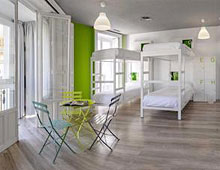 Budget accommodations
  Apartments
  Family Hotel
  Luxury Hotel
  Resorts