Heraklion is a lively town on the island of Crete, famous not only for its beaches but also for being home to archaeological sites such as Knossos and Phaistos.
A city of truly ancient origins, Heraklion is not only one of the four provinces into which Crete is divided but also the capital city of the island. After being the cradle of the Minoan civilisation, Heraklion was dominated by the Arabs, the Venetians and the Ottomans, all peoples who bequeathed their architectural and cultural heritage. In fact, the city is also known by its Venetian name of Candia, which originates from the snow-white colour of the stones with which the houses were built since the 16th century.
Surrounded by valleys full of olive groves and vineyards and bathed by a crystal-clear sea, Heraklion presents itself as the perfect combination of history, nature and excellent beaches. Just a few kilometres from the city centre is one of the world’s most famous archaeological sites, home to the remains of the fascinating Palace of Knossos, where, according to legend, the labyrinth in which the Minotaur was imprisoned was located.
Apart from being an important archaeological centre, the city of Heraklion is also home to the island of Crete’s main airport and is one of Crete’s top tourist destinations with a wide choice of restaurants, hotels and traditional tavernas. A maritime town that preserves the remnants of its long history: from archaeological sites of Minoan origin to the walls built by the Venetians in the mid-16th century. Heraklion is an ideal combination for those who want to spend their days not only relaxing and having fun but also enjoying good food.
Heraklion has managed to keep intact the most historical area of the city known as the ‘old town‘, which is the area bordered by the fortification walls. The city has passed into history for being the best fortified in the Mediterranean thanks to these imposing ramparts.
The first walls were built by the Arabs, but later it was the Venetians who modified and reinforced them. These are now considered to be a true work of engineering conceived by the Venetian architect Michele Sanmicheli who designed them more than five hundred years ago. Of the four gates that provided access to the city, only two remain: Chanioporta (1570) characterised by the presence of St Mark’s Lion and Porta Nuova (1587).
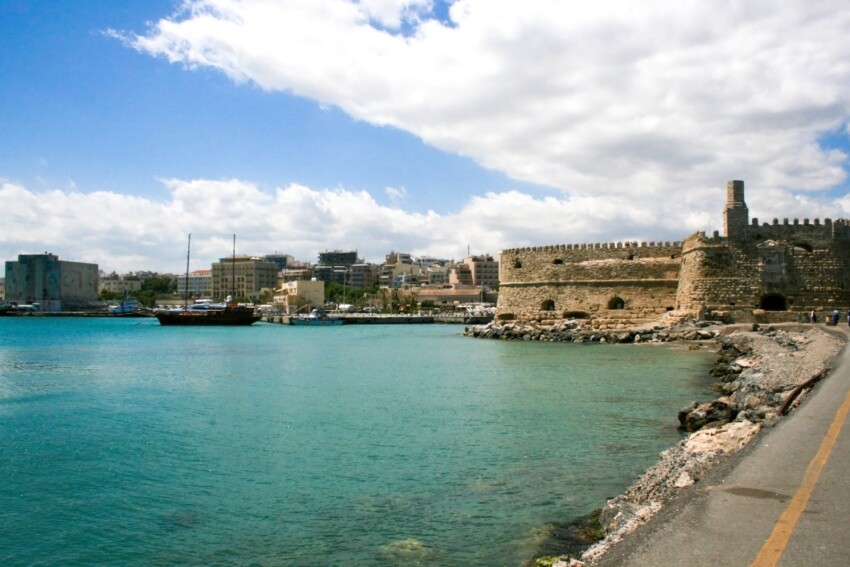
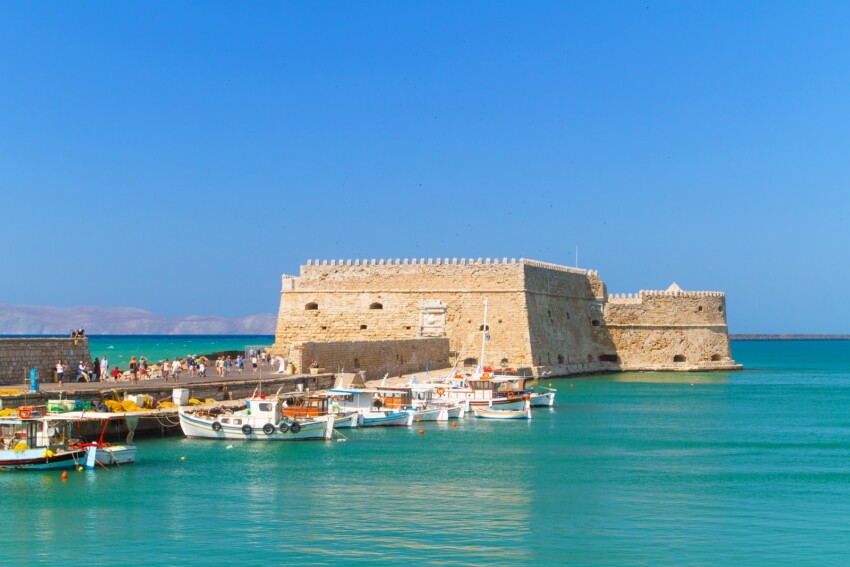
The port of Heraklion was built by the Venetians in the 16th century and is dominated by the presence of the Venetian fortress of Koule. This building, also known as Castello a Mare, was built to defend the city’s harbour from enemy attacks. It can still be visited inside and from the top of its towers one can enjoy a beautiful view of the city and the harbour. The harbour of Heraklion is also a must-see as it offers glimpses of the daily life of Cretan fishermen.
Archaeological Museum
3Ξανθουδίδη και, Chatzidaki 1, Iraklio 712 02, Greece
The Archaeological Museum of Heraklion is one of the most important museums in Greece as it houses exhibits covering more than five thousand years of Cretan history. The museum exhibits objects from all over the island and in particular, there is a rich array of remains from the Minoan civilisation found at Knossos, Phaistos, Malia and other sites. Inside there are also rooms that preserve the beautiful frescoes that were originally at the Palace of Knossos.
The central square of Heraklion, known as the Lions’ Square or Venizelos Square, is home to the beautiful Morosini Fountain commissioned by the Venetian general Francesco Morosini and built in 1628 on the site of a fountain dating back to the 14th century. Originally, this fountain was used by locals to supply themselves with drinking water thanks to a complex hydraulic system.
The fountain, part of the hereditary heritage that Venice left to the city, is an elegant piece of white marble in the Italian style of the time. In the lower part, bas-reliefs depicting mythological figures from the Greek tradition, such as nymphs, dolphins, tritons and sea monsters can be seen, while in the upper part there are four lions supporting the central basin and from whose mouths water flows out.
The Church of St Titus, or Agios Titos in Greek, is a Byzantine church dedicated to St Titus, the first bishop of Crete and patron saint of both the island and the city of Heraklion. This church has a somewhat troubled history: first built during Byzantine rule around AD 961, it became a Catholic cathedral and the seat of the archbishop during the rule of the Serenissima, while later, during the Turkish occupation, it was converted into a mosque.
Rebuilt after an earthquake in the 19th century, today we can admire the stone façade and the massive wooden doorway on the outside, while inside there are three main naves and the silver reliquary that holds the skull of St Titus.
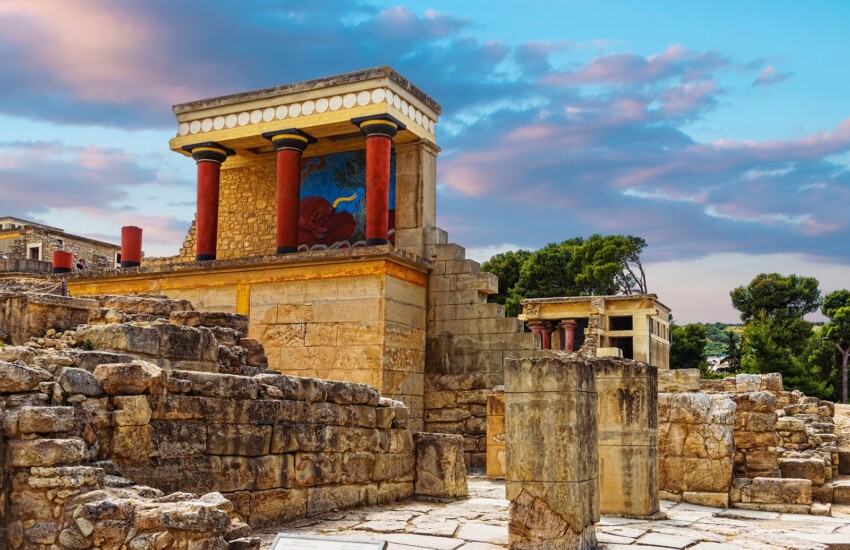
Five kilometres from Heraklion is Knossos, the centre of Minoan civilisation between 1900 and 1400 BC and one of the most famous archaeological sites in Europe. In its heyday, the city of Knossos occupied an area of about 22 thousand square metres and was inhabited by more than 100 thousand people. Besides being the residence of Minos, Knossos was also the political, commercial and administrative centre of the island. Linked to this site is the famous legend of the labyrinth built by Daedalus on the orders of King Minos. Here the king locked up the Minotaur, a half-man, half-bull being, who was killed by Theseus with the help of Ariadne, daughter of King Minos.
The Palace of Knossos is a site that contains a complex of buildings that at the time were used not only by the royal family but also by officials, priests and residents. In addition to the royal flats, the main part also included ceremonial quarters, treasury rooms and craftsmen’s workshops. Don’t miss a visit to the throne room, the queen’s baths and the ancient theatre.
In the following map you can see the location of the main places of interest mentioned in this article.
Beaches near Heraklion
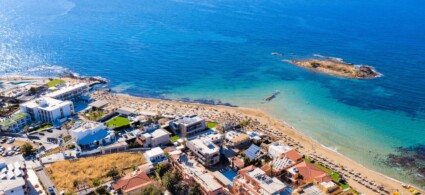
The capital of Crete is also a good base for exploring the region’s beaches. Just a few kilometres from the centre, you will find beautiful beaches and excellent accommodation. The province of Heraklion is home to some of the most beautiful coastlines on the island of Crete.
Along the northern part are the beaches most frequented by tourists and full of bathing facilities. One of the most famous is certainly Agia Pelagia. Here, the beach is confined to a narrow strip of land and what captivates visitors is the crystal-clear sea. Other beautiful beaches in the northern part are Malia, Hersonissos and Palekastro, which are well organised and also offer the possibility of water sports. It should be added that those who frequent these areas often do so not only for the sea but also for the lively nightlife.
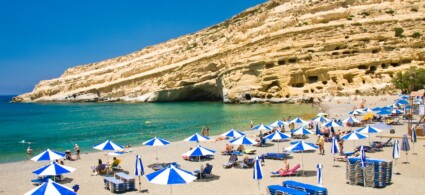
The southern part, on the other hand, is characterised by small, secluded and therefore very quiet bays, where there are fewer bathing establishments and more free beaches. Some of the beaches can give you a truly unique ambience thanks to their black sand and turquoise sea water. Among them we recommend: Aspes, which is perhaps the most famous of the black beaches, Agios Nikitas and Chrysostomos.
Nightlife in Heraklion
Heraklion is a city that does not disappoint when it comes to nightlife either, given the numerous entertainment opportunities it has to offer. Amongst the narrow streets of its old town are pedestrian streets, such as Korai and Milatou Street, where one can find numerous bars, pubs and taverns, while in the harbour area one can discover clubs, cocktail bars and more sophisticated venues.
Not far from Heraklion are also the towns of Hersonisson and Malia, which are two of the most famous resorts in Crete for their buzzing nightlife.
Where to stay in Heraklion
Heraklion is able to offer a wide choice of accommodation to suit different needs. The city comes alive at night and is frequented by many nightlife enthusiasts, so if you take a hotel in the city centre take this into account.
The establishments that overlook the old harbour allow you to enjoy a wonderful view. In this area, however, you can find accommodation for all needs and budgets: from hostels to luxury hotels, from flats to accommodation in historical buildings.
We offer best rates If you find it cheaper we refund the price difference.
Free cancellation Most properties allow cancellation without penalty.
We're available 24 hours a day For any problem call Booking.com.
Recommended hotels in Heraklion
We offer a selection of hotels at Heraklion to suit all categories of travellers. The most booked by tourists are the sea-facing hotels, often right on the beach. If you want to play it safe, choose one of the following: they are among the most booked hotels in Heraklion, sorted by number of reviews.
If you prefer space, privacy and the ability to prepare your own meals to a hotel holiday, book a holiday home at Heraklion. We recommend a few below, but in this case we advise you to book early because houses and apartments for rent at Heraklion are in high demand.
The city of Heraklio is easily accessible thanks to the presence of Kazantzakis International Airport, which is located just over five kilometres from the city. The airport is well connected, especially in summer, with major European cities. Once you arrive at the airport, you can take a bus to the centre or you can consider renting a car if you plan to move around other areas of the island. Alternatively, you can also take a taxi as the proximity of the airport to the centre makes the cost very affordable.
As another solution, you can reach Athens by plane, and then from the Greek capital continue by ferry. Sea connections from the port of Athens or other Greek cities will take you to the port of the city of Heraklion, which is located in the city centre.
Heraklion Weather
What's the weather at Heraklion? Below are the temperatures and the weather forecast at Heraklion for the next few days.
Sunday 8
9°
15°
Monday 9
8°
15°
Tuesday 10
10°
14°
Wednesday 11
11°
15°
Thursday 12
9°
15°
Friday 13
8°
16°
Where is located Heraklion
Heraklion is located in the central eastern part of Crete, the largest and most populous island of Greece. The city, located in the prefecture of the same name, is surrounded by the prefectures of Rethimno and Lassithi and is approximately 140 km from Chania, the island's second largest city, and 90 km from Ierapetra.
 Hotel
Hotel  Budget accommodations
  Apartments
  Family Hotel
  Luxury Hotel
  Resorts