Bestseller
Crete: Palace of Knossos E-Ticket and Audio Guide
From 29,00 €
Buy the ticket
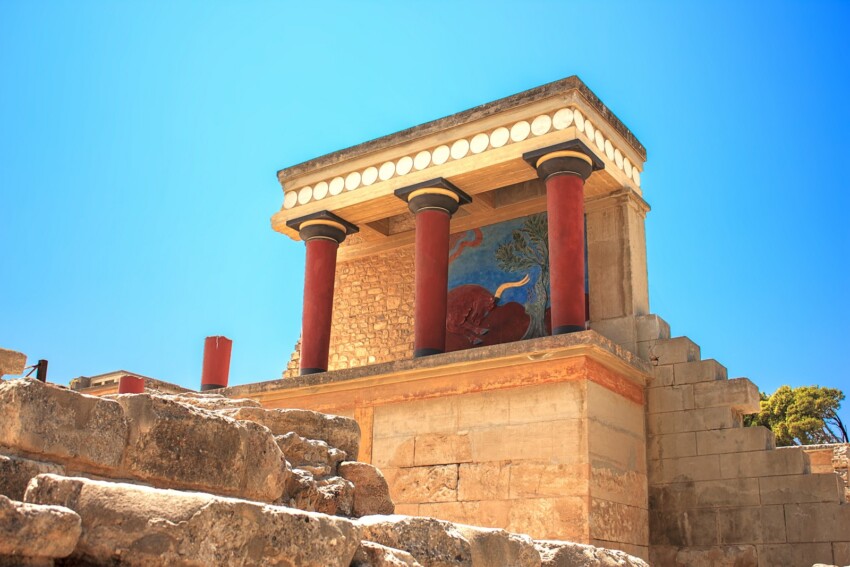
A political, economic and religious centre, the Palace of Knossos was built around 1700 B.C. and is currently located about 6 km from the centre of Heraklion, the capital of Crete. Cradle of the Minoan civilisation, Knossos was a town that, surrounded by the river Kairatos, stood in a strategic position on the hill of Kefala but was not too far from the sea and the port of Heraklion.
This huge site covered an area of around 22,000 m² and consisted of a central courtyard, where gymnasts performed, around which a huge complex was built that included the royal and staff quarters, administrative officials’ rooms, areas for worship and receptions, and the workshops of various craftsmen.
Today, it is possible to stroll through the ruins of this small citadel built by the Minoan people, one of the most interesting ancient civilisations, and admire the masterpieces they were able to create at the time.
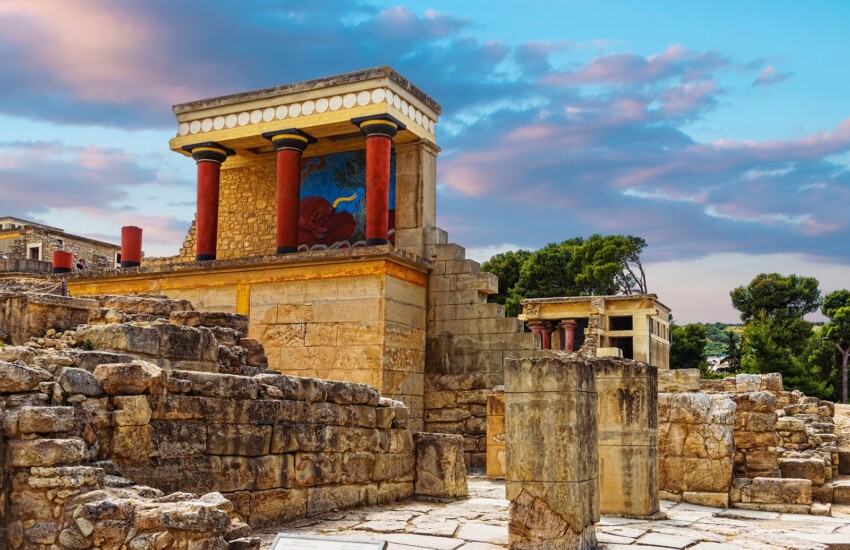
The site of Knossos brings to light the architectural and artistic heritage of this civilisation, which can be admired not only in the majesty and grandeur of this small citadel, but also in the decoration of the rooms and the objects that have been found in the vicinity.
No traces of walls built to protect the Palace of Knossos have been found and the structure of the site appears to have been intricate and difficult to reconstruct in its entirety. In the easternmost area are the royal chambers and workshops, while in the westernmost part is the Small Palace, the House of Frescoes with finely decorated walls and the Villa of Dionysus, a private residence adorned with prestigious mosaics.
Don’t miss a visit to two important areas: the Throne Room and the Queen’s flats. The Throne Room is bright red and the remains of an alabastrine plaster throne were found here, while in the area of the Queen’s flats, wonderful frescoes were discovered, such as that of the ‘dolphins’ and the ‘dancer’.
The queen’s flats were also characterised by the presence of a bathroom that was truly avant-garde for its time, with an advanced system of sewers and drains, as well as large cisterns that ensured that there was always hot drinking water.
Today, the frescoes that can be admired at Knossos are faithful reproductions and the originals of these masterpieces of Minoan art are now kept at the Archaeological Museum of Heraklion.
You can buy your entrance ticket online by following questo link and save the queues at the ticket offices, which are literally stormed during the summer period; discounted tickets are available.
Given the crowds, especially in high season, of Crete’s most visited attraction, buy a skip-the-line ticket to ensure your visit and avoid wasting time at the ticket offices of the archaeological site.
Alternatively, to find out all about the Palace of Knossos, you can have an expert guide accompany you during your visit. The cost is slightly higher than the entrance ticket and even buying one of the tickets below will save you time and avoid queuing at the ticket office.
If, in addition to visiting the archaeological site of Knossos, you would like to combine your ticket with the Archaeological Museum of Heraklion, buy a combination ticket.
The Palace of Knossos is open daily from 08:30 to 17:00, last entry time at 16:30. Closed on the following days: 1 January, 25 March, 1 May, Easter Sunday, 25 and 26 December.
The area of the archaeological site of Knossos is about 6 km (15 minutes) from the city of Heraklion and is therefore easily accessible either by car or by taking the bus that always leaves from the city centre.
Alternatively, if there is more than one person, given the proximity of the site to Heraklion, you can also consider taking a taxi.
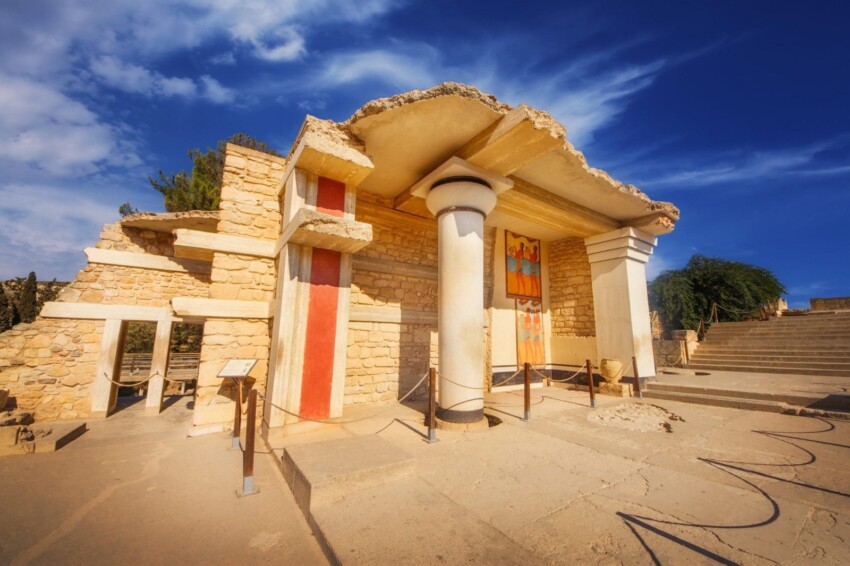
The Palace of Knossos that we can all see today is the result of reconstruction and restoration work on a complex built by the Minoan civilisation some two thousand years before Christ. What appears before our eyes is actually a masterpiece: built on the ashes of an earlier palace, destroyed by an earthquake around 1700 BC, the present Knossos is said to be the place where the legendary King Minos lived and is said to have housed more than 12,000 people.
This magnificent archaeological site, built in the years when the Minoan civilisation was at its peak, was later hit by another earthquake and partly destroyed. The first discoveries of these remains were made at the end of the 19th century by Minos Kalokairinos, an antiquarian from Heraklion, but then it was the English archaeologist Sir Arthur Evans who directed the restoration work, proposing a reconstruction of the complex that some describe as too arbitrary and not very faithful to the original.
Nowadays, Knossos is also famous for the stories and legends that link it to the likes of Daedalus, Icarus, and the famous Minotaur. According to Greek mythology, King Minos asked Daedalus to build an intricate labyrinth in which to enclose the Minotaur, a ferocious being with the body of a man and the head of a bull.
The god Poseidon, in fact, had given King Minos a beautiful white bull asking him to sacrifice it, the king, however, seeing the beauty of this bull decided to keep it and sacrifice another one. Poseidon, having discovered what had happened, to punish him made the king’s wife, Pasiphae, fall madly in love with the bull and from their union the Minotaur was born.
Being a fierce and cruel being, the Minotaur was locked up in a labyrinth and it was decided to send him seven girls and seven boys as sacrifices. Theseus was one of those seven young men who had arrived in Crete to enter the labyrinth as a sacrificial victim. The boy, however, thanks to the help of Ariadne, daughter of Minos, entered the labyrinth unravelling the famous ‘Ariadne’s thread’ behind him. When Theseus arrived in front of the Minotaur, he killed him with his sword and then managed to get out of the labyrinth by following the thread he had unwound.
Today, walking among the ruins of the archaeological site, where perhaps these legendary stories once took place, we can admire the charm and power of this civilisation and what it was able to build thousands of years ago.
The Palace of Knossos is located 6 km from Heraklion, the main city of the island of Crete that also hosts the international airport, 38 km from Malia and 80 km from Rethymno.
 Hotel
Hotel  Budget accommodations
  Apartments
  Family Hotel
  Luxury Hotel
  Resorts