Bestseller
Crete: Palace of Knossos E-Ticket and Audio Guide
From 25,65 €
Buy the ticket
The Palace of Knossos is the most important archaeological site on Crete and one of the most visited attractions across Greece, with over a million visitors annually, making it second only to the Acropolis in Athens amongst Greek attractions. Located approximately 5 km south of Heraklion, the island’s capital, on a gentle hill called Kefala that overlooks the dry riverbed of the ancient Kairatos river, the whole of Crete is rich in Minoan history, but Knossos is its heart. This palace was the political, economic, religious and administrative centre of Minoan civilisation, Europe’s first advanced civilisation, which reached its peak here between 1900 and 1375 BCE.
What you see today is largely the result of reconstructions begun by British archaeologist Sir Arthur Evans from 1900 onwards, employing techniques and interpretative choices still debated by scholars today. Understanding this overlap between ancient and modern is essential to appreciating your visit without misconceptions. Allow 2–3 hours for a leisurely visit to the main areas, or at least 4 if you want to explore every corner of the site in depth.
You can purchase your entrance ticket online by following this link to avoid queues at the ticket office, which are literally swarmed during the summer season; book in advance, especially in July and August, as queues can be lengthy and the timed entry system may result in unexpected waiting times.
Entry is free for EU citizens under 25 (with ID), non-EU children under 5, disabled visitors with a disability certificate, and secondary and vocational school students from EU and EEA countries. Entry is also free for everyone on specific dates throughout the year: 6 March, 18 April (International Monuments Day), 18 May (International Museums Day), the last weekend of September, 28 October and every Sunday from 1 November to 31 March.
Given the particularly heavy footfall during peak season at Crete’s most visited attraction, purchase a skip-the-line entrance ticket to guarantee your visit and avoid wasting time in queues at the archaeological site’s ticket office.
Alternatively, to discover everything about the Palace of Knossos, you can be accompanied by an expert guide during your visit. The cost is only slightly higher than the standard entrance fee, and by booking one of the tickets below, you’ll also save time by avoiding the queue at the ticket office.
There is also a combined Knossos + Heraklion Archaeological Museum ticket, valid for 3 days from the booking date: this is the wisest choice for those visiting both sites, particularly as the museum houses the original frescoes, of which Knossos displays only copies.
The Palace of Knossos is open every day of the year, with hours varying by season. April to August: 8:00 am–8:00 pm. September: 8:00 am–7:30 pm (first half) and 8:00 am–7:00 pm (second half). October: 8:00 am–6:30 pm (first half) and 8:00 am–6:00 pm (second half). November to March: 8:30 am–5:00 pm. Last admission is always approximately 30 minutes before closing. The site is closed on the following public holidays: 1 January, 25 March, 1 May, Orthodox Easter Sunday, 25 and 26 December. For updated opening times, always check the official website before your visit, as these may be subject to change.
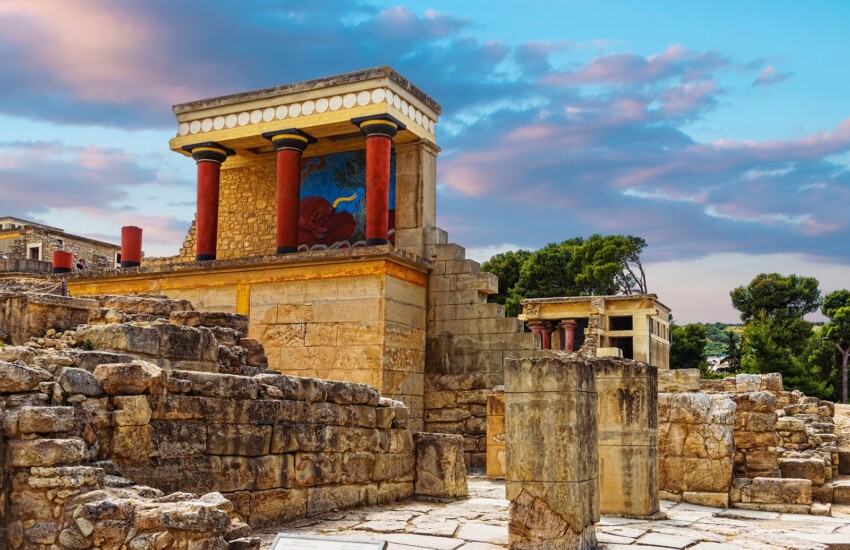
The site covers approximately 22,000 m² of built-up area spread across multiple levels, organised around the grand rectangular Central Court, the heart of all palace life. The visitor route is marked but fairly free-flowing: it’s worth following the suggested order to understand the architectural logic of the complex.
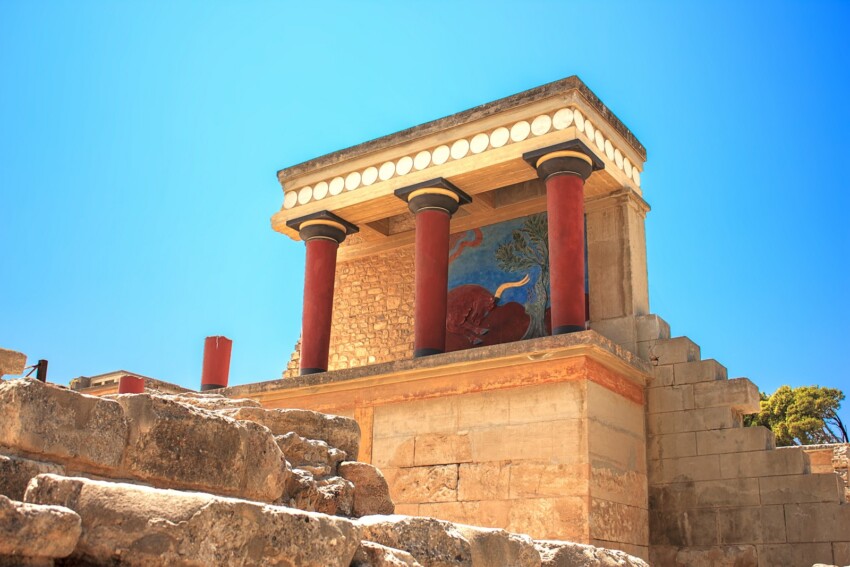
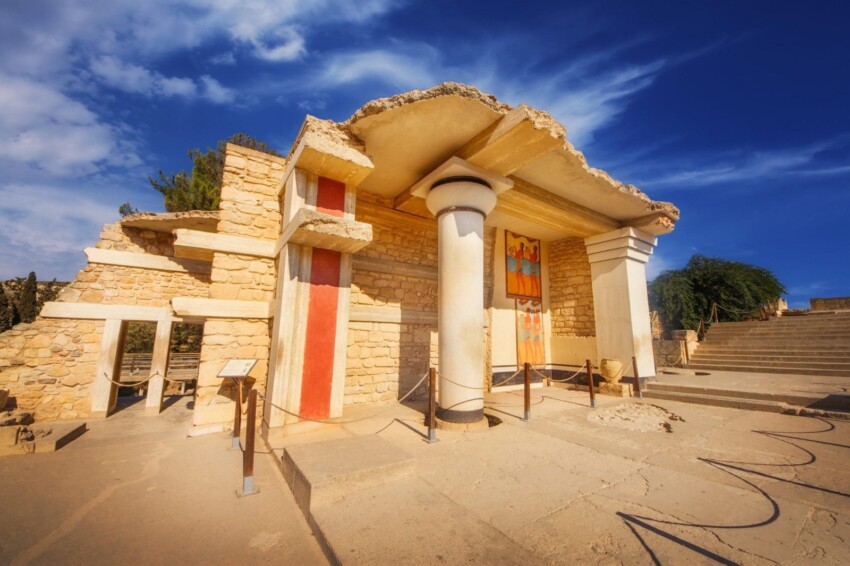
The Central Court, roughly 50 metres long and 27 metres wide, was the heart of the palace’s ceremonial life. It probably hosted rituals linked to the bull, the pre-eminent sacred symbol of Minoan culture, whose images recur obsessively throughout the complex’s frescoes and decorations. The Southern Propylaea, the grand ceremonial entrance to the palace, preserves copies of the Procession frescoes, depicting male figures bearing gifts to the ruler. Evans reconstructed this area with inverted columns in red and black, a visually striking choice but one that subsequent archaeologists have long debated.
The Throne Room is Knossos’s most famous chamber and arguably the space that leaves the strongest impression. It contains what is considered Europe’s oldest throne: a seat of white alabaster, still in its original position after over 3,500 years. On either side of the throne, frescoes of griffins—mythical creatures symbolising authority and divinity—appear to stand guard. Before the throne lies a sunken lustral basin set into the floor, likely used for ritual purification. Scholars still debate whether this was truly a royal throne or rather a ceremonial seat used in religious contexts: the room’s dimensions, far too small for a court audience, suggest a ritual rather than administrative function.
The palace’s eastern wing houses the Royal Apartments, distributed across multiple levels connected by the Grand Staircase, considered one of Minoan architecture’s masterpieces. The staircase made ingenious use of light wells to naturally illuminate the interior spaces—a sophisticated engineering solution whose logic still works today. The King’s Megaron and Queen’s Megaron are the most elegant rooms: the latter preserves a copy of the Dolphin Fresco, one of Minoan civilisation’s most celebrated paintings, depicting dolphins swimming against a turquoise background in naturalistic style of remarkable freshness.
Along the western corridor lie the palace’s magazines, where supplies of oil, wine, grain and other goods were stored in enormous terracotta vessels called pithoi, some still in their original positions and as tall as a man. These magazines reveal the palace’s economic dimension: Knossos was not merely a royal residence but a redistribution centre for resources across the entire island, with storage capacity implying control over vast agricultural territories.
An important thing to know before visiting Knossos: all the frescoes visible on the site are copies, created based on original fragments discovered during excavations. The originals, or what remains of them, are housed in the Heraklion Archaeological Museum. Evans commissioned Swiss painters, the brothers Emile and Edouard Gilliéron, to reconstruct the painted scenes from often tiny fragments, supplementing them with considerable creative licence. The result is visually compelling, but some frescoes such as the “Prince of the Lilies” or the “Saffron Gatherer” have since been challenged by scholars as being more creative reconstructions than philologically accurate ones. This doesn’t diminish the appeal of the visit, but it makes a trip to Heraklion’s museum almost essential to understand what is authentically ancient.
The Knossos archaeological site is approximately 6 km (15 minutes) from Heraklion city and is easily accessible by car or by bus departing from the city centre.
Alternatively, if travelling in a group, given the site’s proximity to Heraklion, you could also consider taking a taxi.
Knossos’s history is more complex than the simple title “Minoan palace of 1700 BCE” suggests. Settlement on the Kefala hill dates back to the Neolithic period, around 7000 BCE, making it one of Europe’s longest continuously inhabited sites. The first palace was built around 1900 BCE and destroyed by a devastating earthquake around 1700 BCE. It was immediately reconstructed on an even grander scale: the Second Palace, whose ruins we see today, reached its definitive form around 1650 BCE and remained in use until approximately 1375 BCE, when it was destroyed by fire, likely during invasions by Mycenaeans from mainland Greece.
The Second Palace’s structure was imposing: it spread across at least four storeys, with over 1,300 rooms, advanced water canalisation systems, functioning sewers, courtyards exploiting natural light, and a spatial organisation so labyrinthine that it has inspired, according to many scholars, the myth of Daedalus’s Labyrinth and the Minotaur. The very word “labyrinth” may derive from labrys, the double-headed axe, a sacred Minoan symbol that appears throughout the site.
In 1878, a Cretan merchant named Minos Kalokairinos conducted the first informal excavations and uncovered some of the large pithoi from the magazines. It was Arthur Evans (1851–1941), a wealthy British archaeologist and then director of Oxford’s Ashmolean Museum, who conducted systematic excavations beginning in 1900, shortly after Ottoman rule ended on the island. Evans worked at Knossos for over thirty years, bringing to light thousands of artefacts, reconstructing large sections of the palace in reinforced concrete with painted columns, and essentially inventing the name “Minoan civilisation” in honour of the legendary King Minos. His reconstructions, whilst criticised by the scholarly community for using modern materials and placing excessive faith in personal interpretation, made the site comprehensible to the general public and were instrumental in bringing to light a civilisation previously known only through Greek myths.
Today Knossos is also famous for the stories and legends connecting it to figures such as Daedalus, Icarus and the famous Minotaur. According to Greek mythology, King Minos asked Daedalus to construct an intricate labyrinth in which to confine the Minotaur, a fierce creature with a human body and the head of a bull.
The god Poseidon had indeed given King Minos a beautiful white bull, asking him to sacrifice it. However, the king, enchanted by the bull’s beauty, decided to keep it and sacrifice another instead. When Poseidon discovered this deception, he punished the king by causing his wife, Pasiphae, to fall hopelessly in love with the bull; from their union was born the Minotaur.
Being a fierce and cruel creature, the Minotaur was locked in a labyrinth, and it was decided to send it seven young women and seven young men as sacrificial victims. Theseus was one of those seven youths who came to Crete to enter the labyrinth as a sacrificial victim. However, the young man, aided by Arianne, daughter of Minos, entered the labyrinth whilst unwinding the famous “thread of Ariadne” behind him. When Theseus reached the Minotaur, he slew it with his sword and then successfully exited the labyrinth by following the thread he had unfurled.
Today, walking amongst the ruins of the archaeological site where perhaps these legendary stories once unfolded, we can admire the fascination and power of this civilisation and what it achieved thousands of years ago.
 Hotel
Hotel  Budget accommodations
  Apartments
  Family Hotel
  Luxury Hotel
  Resorts