Pelagos
Aegiali - Aegiali
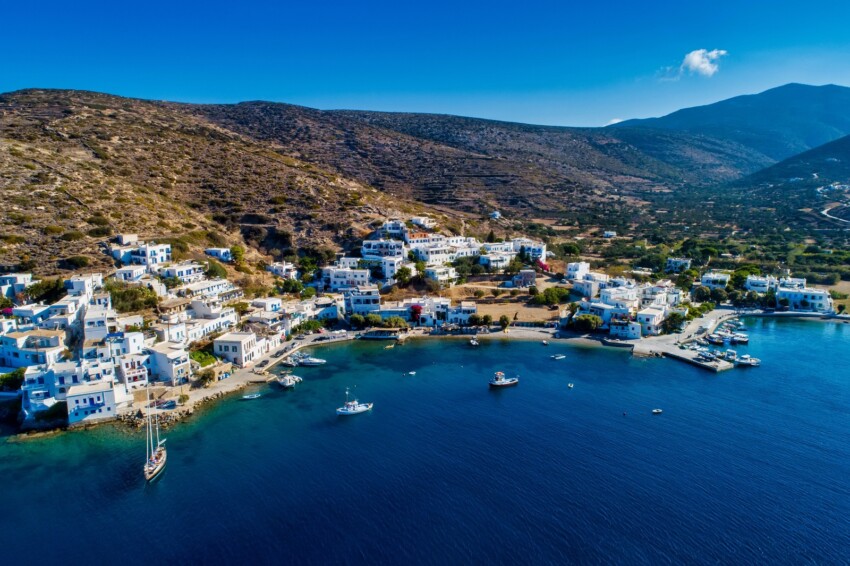
Just 150 metres from the sandy beach of Aegiali in Amorgos, the Cycladic-style Pelagos offers air-conditioned rooms with free Wi-Fi and balcony overlooking the Aegean Sea.
Book now
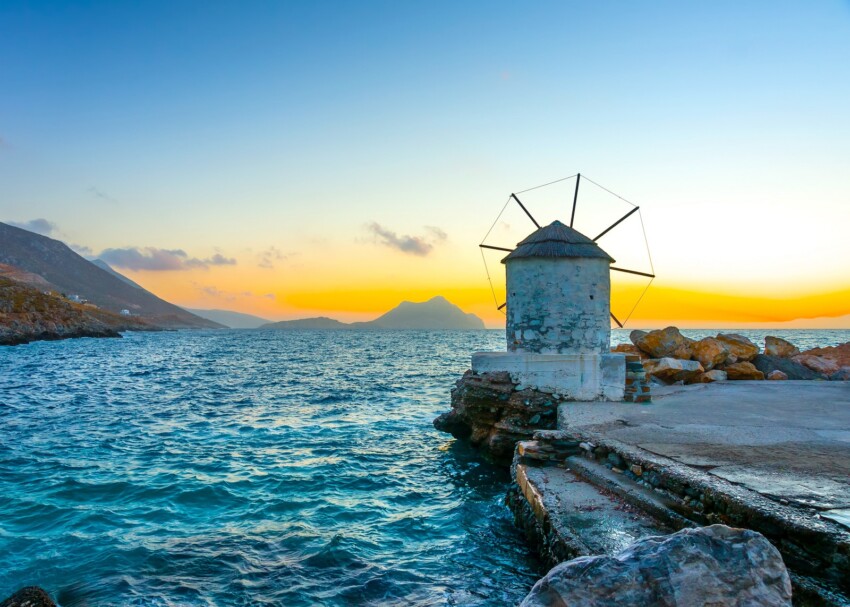
Amorgos is the easternmost island of the Cyclades, a limestone ridge roughly 33 km long and just 2–6 km wide, covering 126 km² with a population of just over 2,000. Located approximately 173 nautical miles (320 km) from Athens’s Piraeus port, it sits between Naxos and the Dodecanese archipelago. Its two main harbours—Katapola in the south-central area and Aegiali to the north—along with the capital Chora, perched on a medieval hilltop inland, define the human geography of an island without an airport, accessible only by sea.
Amorgos owes its international fame to Luc Besson’s film The Big Blue (1988), partially shot in the tiny cove of Agia Anna and around the wreck of the Olympia in Kalotaritissa Bay to the south. Since then, the island has become a reference point for those seeking an authentic alternative to the Cyclades’ more commercialised destinations: no beach clubs or motorways here, but ancient pathways, waterfront tavernas, a monastery carved into the rock itself, and a sea so intensely cobalt-blue that at certain points it seems almost unreal.
The landscape is harsh and vertical: Mount Krikelos, the island’s highest peak at 821 metres, dominates the ridge running north to south. The eastern coast is a succession of sheer cliffs plunging into the sea; the western side is gentler and home to sandy beaches. Those undeterred by winding roads and persistent winds—the summer meltemi blows hard, especially across the ridges—will find an island capable of leaving a lasting impression for years.
Plan to spend at least 4–5 days on Amorgos to explore it properly: fewer than three nights simply won’t give you a true sense of this place.
Amorgos concentrates its main attractions across three areas: medieval Chora at the centre, the Monastery of Hozoviotissa on the eastern coast, and the Aegiali region to the north. Archaeological sites, mountain villages, and wild beaches round out an offering that extends far beyond simple seaside tourism.
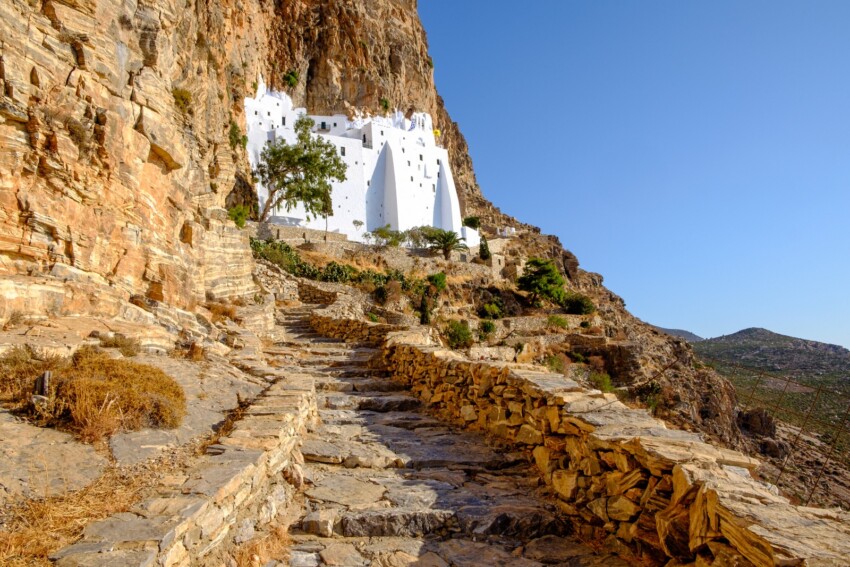
The Monastery of Panagia Hozoviotissa is the most sought-after and most photographed attraction on Amorgos, and one of the Aegean’s most extraordinary religious sites. Built in 1017 and later expanded in 1088 at the behest of Emperor Alexios I Komnenos, it is literally carved into a rocky cliff face 300 metres sheer above the sea on the island’s eastern flank. Just 40 metres long and a mere 5 metres wide, the brilliant white structure develops its eight storeys vertically, using the rock itself as a supporting wall—it is Greece’s second-oldest monastery.
Tradition holds that an icon of the Virgin Mary from 812 AD is safeguarded here, having survived destruction during the Iconoclastic period and arrived by sea from Palestine. Access involves climbing more than 300 stone steps—the ascent is well-ventilated and not particularly strenuous, but wear shoes with non-slip soles as the stone is smooth. At the entrance, a low doorway carved into the rock welcomes visitors with unchanged hospitality: the three monks here offer a glass of psimeni raki, a local herbal and honey liqueur, accompanied by traditional sweets. Entry is free, though donations are welcome.
Shoulders and knees must be covered during visits; alternative garments are provided at the entrance if needed. Opening hours are 8:00–13:00 and 17:00–19:00. On 21 November, the Feast of the Presentation of the Virgin, the monastery hosts a procession of the icon through island villages, followed by a communal celebration with local food and wine. The late afternoon slot (around 17:30) is recommended: your visit concludes in time for sunset over Chora.
Chora—also simply known as Amorgos Town—is the island’s capital, strategically positioned inland to escape the pirate raids that plagued this corner of the Aegean for centuries. It’s a compact maze of whitewashed houses, narrow alleyways barely wider than a man’s shoulders, Byzantine churches tucked between walls, time-worn stone staircases, and terraces overlooking a panorama that on clear days embraces the Small Cyclades.
The village is dominated by the Venetian Kastro, built in the 13th century using a technique where houses nestle against one another to form a continuous defensive perimeter wall—a system typical of medieval Cycladic settlements. Around the Kastro stand characteristic traditional windmills, dormant for decades but still perfectly preserved in the landscape. Chora is also the best spot for sunset: from the vantage points along the ridge, when the wind permits, the sun descends behind the silhouettes of islands on the horizon in light that shifts every minute.
The town comes moderately alive in the evening: there are stylish bars open late, some local craft and jewellery shops, and good tavernas where you can eat well without spending much. Katapola is only 5 km away, a 10-minute drive or local bus ride.
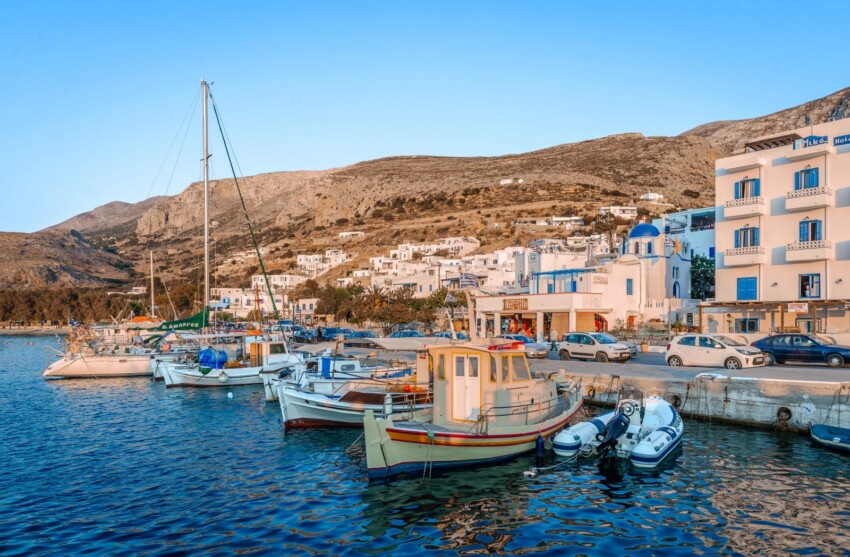
Aegiali is the island’s second harbour and the most tourism-ready area. The bay opens onto a 600-metre sandy beach sheltered from prevailing winds, with shallow water in the shallows and a line of tavernas and hotels just steps from the shore. Compared to Katapola, Aegiali has more venues and a slightly livelier evening atmosphere.
Yet Aegiali’s most appealing aspect lies in the mountain villages that overlook it: Tholaria and Langada are reached on a roughly 30-minute walk from the harbour or by bus. Tholaria commands a view over Aegiali Bay that many regard as among Greece’s finest; Langada is where most locals live, complete with its kafenion, dry-stone walls, and cats. The village of Potamos, part of Aegiali, is white, peaceful, and virtually devoid of tourists. The numbered paths linking these villages—particularly Trail 1, which descends from Aegiali to the Monastery of Hozoviotissa via the abandoned village of Asfontilis—rank among the Cyclades’ finest walks.
Near Katapola, on a hilltop accessible via a roughly 20-minute uphill walk from the harbour (or by car on a paved road), lie the remains of Ancient Minoa, one of three city-states that shared control of the island in antiquity alongside Aegiali and Arkesini. Human settlement on Amorgos is documented from the Cycladic period (3000–2000 BC): the most important Cycladic figurines now kept at Athens’s National Archaeological Museum come from this area, including the largest such figurine ever discovered.
The site has no interpretive panels and visible structures are limited—perimeter walls, building remains, necropolis traces—but the view over Katapola harbour and surrounding bay is spectacular and alone justifies the climb. The remains of Ancient Arkesini in the island’s south, accessible from the village of Vroutsi, include a well-preserved 4th-century BC defensive tower.
Amorgos has a network of over twelve marked trails, eight of which are officially numbered with wooden signage. The most celebrated is the Palia Strata (Trail 1), the ancient route linking Aegiali to Chora before the paved road was built: roughly 14 km with 800 metres of uphill elevation, passing through the abandoned villages of Potamos and Asfontilis and a small monastery preceding Hozoviotissa. Another unmissable walk leads to the Monastery of Profitis Ilias, at 698 metres altitude, with panoramic views encompassing the entire island and the Small Cyclades. The path departs from Chora and takes about an hour’s walking.
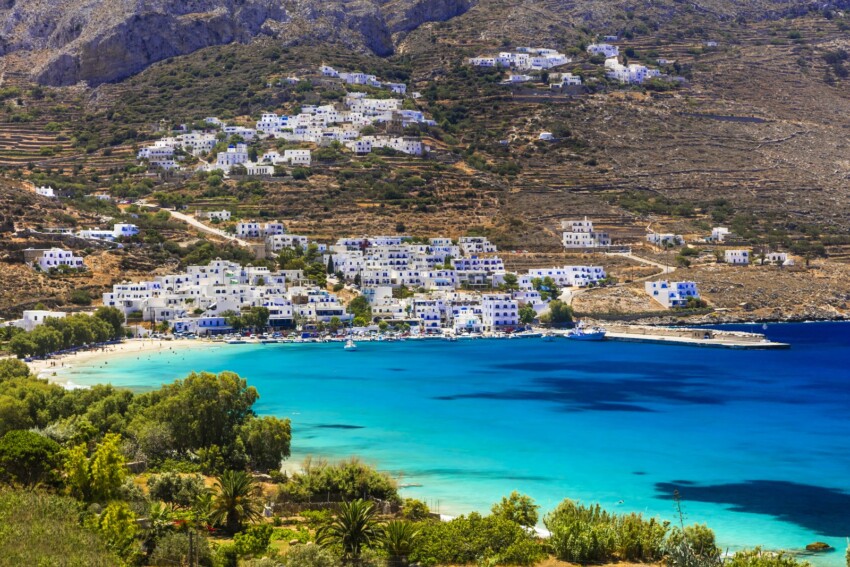
Amorgos’s beaches are wild, often difficult to reach, and rarely crowded. Variety is their strength: pebble coves with deep waters ideal for diving, long stretches of white sand, islets reachable by boat. The eastern coast is almost entirely vertical cliff, whilst the most accessible beaches cluster around Aegiali to the north and the southern Kato Meria zone.
Agia Anna is Amorgos’s most famous beach and probably the most photographed in the eastern Cyclades. Small, dark-pebbled with flat stones, it sits directly below the Monastery of Hozoviotissa, its water a cobalt-blue that, looking seaward, seems almost artificial. Iconic scenes from Luc Besson’s The Big Blue were filmed here, transforming the cove into a sort of secular pilgrimage site for film enthusiasts. It’s not ideal if you want a comfortable day with loungers and bars, but it’s an essential stop: even 30 minutes for a swim and a photo with the monastery looming on the rock above suffice. Reach it by car or bus from Chora, following the Agia Anna turnoff after the monastery junction.
Mouros is the beach visitors to Amorgos remember most vividly. Located on the southern coast between Chora and Kato Meria, it’s reached by car down a steep winding road to a spacious car park, then on foot to the sea. The seabed is strewn with colour-shifting pebbles—grey, beige, white—with rocky outcrops breaking the water’s surface and sea caves inviting snorkelling. The water is crystalline and an intense turquoise, among the island’s deepest blues. Above the car park sits a taverna with extraordinary sea views: the perfect spot to lunch before or after your swim. Expect no beach facilities: Mouros remains essentially wild.
Aegiali beach, also known as Ormos, is Amorgos’s only beach with umbrellas and loungers. It stretches roughly 600 metres of fine sand sheltered by the bay, with shallow water near shore, ideal for families with small children. Behind the beach are tavernas, bars, and hotels just steps from the water. It’s not the island’s most spectacular beach, but it’s the most convenient and liveable if you want to spend an entire day by the sea without moving around. From Aegiali, you can reach the more secluded beaches of Levrosso and Psili Ammos on foot in 10–20 minutes via a marked trail—far less crowded and equally beautiful.
Agios Pavlos is a tongue of white pebbles tapering into open water, with turquoise depths that shift colour with the light. Located midway between Aegiali and Chora, it’s a five-minute drive or bus ride away. It has a small car park and a taverna and snack bar nearby.
Agios Pavlos’s claim to fame is the regular caïque service to the islet of Nikouria: uninhabited, with wild goats roaming freely across the rocks and a sandy beach that’s almost always empty. The boat service costs just a few euros and runs frequently in summer. Nikouria is one of Amorgos’s most memorable experiences: a place where, even in August, you feel like you have the world to yourself.
Kalotaritissa sits at the island’s far southern tip, in a sheltered inlet that remains accessible even on days when the meltemi blows strongly elsewhere. The beach is a blend of sand and pebbles, with shallow, child-friendly waters, and a small seasonal bar. The road from Kato Meria is paved but narrow and winding. Along the way, to the right, you’ll spot the wreck of the Olympia, the sunken ship used as a set piece in The Big Blue‘s opening sequence: a detail few tourists notice but film fans won’t want to miss. Kalotaritissa is worth the journey for tranquillity alone: even in peak season it’s far quieter than the more famous beaches.
Maltezi is Katapola’s most accessible beach and a local favourite. Reachable on foot from the harbour in roughly 20 minutes via the path hugging the bay’s left side beyond the main pier—a level, scenic walk doable even in flip-flops—it features mid-sized pebbles, some shady trees offering sun shelter during midday hours, and crystalline water with gradually shelving seabed. It has a few fixed umbrellas and a small seasonal kiosk.
Views from the beach sweep across Katapola Bay with moored boats and village profiles beyond—a calm panorama far removed from the bustle of busier destinations. For ferry arrivals without a rental car, Maltezi is the simplest answer to that afternoon craving for a swim.
In the following map you can see the location of the main places of interest mentioned in this article.
Katapola is the ideal base for those wanting to explore the whole island: it has the most ferry connections, essential services and an authentic Greek port atmosphere. The Xylokeratidi district, to the left of the port, is home to several waterfront tavernas and family-run guesthouses where prices remain reasonable even in high season. Accommodation is predominantly small-scale – studios, apartments and pensions – without large chain hotels.
Aegiali offers the widest choice of structured accommodation: boutique hotels like the Aegialis Hotel & Spa with swimming pool and thalassotherapy centre, holiday homes with bay views and more budget-friendly options near the port. It’s the right area for those wanting the beach within reach and a few extra amenities. Chora has very few tourist facilities, but staying here – amongst whitewashed alleyways and wind sweeping across the peaks – is an extraordinarily romantic experience. Those seeking absolute tranquillity can choose Kato Meria, the southern part of the island, with minimal services but immediate access to Mouros and Kalotaritissa beaches.
In all cases, booking well in advance is essential for July and August: accommodation is limited and tends to sell out weeks ahead.
We offer a selection of hotels at Amorgos to suit all categories of travellers. The most booked by tourists are the sea-facing hotels, often right on the beach. If you want to play it safe, choose one of the following: they are among the most booked hotels in Amorgos, sorted by number of reviews.
If you prefer space, privacy and the ability to prepare your own meals to a hotel holiday, book a holiday home at Amorgos. We recommend a few below, but in this case we advise you to book early because houses and apartments for rent at Amorgos are in high demand.
Amorgos has no airport: the only way to reach it is by sea. The nearest airports with direct flights from the UK are Mykonos, Santorini and Athens. From Santorini, Seajets fast ferries reach Katapola in approximately 1 hour 30 minutes; from Mykonos, crossings take 2-3 hours depending on the route. From these ports you can avoid the longer crossing from Piraeus, particularly recommended in summer when services are more frequent.
The main route is from Athens Piraeus port, served year-round by Blue Star Ferries. Conventional ferries take between 8 and 9 hours 40 minutes to reach Katapola; high-speed vessels cover the same distance in around 4 hours 40 minutes. In summer there are up to 2 daily departures; in low season this reduces. Ferry tickets start from around €52 per person for deck seating; fast ferries cost between €82 and €95. It’s advisable to book in advance, especially for July and August, and arrive at Piraeus port at least an hour before departure: it’s an enormous port and gates E6, E7 and E9, from which Cyclades ferries depart, are far apart.
Amorgos has two ports: Katapola (the main, busier and better-connected port) and Aegiali to the north. Not all ferries call at both, so it’s important to check your port of arrival when booking. Katapola is the best choice for those wanting to explore the whole island; Aegiali is convenient if staying in the northern area. Between the two ports is approximately 21-24 km of road and 25-35 minutes’ journey time. Small Cyclades Line operates Monday to Saturday, connecting Naxos with both Amorgos ports via the Small Cyclades.
The island has a bus service (KTEL Amorgos) connecting Katapola with Chora, Hozoviotissa Monastery, Agia Anna and Aegiali; in summer services increase and also cover some main beaches. An average ticket costs between €2 and €5 per journey. Buses are useful for main routes, but timetables can vary: always check the updated schedule upon arrival.
Car hire is highly recommended for those wanting to explore the island without timetable constraints, reach the southern beaches (Mouros, Kalotaritissa) and drive the scenic road that crosses the entire ridge. Scooter hire is not recommended in the northern part of the island when the meltemi wind blows strongly: wind-exposed roads along the ridges can be dangerous for two-wheelers. Quad bikes are a safer and more versatile alternative, at around €15-20 per day. Taxis are scarce: in high season book in advance, especially at ferry arrival times: the Katapola-Chora journey costs around €15-20.
The best time to visit Amorgos is June and September: the sea is warm, ferries run regularly, facilities are open but tourist numbers are far lower than in mid-summer. Daytime temperatures hover around 25-28°C, with sea temperatures around 24-26°C.
July and August are the busiest and hottest months (temperatures often exceeding 32°C), with the meltemi blowing more persistently – a feature particularly pronounced on Amorgos compared to other Cyclades, due to the island’s mountainous terrain. Strong winds can make navigation to certain beaches difficult and turn mountain days into an adventurous experience. May and October are quiet months with lower prices, ideal for trekking, but some tourist facilities may already be closed. In winter the island is virtually deserted, with only one ferry per week and few services operating.
What's the weather at Amorgos? Below are the temperatures and the weather forecast at Amorgos for the next few days.
Amorgos is located in the south-eastern part of the Cyclades archipelago, approximately 320 km from Piraeus port in Athens and 30 km south-east of Naxos. To the east, the sea opens towards the Dodecanese Islands. The nearest islands are the Lesser Cyclades (Koufonisia, Schinoussa, Iraklia and Donoussa), reachable by ferry in less than an hour.
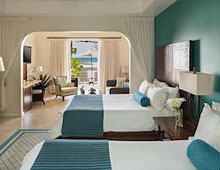 Hotel
Hotel 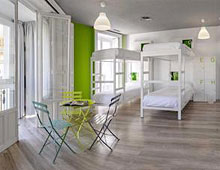 Budget accommodations
 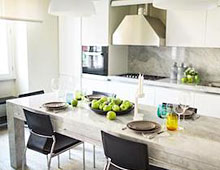 Apartments
  Family Hotel
 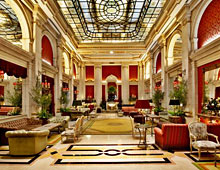 Luxury Hotel
  Resorts