Poseidon Hotel Suites
Things to do in Mykonos, the queen of the night, after the club music has died down and before it’s time for drinks on the beach?
Mykonos’ reputation as a destination for young party-seekers does not do justice to the island’s many attractions, starting with its beautiful beaches. Apart from the party beaches beloved by the night-owl, there are also remote beaches for those seeking tranquillity and equipped beaches ideal for families with small children.
The cultural offer is no less impressive, with interesting and well-kept museums of history, art and folklore; boat trips to the ruins of Delos, the sacred island of Apollo and Artemis, depart from Mykons.
Dedicate some time of your holiday to the eclectic Mykonos Town, the island’s capital, which with its clubs and enchanting views is capable of enchanting the night crowd as much as romantic couples on a romantic getaway, after which visit a traditional village such as Ano Mera.
Of all the tourist attractions on the island, we have selected for you the things not to miss in Mykonos.
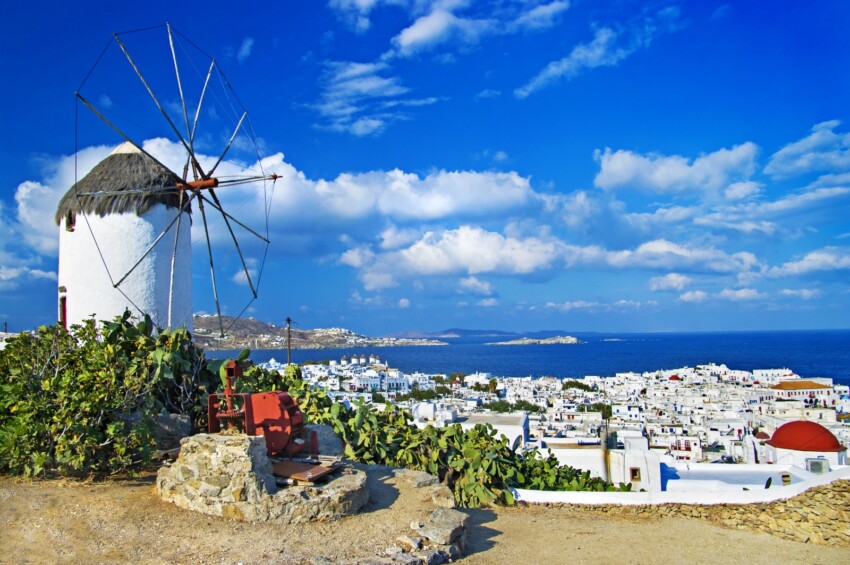
Chora, Hora or Mykonos Town: whatever you want to call it, the island’s capital and main port is an unforgettable sight. Imagine a cascade of small white houses in a maze of narrow streets and blooming bougainvillea. Add to this idyllic image noisy live music bars that coexist perfectly at ease with expensive jewellery shops, trendy art galleries, exclusive boutiques and souvenir shops and you get an idea of the eclecticism of Mykonos.
The town has successfully – and continues to – cater to travellers as diverse as young groups of friends, couples on romantic holidays and solo travellers.
Matoyianni Street is the main shopping and nightlife artery, where luxury boutiques alternate with traditional taverns and souvenir shops. Despite the influx of tourists, the neighbourhood retains its authenticity: one only has to take one of the many side alleys to find the authentic atmosphere of a Cycladic village, with houses adorned with blooming bougainvillea and cats snoozing in the shade.
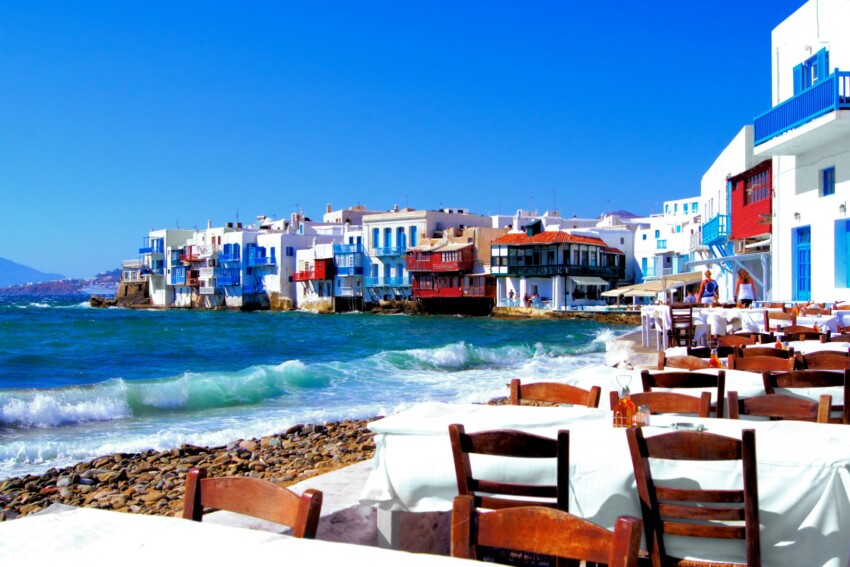
Little Venice is undoubtedly one of the most romantic and photographed neighbourhoods on Mykonos. This magical corner of the island owes its name to the colourful houses built flush with the water, reminiscent of the Venetian palazzi overlooking the canals. Once home to wealthy merchants and ship-owners, these buildings now house some of the island’s most exclusive bars and restaurants.
The peculiarity of this district lies in its unique location: the houses literally seem to ‘float’ on the water, with their balconies jutting out directly into the sea. In centuries past, this configuration allowed the rapid loading and unloading of goods, often to escape the controls of the pirates that infested the Aegean.
The most magical time to visit Little Venice is definitely sunset, when the sun dips into the Aegean Sea, tinging the sky with shades of orange and pink. The bars in the neighbourhood offer cocktails to enjoy with your feet on the water, as the waves gently crash against the foundations of the houses. The atmosphere is so atmospheric that many consider the sunsets of Little Venice to be among the most beautiful in Greece.
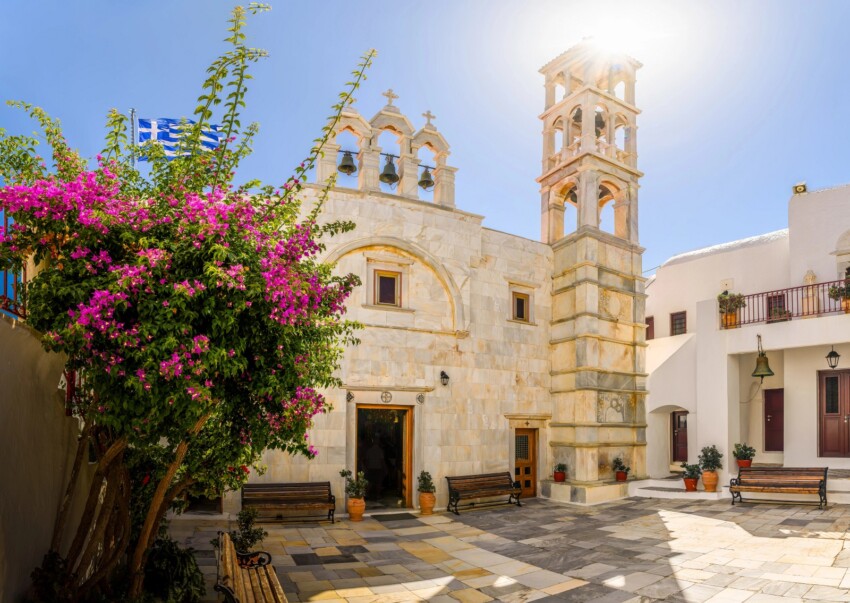
Ano Mera represents the authentic soul of Mykonos, a haven of peace just 8 kilometres from Chora where time seems to stand still. This small inland village is the only significant settlement on the island apart from the capital and offers a completely different experience from the hectic coastal life.
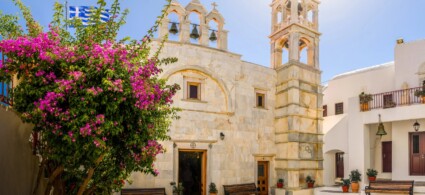
The heart of Ano Mera is its central square, dominated by the Byzantine monastery of Panagia Tourliani, founded in 1542 and dedicated to the Virgin Mary, protector of the island. The monastery houses valuable icons, a carved wooden iconostasis from the 18th century and an ecclesiastical museum that tells the religious history of the Cyclades. The three-bell tower is one of the most photographed architectural elements in the village.
Around the square, the social life of the village unfolds: traditional taverns serve homemade dishes at much more affordable prices than on the coast, local handicraft shops sell ceramics and textiles produced according to ancient techniques, and traditional cafes (kafeneion) host the village elders for their daily social gatherings.
The atmosphere of Ano Mera is that of rural Greece that resists mass tourism: mules and donkeys rest in the shade of trees, well-kept gardens produce fresh vegetables for the taverns, and the rhythm of life still follows that of the agricultural seasons. It is the ideal place for a contemplative break and to sample the authentic flavours of Mykonos cuisine.
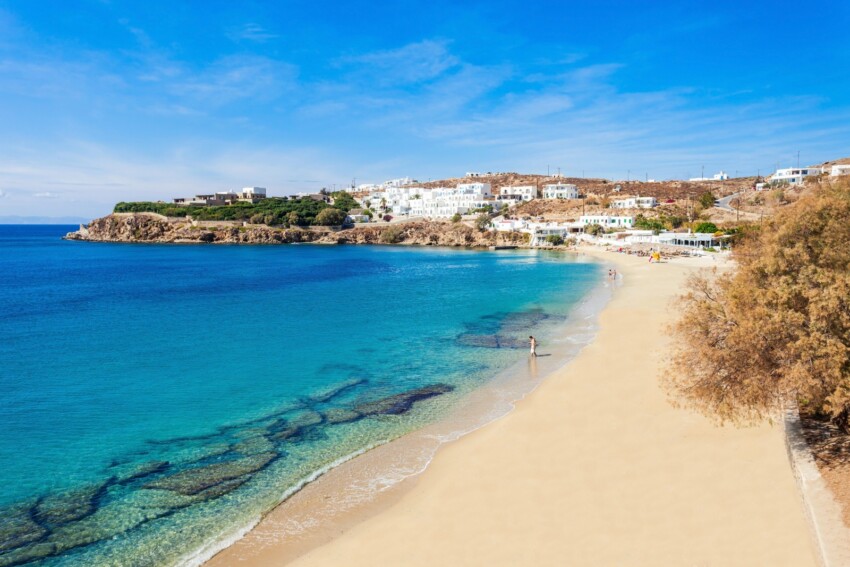
Agios Stefanos and Tourlos are the first towns one encounters going north from Hora, the ancient town of Mykonos, and are located along the north-western coast of the island.
These villages are located 3 kilometres from the island’s capital, have developed around the golden sandy beaches of the same name, and enjoy a wonderful location to enjoy the sublime Mykonos sunsets.
Tourists find both in the beach area and in the hilly area behind the bay many small, high quality hotels, flats, villas, all kinds of services such as car rental, beautiful views and tranquillity.
The bay has shallow crystal-clear waters ideal for children’s play, is well protected from the winds and is dotted with taverns and cafes. The settlement of Agios Stefanos climbs eastwards up the slope to the beach, from which there is a splendid view of the islands of Tinos, Syros and Rinia.
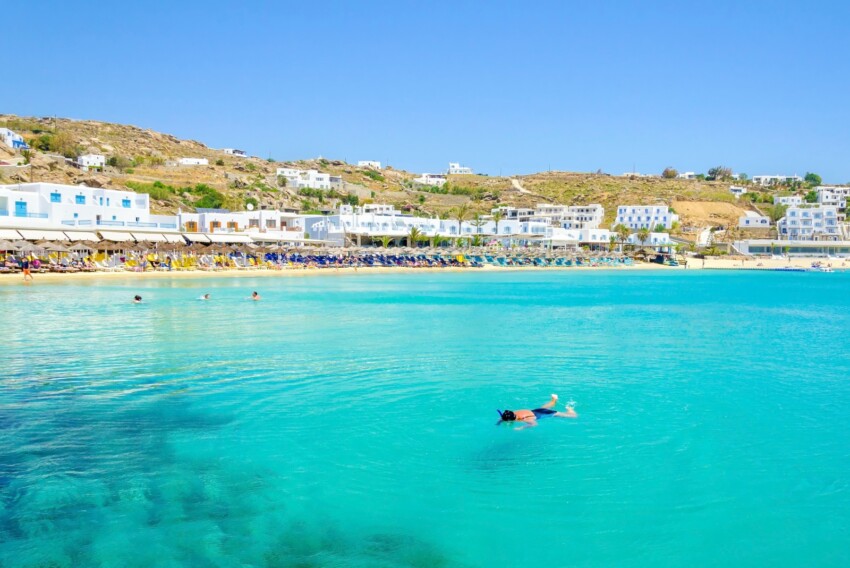
Platis Gialos is one of the best known villages on the south coast of Mykonos. The pleasant ambience, the beautiful sea, the choice of hotels and holiday villages of all categories and the many typical restaurants attract many tourists here during the summer period.
The village of Platis Gialos is located 4 ½ kilometres from Mykonos Town and is built around the sandy beach of the same name.
The town is well connected and when arriving from Hora (the old name for Mykonos Town), one can see that the beautiful bay is actually composed of three smaller beaches: that of Psarou to the right, with the rocky mass of Lazaros to the west; that of Platis Gialos in the middle and, finally, the sandy bay of Agia Anna to the south-east. The landscape is impressive, the resort relaxing and the hills protect the bay from the strong southerly winds.
Despite the development of tourism over the last few years, one can still find typical rural elements, such as old farmhouses and small groves. Finally, it should be noted that on the hill of Platis Gialos, the remains of the ancient ‘Portes’ tower are preserved, an extraordinary monument and symbol of the coastal area.
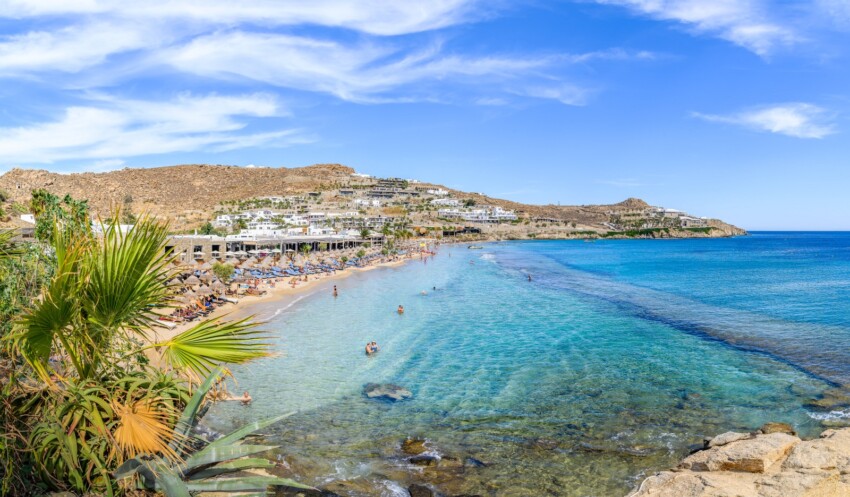
Paradise Beach is undoubtedly the most famous and iconic beach in Mykonos, a symbol of the clubbing culture that has made the island world-famous. This long stretch of golden sand is bathed by crystal clear turquoise waters and protected by the surrounding hills, which shelter it from the strong meltemi winds during the summer months.
The beach is famous for its legendary beach clubs: the Tropicana, nicknamed ‘the Italians’ disco’, where every afternoon the Italian DJ Sasà enlivens the crowds with music and entertainment from 4.30 pm until late at night; the Cavo Paradiso, considered one of the best clubs in the world since 1993, regularly hosting top international DJs; the Guapaloca, famous for its selection of Latin, EDM and reggaeton music; and the Paradise Beach Club, ranked 14th among the world’s best clubs.
But Paradise Beach is not just about partying. In the mornings it transforms into a relaxing oasis, where you can enjoy the Greek sun on comfortable sun loungers or explore the seabed with a mask and flippers. Prices are relatively affordable and the beach also offers free areas for those who prefer to lay their towel on the sand.
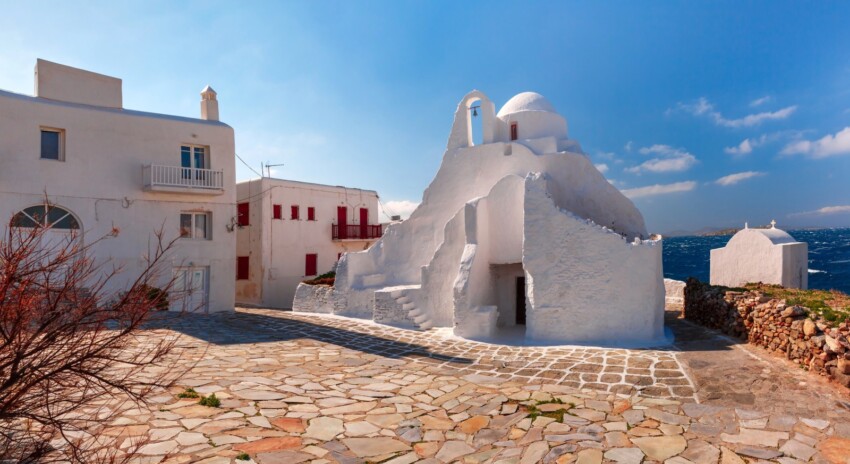
The Church of Panagia Paraportiani is considered one of the most beautiful and photographed religious buildings in Greece. Located in the historical quarter of Kastro, this church is actually a unique religious complex, formed by the union of five small churches built at different times between the 15th and 17th centuries.
The main structure, called Panagia Paraportiani (meaning ‘Our Lady of the Secondary Gate’), rises above the other four churches: Agios Efstathios, Agios Anargiros, Agia Anastasia and Agios Sozon. This architectural configuration creates an extraordinary visual effect, with asymmetrical volumes merging into a single white mass that seems sculpted by the sea breeze.
The architectural style is typically Cycladic: curved, sinuous lines, an absence of superfluous decoration, the dazzling white of the lime reflecting the sun’s rays. The church was built without solid foundations, resting directly on the rock, which gives it an almost organic appearance, as if it had grown naturally from the ground.
The location by the sea makes Panagia Paraportiani particularly striking at dawn and dusk, when the grazing light enhances the soft shapes of the building, creating unforgettable plays of light and shade. Inside, the intimate spaces and semi-darkness invite contemplation, offering a moment of peace away from the hustle and bustle of the centre.
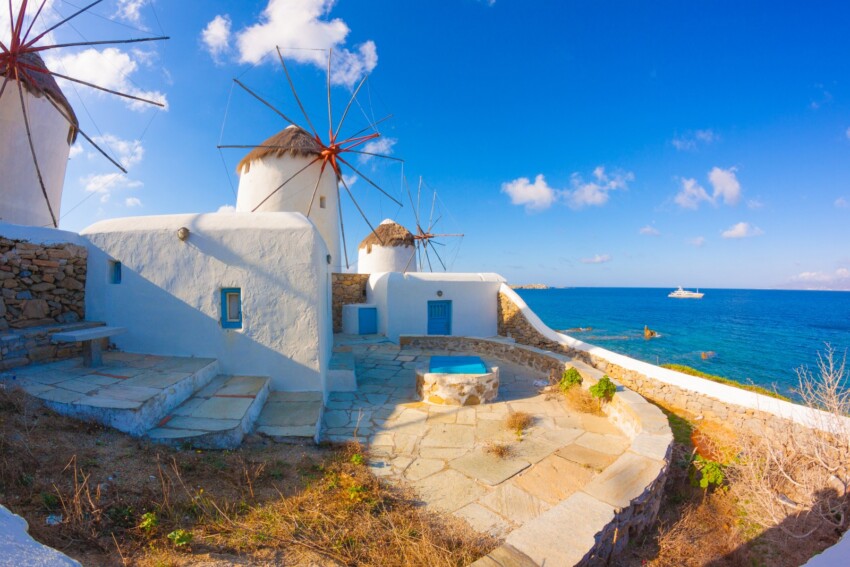
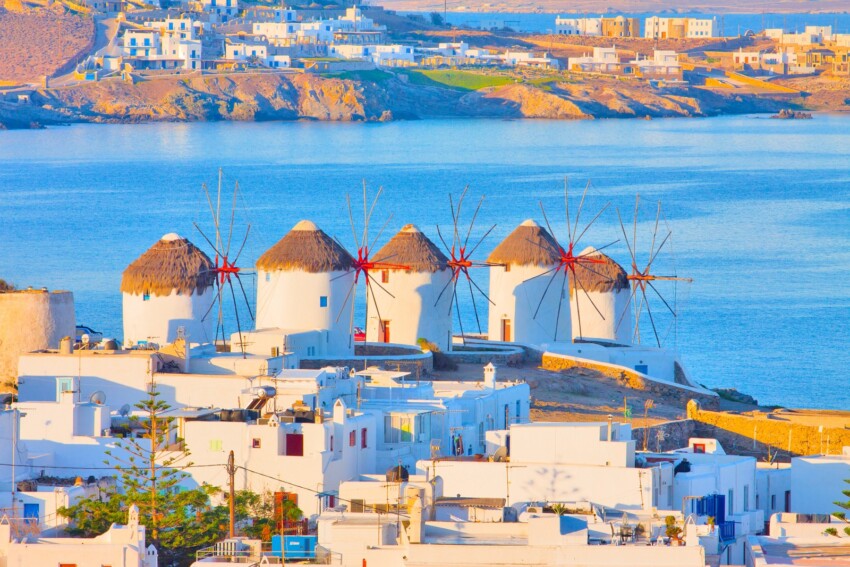
The windmills are the most recognisable icon of Mykonos and one of the most photographed symbols of the Greek islands. These seven conical windmills stand on a small hill overlooking both Chora and Little Venice, offering spectacular views of the whole town and the Aegean Sea.
Built in the 16th century during Venetian rule, the mills were the hub of the local economy for over four centuries. Their job was to grind the grain grown on the island, which was then exported in the form of flour to markets throughout the eastern Mediterranean. The huge wooden paddles took advantage of the strong winds constantly blowing over Mykonos – hence the nickname ‘island of the winds’ – to drive the stone millstones.
Today, the mills are no longer in operation, but one of them has been turned into an ethnographic museum with photographs and explanatory panels in Greek and English that tell of the importance of this activity to the island’s economy. The view from the hill is breathtaking, sweeping from the white houses of Chora to the endless horizon of the Aegean, with the islands of Delos and Rinia emerging from the crystal-clear waters.
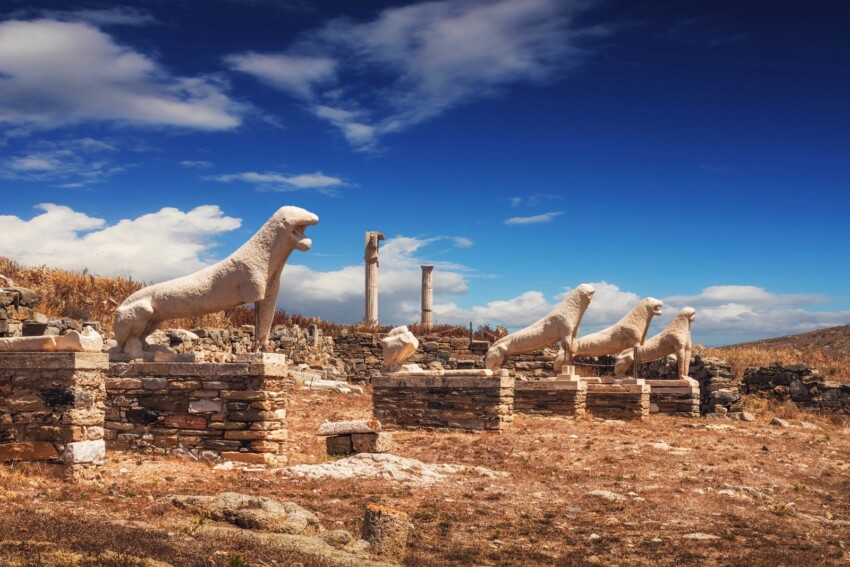
The excursion to Delos is a journey back in time more than 2,500 years and a cultural experience not to be missed during your stay in Mykonos. This small island of just 6.8 km², located a 45-minute ferry ride from the port of Mykonos, is home to one of the most important archaeological sites in ancient Greece.
According to Greek mythology, Delos is the birthplace of Apollo and Artemis, sons of Zeus and Latona. Legend has it that Latona, in order to escape Hera’s jealousy, took refuge on this floating island that Zeus brought up from the waters of the Aegean. From this mythological event derived the sacredness of the place, which became the most important religious centre of the Cyclades.
The archaeological site is extraordinary: the Terrace of the Lions, with its iconic marble statues from the 7th century B.C. donated by the Naxians; the Sanctuary of Apollo with the remains of three temples dedicated to the god of light; the ancient theatre that could seat 5,500 spectators; the patrician houses with magnificent floor mosaics, such as the House of Dionysus, the House of Cleopatra and the House of the Masks.
From Mount Kynthos (113 metres), the highest point on the island, there is a breathtaking view of the Cyclades: Naxos and Syros to the north, Tinos to the south, Mykonos to the east. The site has been a UNESCO World Heritage Site since 1990 and excavations, begun in 1872 by the French Archaeological School, continue to this day.
The catamaran excursion to Rhenia is one of the most exclusive experiences you can have on Mykonos. Rhenia, also known as ‘Great Delos’, is a completely uninhabited island accessible only by sea, making it a small, unspoilt paradise far from the tourist crowds.
The island is characterised by turquoise bays of disarming beauty, with waters so crystal-clear that one can see the seabed even several metres below the surface. The white sandy beaches are completely wild, without any tourist facilities, offering an authentic experience of contact with unspoilt Mediterranean nature.
Catamaran cruises to Rhenia generally depart from the new port of Mykonos and last about five to six hours. During the cruise you can admire the south coast of Mykonos with its famous beaches, pass the archaeological site of Delos and reach the secret bays of Rhenia for swimming and snorkelling stops. A lunch of Greek specialities, local wine and cool drinks is served on board.
The experience is especially magical at sunset, when the sun dips into the Aegean creating golden reflections on the calm waters of the bays. Many excursions include free snorkelling equipment, allowing you to explore the seabed rich in Mediterranean fish and discover hidden sea caves.
The small island of Dragonisi, also known as Tragonisi, is located one and a half kilometres east of the east coast of Mykonos, and six and a half kilometres from the bay of Kalafatis. The islet is a true paradise, especially for scuba-diving enthusiasts.
Rocky and uninhabited, this island is a popular destination for boat trips due to its beautiful seabed and magnificent sea caves. Of the spectacular natural rock formations, carved out over thousands of years by the waves, the most famous is Sigillo Cave, accessible only to experts.
Dragonisi is a protected nature reserve, part of the Natura 2000 project, and is the refuge of the monk seal, which if you are lucky you may encounter during your visit, and habitat of the yellow sea anemone.
The island also has a small, unspoilt sandy beach surrounded by high cliffs.
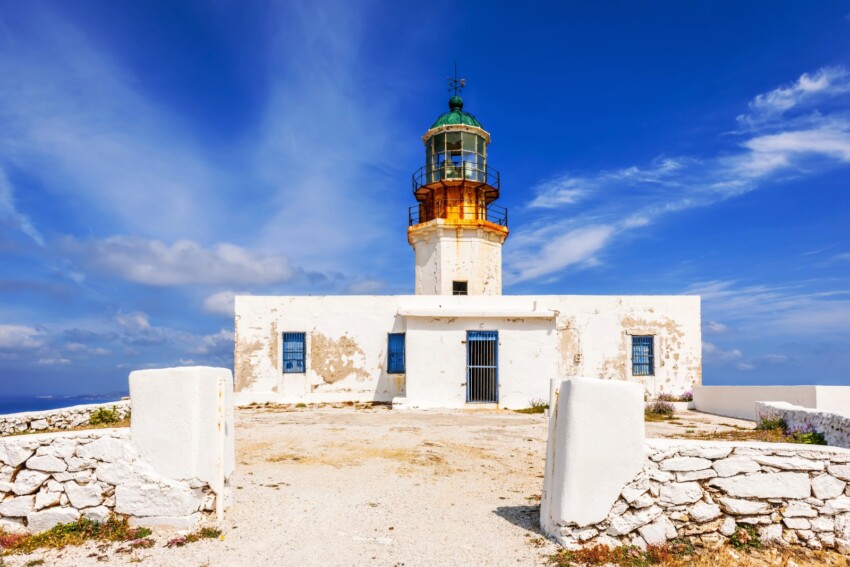
The Armenistis Lighthouse represents one of the most authentic and scenic experiences Mykonos has to offer. Located on the north coast of the island, this historic 19th century lighthouse stands on a rocky promontory offering spectacular views of the entire North Cyclades archipelago.
The road to the lighthouse is an adventure in itself: a dirt track of about 4 kilometres traverses the barren and windy landscape of the northern part of the island, characterised by granite rocks sculpted by wind and salt. The path, which can be travelled by car or scooter (with caution), offers breathtaking panoramic views of the northern Aegean Sea.
The lighthouse itself, although no longer in perfect condition, retains an irresistible charm. Its white tower stands out against the deep blue sea, creating a colour contrast that has inspired generations of photographers. From the base of the lighthouse, the view sweeps 360 degrees: to the south you can see the white houses of Mykonos Town and the windmills, to the north the islands of Tinos and Andros emerge from the crystal-clear waters.
The most magical time to visit Armenistis is definitely sunset, when the sun dips into the endless horizon tinging the sky with shades of orange and pink. The feeling of being at the ‘end of the world’ is amplified by the almost absolute silence, broken only by the sound of the waves breaking on the rocks below.
Don’t be surprised if wandering around the island’s capital you come across a group of… free pelicans!
The pelican Petros was the island of Mykonos’ mascot for many years. Having arrived from who knows where in 1954, he lived for over 30 years on the capital’s seafront, earning the affection of the islanders.
When he died, the grief for his loss was so great that it was decided to take in more pelicans, a custom that has been consolidated over time so that pelicans are now a true symbol of Mykonos.
In the following map you can see the location of the main places of interest mentioned in this article.
 Hotel
Hotel  Budget accommodations
  Apartments
  Family Hotel
  Luxury Hotel
  Resorts