From the crystal-clear waters near Pafos, Aphrodite, the goddess of love and beauty, was born. This legend contains the two ingredients of the tourist success of the most important town on the west coast of Cyprus: myth and scenery.
Also called Pafo or Paphos, it is divided into two: Kato Pafos (lower town) and Ktima Pafos (upper town). The lower town is the more touristy one, with streets clogged with bars and souvenir shops. However, one only has to leave the main streets and explore the secondary ones, ignored by tourists, to discover hidden treasures such as medieval baths, catacombs and small churches.
In the upper town, one breathes a completely different atmosphere. Life has been the same for centuries, punctuated by small daily rituals. It is an area rich in cultural attractions: the city’s main museums and splendid colonial buildings that now house government offices are concentrated here.
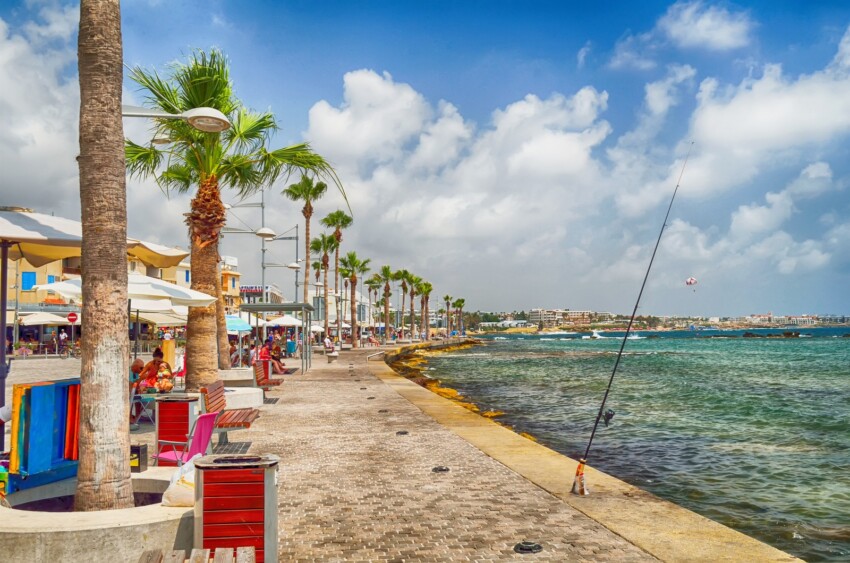
The coast of Pafos is a succession of sandy shores and inlets, with beaches to suit all tastes: small and large, free and equipped, within walking distance of the centre or remote. The sea is a seductive blue.
The sites of Aphrodite and the magnificent beaches would be enough to attract droves of tourists, but Pafos also boasts an archaeological site that earned it the title of European Capital of Culture in 2017 (along with Aarhus in Denmark). With a holiday in Pafos, you certainly won’t have the problem of how to fill your days.
Pafos beaches
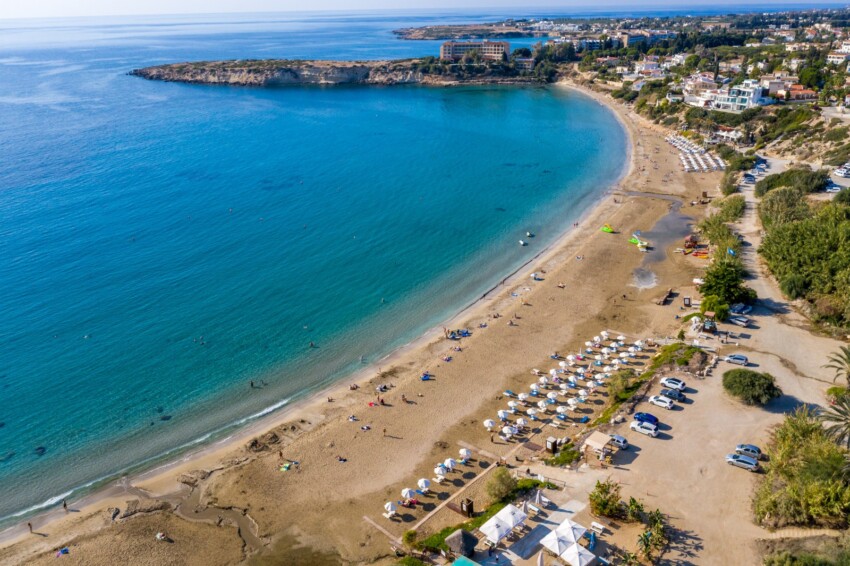
Coral Bay, a few kilometres from Pafos
The municipal beach in the centre of Pafos and Vrysoudia, another town beach, are convenient options for a few hours of relaxation in the sun, but there are much better beaches nearby.
Coral Bay, considered the most beautiful beach on the entire west coast of Cyprus, is only 12 km from Pafos. A gently curving cove, golden sand, calm, transparent waters: it is perfect for hours of relaxation or water adventures. It is an equipped beach, with umbrella rental and kiosks.
Just 8 km north of the centre is Kissonerga, a long sandy beach surrounded by banana plantations and little else. It is a free beach, with few facilities nearby, perfect for those seeking solitude and nature.
Further away (about 27 km) is the enchanting Lara Beach, a wild beach of fine sand set in a horseshoe-shaped bay. Caretta caretta turtles choose it to make their nests: be respectful of the delicate ecosystem here.
The best family beach in Paphos is Alykes Beach: easy to reach from the centre and with all amenities, it alternates between sandy and rocky stretches. The waters are calm and clean.
If you are looking for romantic glimpses and postcard views, here are the best beaches to watch the sunset: Akamas Beach, Chloraka, Ayios Georgios, Kissonerga, Coral Bay and the birthplace of Aphrodite. Other beaches not to be missed in and around Pafos are Blue Lagoon, Yiannakis Beach and Geroskipou Beach.
Don’t miss a boat trip during your holiday to admire the numerous sea caves dotted along the coast of the Pafos region.
The sites of Aphrodite
Traces of the thousand-year-old cult of Aphrodite are scattered all over the island: here are the most interesting and significant places.
Birthplace of Aphrodite
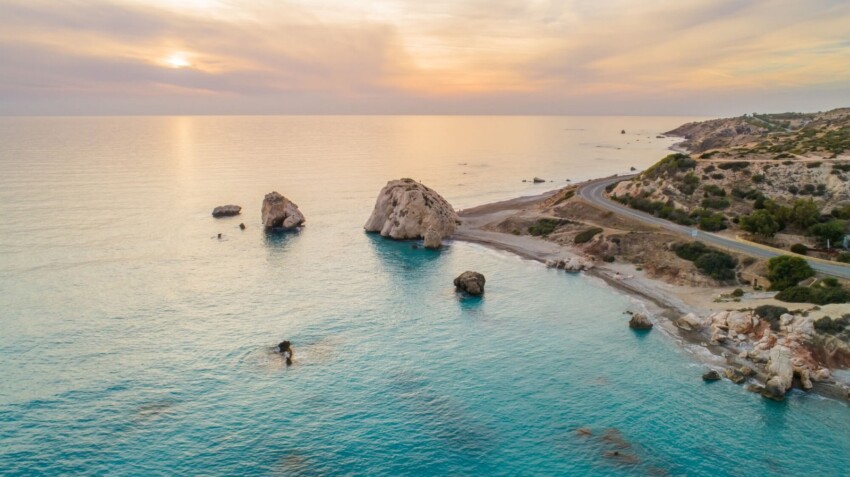
Petra tou Romiou
Were it not for the goddess, Petra tou Romiou would be famous as the most beautiful beach on Pafos; instead, myth has made it famous as the birthplace of Aphrodite. According to Greek mythology, this is in fact the spot where the goddess of love and beauty emerged from the sea.
Not a bad choice: the waters bathing this enchanting bay are azure blue and transparent, and the huge rock towering above it is imbued with charm and mystery.
Despite being one of the most visited attractions on Pafos, the beach at Petra tou Romiou is a must-see, both for the breathtaking beauty of the landscape and for the suggestion of millennia-old stories and legends, and is generally not too crowded.
You can take relaxing walks, bathe your feet in goddess-worthy waters or take magnificent panoramic photos from the access road. Climbing to the top of the rock is not allowed: this privilege is reserved for the gods of Olympus; swimming is dangerous because of the currents.
Baths of Aphrodite
After seeing where she was born, I went to see Aphrodite’s Baths, a spring of water inside a small cave where the goddess loved to bathe and where her fateful meeting with Adonis took place.
From the car park of Aphrodite’s baths you can also get to a small pebble beach with a small fish restaurant. It is a narrow strip of land lapped by the sea behind a rocky promontory, reached by a short walk.
Aphrodite Trail
Close to the Baths of Aphrodite is the Aphrodite Trail, a 7.5 km looped walking trail around the magnificent Akamas peninsula. The views of the sea and in particular of the Blue Lagoon are spectacular.
The trail is well maintained and does not present any particular difficulties, except for a steep climb at the beginning. Remember to protect yourself from the sun and take plenty of water with you.
Sanctuary of Aphrodite
The Sanctuary of Aphrodite is one of the most historically important sites linked to the myth of Aphrodite and ironically one of the least visited.
The complex includes the remains of a temple and a house both from Roman times, a small shrine and a conical stone representing the goddess before the Roman conquest. The idyllic hilltop location of the village of Kouklia with panoramic views of the sea adds to the charm of this epic site.
In addition to the ancient ruins, you can visit a small museum with exhibits from excavations in the area.
Things to do in Pafos
Beaches and Aphrodite sites are enough to fill an entire holiday, but if you love history and culture, you can add several other attractions to your Pafos travel plan.
Archaeological site Nea Pafos
The top attraction is the archaeological site of Nea Pafos, west of the lower town: here you can see what remains of the ancient city of Pafos, founded in the 4th century BC and once surrounded by massive walls. Conquered by the Romans in 58 AD, it remained the most important political and administrative centre of Cyprus for centuries.
The real wonder of the park is the splendid collection of mosaics that once decorated three luxurious Roman villas on Pafos: the House of Dionysus, the Villa of Theseus and the House of Aion. They are almost all decorated with stories from Greek mythology; the two most famous are the mosaic of Theseus in the Labyrinth and the mosaic of Scylla and Charybdis.
Inside the park you can also admire the remains of the Agora, the Askipieion (dedicated to the god of medicine), a semicircular theatre and the medieval Saranta Kolones fortress.
Tombs of the Kings
The second unmissable attraction in Pafos is another jewel of antiquity: the Tombs of the Kings, a necropolis from the Hellenic and Roman periods so called because of its magnificence.
Seven tombs have been unearthed, scattered over a large desert area close to the sea. The most impressive is number three, with an open atrium below surface level and surrounded by a colonnade.
Their uniqueness lies in the fact that – a rather unusual fact in Greek antiquity – the architecture of these tombs is strongly influenced by Egyptian tradition and the belief that the burial place should resemble the homes of the living.
Panagia Chrysopolitissa Church
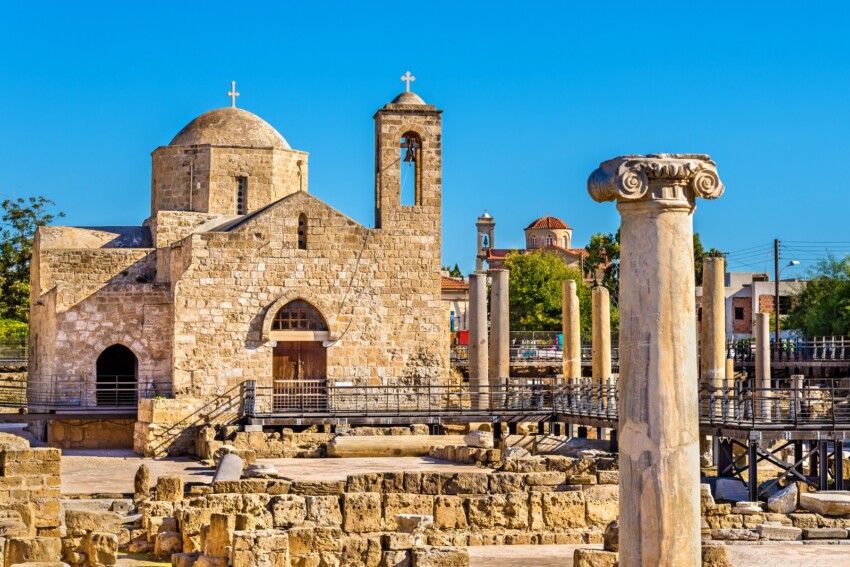
Another important archaeological site in Pafos is Panagia Chrysopolitissa where one can admire what remains of an impressive early Christian basilica: the foundations, a series of magnificent marble columns and some mosaics.
On the west side of the basilica is the Column of St Paul, to which the saint was tied for being whipped. After 39 lashes, it was not he who succumbed but his tormentor, a Roman governor who converted to Christianity.
Other attractions in Pafos
Do you have any time left? Good, because the list of things to see in Pafos can still be lengthened with these attractions:
Agia Paraskevi Byzantine Church
Agia Solomoni Church and Roman Catacombs
Ecclesiastical Museum
Grivas Museum
Ayios Neofytos Monastery
Family-friendly attractions in Pafos include a zoo, water park, donkey tours, jeep safari, go-kart track and easy cycling trails.
Where to stay in Pafos
Pafos offers a wide choice of accommodation, with options to suit all budgets and holiday types.
Families can choose between comfortable holiday homes and flats and good value mid-range hotels. Couples on a romantic getaway will find adult-only hotels that guarantee discretion, silence and charm. Low-cost travellers will find some good budget options such as family-run guesthouses and hostels. Those looking for luxury and comfort can choose from a couple of exclusive beachfront resorts.
We offer best rates If you find it cheaper we refund the price difference.
Free cancellation Most properties allow cancellation without penalty.
We're available 24 hours a day For any problem call Booking.com.
Recommended hotels in Pafos
We offer a selection of hotels at Pafos to suit all categories of travellers. The most booked by tourists are the sea-facing hotels, often right on the beach. If you want to play it safe, choose one of the following: they are among the most booked hotels in Pafos, sorted by number of reviews.
If you prefer space, privacy and the ability to prepare your own meals to a hotel holiday, book a holiday home at Pafos. We recommend a few below, but in this case we advise you to book early because houses and apartments for rent at Pafos are in high demand.
Pafos has an international airport connected to some European cities by low-cost and charter flights. From the airport you can easily reach the town centre, only 6 km away, by shuttle bus.
If the airport of departure is not convenient for you to reach, there are two options: fly to Larnaca, the other international airport on the island of Cyprus, or arrive in Pafos with a stopover in a European city.
You can also reach Pafos from Larnaca airport by bus via Limassol: the journey time is about 50 minutes, with a run every hour or so.
Pafos Weather
What's the weather at Pafos? Below are the temperatures and the weather forecast at Pafos for the next few days.
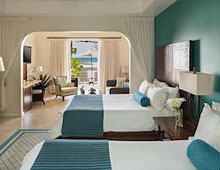 Hotel
Hotel 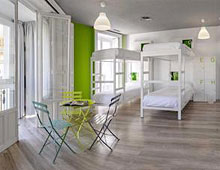 Budget accommodations
 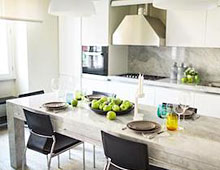 Apartments
  Family Hotel
 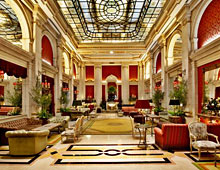 Luxury Hotel
 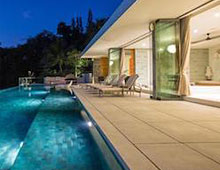 Resorts