Maritina Hotel
Kos Town - L. Vironos Street 19
Located in the centre of Kos Town, Maritina Hotel offers comfortable accommodation close to the island's attractions such as Kos Castle.
Book now
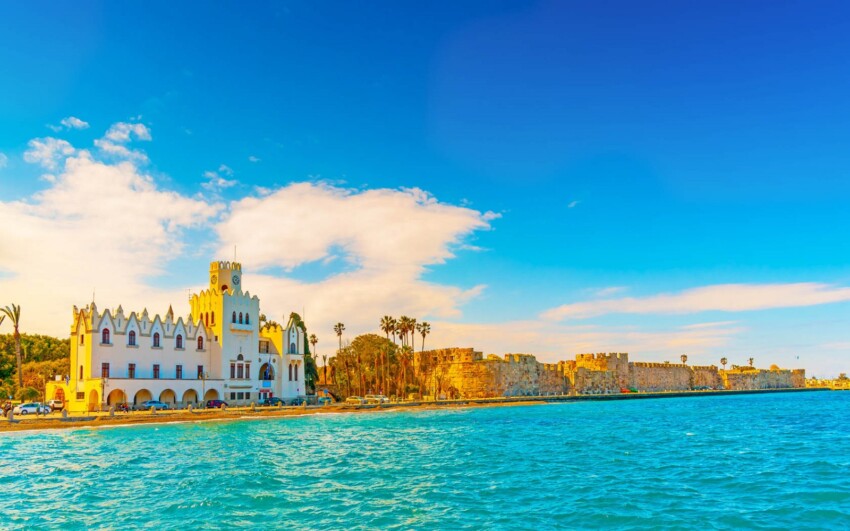
Kos Town, the capital of the Dodecanese island of the same name, is the beating heart of one of the most popular tourist destinations on the Greek islands. With a population of 17,000, this charming port town perfectly combines the thousand-year-old historical heritage with the modern conveniences of an international tourist centre.
The city is characterised by its unique urban layout, where the medieval historical centre blends harmoniously with the modern districts developed after the 1933 earthquake. The wide tree-lined streets, designed during the Italian occupation, create a unique Mediterranean atmosphere that distinguishes Kos Town from other Greek cities.
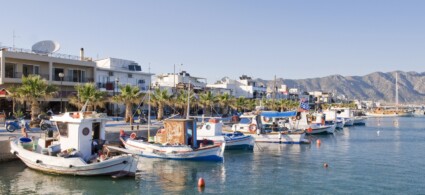
The marina, the arrival point for thousands of visitors coming to the island by sea, offers a breathtaking panorama with its crystal-clear waters and a view of the Turkish coastline just 4 kilometres away. The strategic location in the Aegean Sea has made Kos Town a crossroads of cultures since antiquity, a legacy still visible today in the architecture and local gastronomy.
The island’s capital offers an extraordinary cultural and historical heritage spanning more than 2,500 years. From the ruins of the ancient Greek agora to Ottoman monuments, every corner tells a different story of this borderland.
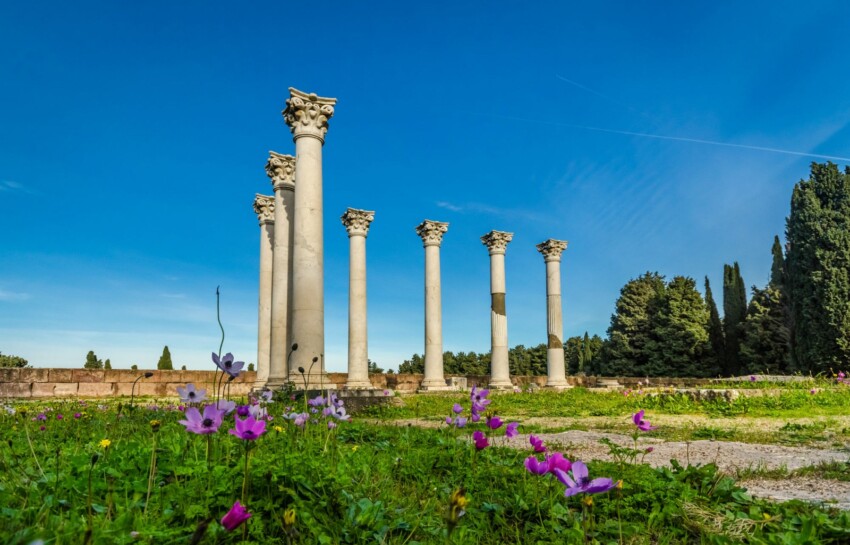
The Asklepion is without doubt the most important archaeological site on the island and one of the best-preserved healing sanctuaries in the Greek world. Located just four kilometres from the town centre, this sacred complex dedicated to the god Asclepius served as a hospital and medical school in antiquity.
The site is spread over three panoramic terraces offering spectacular views of the Turkish coastline. The lower terrace houses the remains of the Hellenistic temple, while the upper terrace preserves the foundations of the Doric temple from the 4th century BC. Here Hippocrates, the father of modern medicine, taught the principles of the medical art that influenced western medicine for millennia.
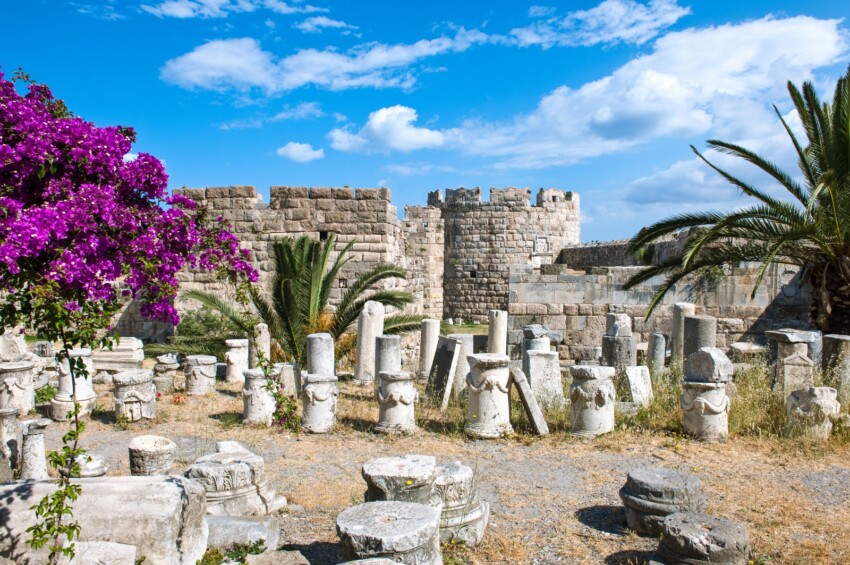
The Fortress of the Knights of St. John, built in the 14th century, dominates the entrance to the old harbour with its mighty limestone walls. This masterpiece of medieval military architecture was erected to protect the island from Ottoman incursions and is one of the best preserved examples of the Knights Hospitaller fortifications in the Dodecanese.
Inside the walls one can admire heraldic coats of arms, Venetian cannons and the remains of the chapel of St. John. The walk along the ramparts offers breathtaking views of the harbour and the modern city. The castle often hosts cultural events and concerts during the summer season, turning into an atmospheric open-air stage.
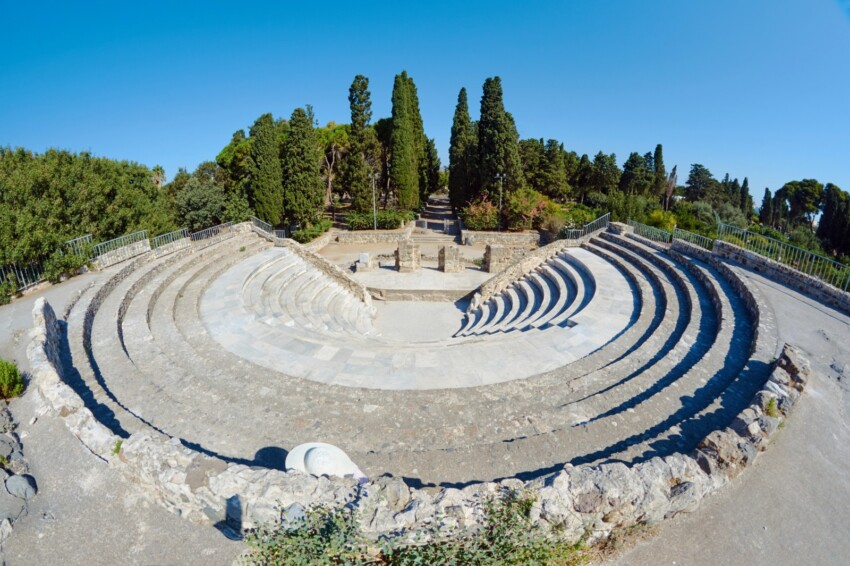
The heart of ancient Kos lies in the archaeological area of the agora, where the remains of the 2nd century A.D. Roman theatre and the ancient public baths intersect. The theatre, with its 750 seats, still preserves part of the original cavea and orchestra in white marble.
The adjacent Roman baths testify to the importance the Romans attached to physical well-being. The polychrome mosaics of the frigidarium and tepidarium depict mythological scenes of rare artistic beauty, while the hypocaust system for heating demonstrates advanced Roman engineering.
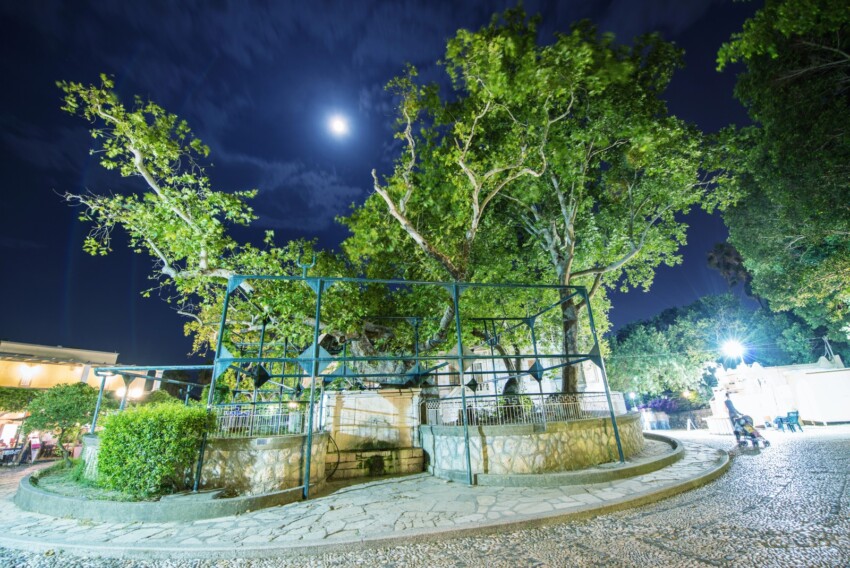
In the heart of the old city stands the legendary Platanus of Hippocrates, a centuries-old tree that, according to local tradition, is the same one under which the great physician taught his disciples. Although the actual age of the tree is around 500 years, this magnificent specimen of Platanus orientalis with its 12 metre circumference is a living symbol of the island’s medical tradition.
The area surrounding the plane tree has been transformed into a charming pedestrian square surrounded by traditional cafes and taverns. During the evening hours, this place becomes a favourite meeting point for locals and tourists alike, creating an authentic atmosphere of Greek social life.
The Defterdar Mosque, known locally as the Gazi Hassan Pasha Mosque, is the main Ottoman-era monument in the city. Built in the 18th century on the foundations of a Byzantine church, this mosque with its distinctive octagonal minaret bears witness to the centuries of Turkish rule on the island.
The interior still retains original decorative elements, including finely worked mihrab and remains of Byzantine frescoes. The mosque is no longer used for worship but can be visited as a historical monument, offering an interesting insight into the religious coexistence that characterised Kos in past centuries.
The Archaeological Museum of Kos, housed in an elegant Italian-era building, holds one of the most important collections in the Dodecanese. The statue of Hippocrates from the Hellenistic period is the most valuable piece in the collection, together with Roman mosaics from the patrician villas of the ancient town.
Particularly interesting is the section devoted to ancient ceramics, with specimens ranging from the Geometric period to Roman times. The Asklepion exhibits include ancient surgical instruments and votive offerings that illuminate the medical practices of antiquity. The museum regularly organises temporary exhibitions that explore specific aspects of local history.
The Roman House, discovered during excavations in the 1930s, represents one of the best preserved examples of a patrician villa from the 2nd-3rd century AD. This aristocratic residence, with its 36 rooms distributed around three courtyards, offers a unique insight into daily life in ancient Kos.
The polychrome mosaics decorating the floors of the main rooms depict hunting scenes, geometric motifs and marine representations of extraordinary beauty. The central peristyle with its reconstructed Ionic columns allows one to imagine the elegance of Roman domestic architecture.
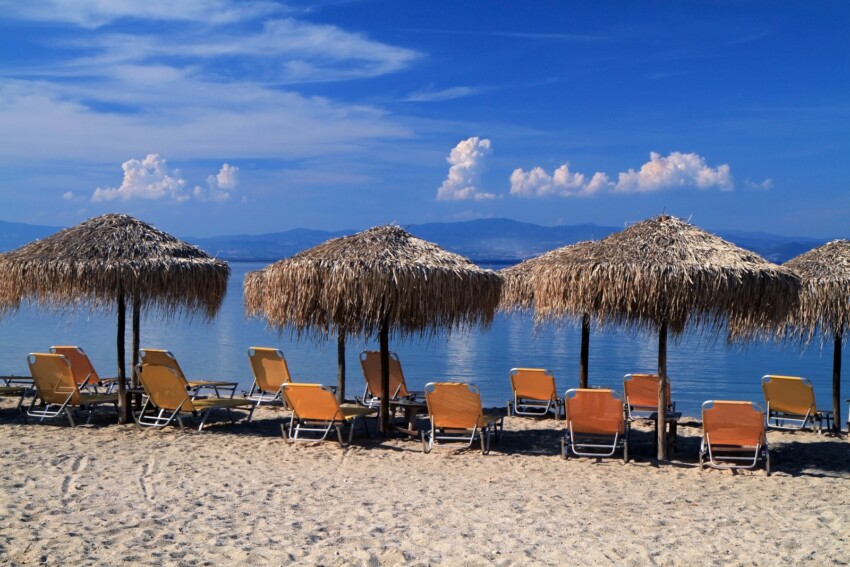
The capital of the island offers easy access to some of Kos’ most beautiful beaches, characterised by crystal-clear waters and comprehensive tourist services. Just three kilometres from the centre is Lambi Beach, a long stretch of golden sand with bathing establishments, water sports and beach bars. This beach, protected from northern winds, is ideal for families thanks to its shallow and gradual waters.
Psalidi Beach stretches for more than two kilometres along the east coast, offering a combination of sand and pebbles that create striking colour nuances. The thermal waters bubbling up at certain points along the shoreline create a natural spa that is very popular with visitors. The beach is easily accessible by bicycle from the centre via a pleasant coastal cycle path.
For those seeking tranquillity, Tingaki Beach is just 12 kilometres from the city and is famous for its white sand and shallow turquoise waters. This Blue Flag awarded beach offers a preserved natural environment with sand dunes and Mediterranean vegetation, while maintaining quality facilities such as sunbeds, umbrellas and traditional tavernas.
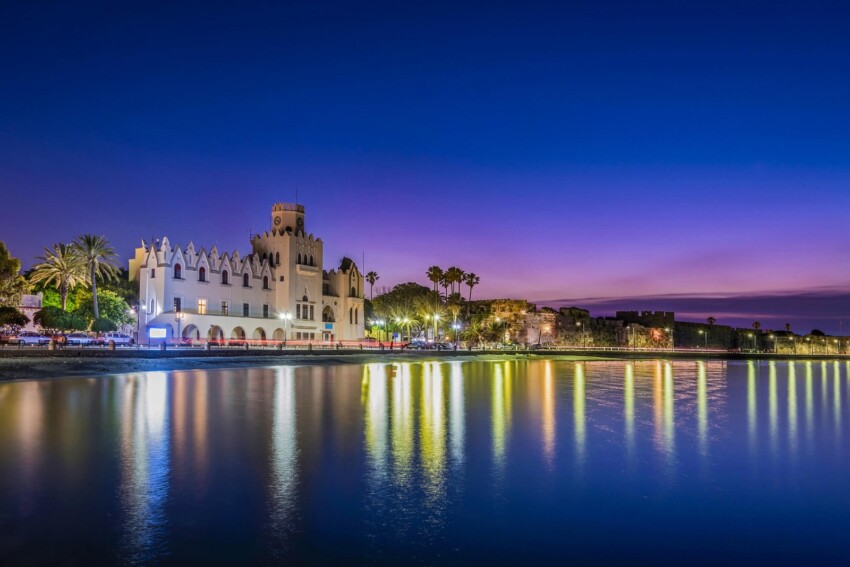
The old town is the most charming area to stay, offering boutique hotels in historic buildings and family pensions with sea-view terraces. Facilities in the centre allow you to walk to all the main monuments and experience the authentic evening atmosphere of the illuminated squares.
The port area concentrates modern, full-service hotels, ideal for those arriving by ferry and wanting immediate convenience. Many offer rooms with harbour views and panoramic terraces, perfect for admiring sunsets over the sea. The proximity to the docks also facilitates boarding for day trips to other islands of the Dodecanese.
The Psalidi district, east of the city, combines residential tranquillity with proximity to the centre. Here one finds seaside resorts with private beaches and spa facilities, as well as holiday flats in modern buildings. The area is well connected by public transport and offers traditional restaurants frequented by locals.
We offer a selection of hotels at Kos Town to suit all categories of travellers. The most booked by tourists are the sea-facing hotels, often right on the beach. If you want to play it safe, choose one of the following: they are among the most booked hotels in Kos Town, sorted by number of reviews.
If you prefer space, privacy and the ability to prepare your own meals to a hotel holiday, book a holiday home at Kos Town. We recommend a few below, but in this case we advise you to book early because houses and apartments for rent at Kos Town are in high demand.
Kos Town is located on the north-east coast of the island, strategically positioned to control the strait separating Greece from Turkey. The town is just 4 kilometres from the Anatolian coast, 160 kilometres from Rhodes and 200 kilometres from the southernmost Cyclades.
Hippocrates Airport is located 24 kilometres from the town centre, connected by public buses every 30 minutes during the summer season. The KTEL service provides regular runs with a journey time of 45 minutes and stops in the centre and at the port.
Taxis from the airport cost around 35-40 euro to the city centre, while car rental is available from several international companies in the terminal. The road between the airport and the city runs through the village of Antimachia, offering panoramic views of the island’s countryside dotted with traditional windmills.
The port of Kos is connected daily with Athens (Piraeus) by conventional ferries and high-speed hydrofoils. During the summer, daily runs make it possible to reach the Greek capital in 8-12 hours, depending on the type of vessel.
Local Dodecanese lines connect Kos with Rhodes, Kalymnos and Patmos several times a week. During the high season there are also direct connections with Santorini and Mykonos, making Kos an excellent starting point for island hopping in the Aegean.
Kos Town is served by a distinctive tourist train that connects the centre with the island’s main beaches. This seasonal service, operating from May to October, runs hourly to Psalidi, Therma and the eastern beaches, offering a picturesque and convenient way to explore the coast without a car.
Kos Town’s central location makes it the ideal starting point for exploring the natural and historical beauty of the island. Car hire makes it easy to reach the most beautiful beaches and traditional inland villages, discovering authentic corners far from the main tourist circuits.
The village of Zia, perched on the slopes of Mount Dikeos, offers breathtaking views of the entire island and the Turkish coastline. This mountain village, famous for its spectacular sunsets, retains traditional Greek architecture with white houses and cobbled streets. Local tavernas serve inland specialities such as local cheese and thyme honey.
Kefalos, at the south-western end of the island, holds the remains of the ancient capital of Kos and some of the wildest beaches in the archipelago. The medieval castle dominates the peninsula, while the beaches of Paradise and Bubble Beach offer crystal-clear waters and geothermal phenomena unique in the eastern Mediterranean.
The natural thermal baths of Therma, just 12 kilometres from the town, allow visitors to bathe in sulphurous waters that bubble up directly from the seabed at 50°C. This geothermal phenomenon, known since antiquity, creates a free natural spa frequented by locals and tourists alike in search of well-being.
What's the weather at Kos Town? Below are the temperatures and the weather forecast at Kos Town for the next few days.
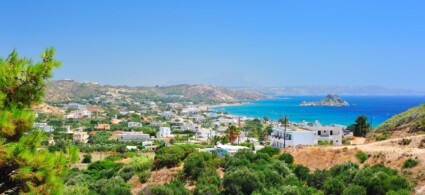
Kos Town occupies the north-east coast of the island of Kos, 4 kilometres from the Turkish coast of Bodrum. The town overlooks a large natural gulf that offers protection from the north winds, creating ideal conditions for the tourist and commercial port that connects it to the main Aegean destinations.
 Hotel
Hotel  Budget accommodations
  Apartments
  Family Hotel
  Luxury Hotel
  Resorts