Bestseller
Rhodes: Butterfly Valley and Seven Springs Nature Day Trip
From 29,00 €
Buy the ticket
Imagine walking along a shady path where, suddenly, thousands of butterflies soar out of the tree trunks, creating a swirl of orange and black colours in the summer air. This unique spectacle can be admired in Rhodes’ Valley of the Butterflies, known in Greek as Petaloudes (Πεταλούδες), meaning ‘butterflies’.
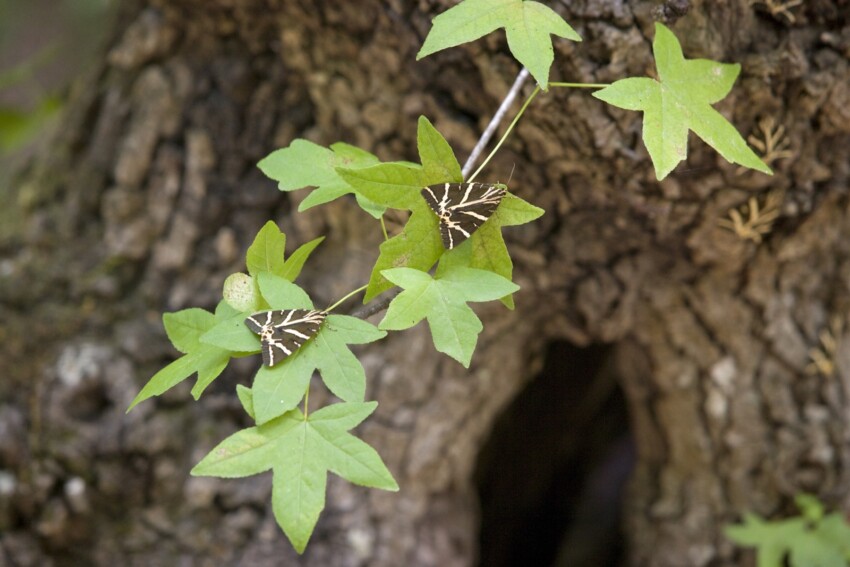
Located 27 kilometres from Rhodes town, in the heart of the island’s western hinterland, this 60-hectare nature reserve is an extraordinary biological phenomenon. From June to September, the valley is home to thousands of specimens of the Euplagia quadripunctaria rhodosensis, an endemic Rhodian subspecies of the Jersey tiger moth, attracted by the intoxicating scent of resin from the Liquidambar orientalis trees.
The uniqueness of this place lies in the presence of the only natural Liquidambar orientalis forest in Europe, a tree that secretes a resin with a characteristic vanilla scent that attracts these lepidopterans in impressive numbers. The phenomenon is so unique that the area has been included in the Natura 2000 network for its ecological importance.
The absolute star of Petaloudes is the Euplagia quadripunctaria rhodosensis, a subspecies endemic to Rhodes that differs from other European varieties due to certain specific morphological characteristics. These lepidopterans, although technically nocturnal moths, are also active during the day, making them easily observable by visitors.
During the period of their presence (late May to September), the butterflies perfectly camouflage themselves on tree trunks. With their wings closed, they display a dark brown colouration crossed by white streaks that make them almost invisible against the bark. When disturbed or in flight, they reveal their bright orange-red hind wings with four characteristic black spots, hence the scientific name ‘quadripunctaria’.
The heart of the attraction lies in the Liquidambar orientalis trees, also called ‘zitia’ in Greek. These trees, found naturally only on Rhodes and in limited areas in south-western Turkey, represent a relict from the Tertiary era and constitute the only natural forest of the species in Europe.
The aromatic resin that exudes from the bark of these trees, with its characteristic scent of vanilla and benzoin, is the key element that attracts butterflies. During the summer, when the humidity is high and the resin becomes more fluid, thousands of specimens gather to feed on this sugary substance, creating the famous natural spectacle.
The visit is along a well-equipped path of about 1 kilometre that meanders through the valley following the course of the small Pelecanos River. The route is characterised by wooden bridges, natural steps and strategically placed resting areas for fauna observation.
During the walk, in addition to butterflies, one can observe freshwater crabs in the ponds, the rare gizani fish endemic to the area, turtles and a rich bird life. The lush vegetation includes oriental plane trees, strawberry trees, myrtles and a variety of ferns that grow thanks to the area’s high humidity.
The trail culminates at the Monastery of Panagia Kalopetra, a small 18th-century Orthodox church built in 1784 by Greek Prince Alexander Ypsilantis. The monastery, with its characteristic snow-white colour, offers a panoramic view of the valley and the Aegean Sea.
Two legends are linked to this place: the first says that Ypsilantis took his tuberculosis-sick daughter there to cure her with the therapeutic waters of a local spring; the second tells of a miraculous rescue of the prince during a sea storm, guided by a mysterious light from the Kalopetra hill.
Access to the valley is through two main entrances: one located at the base of the hill and one at the top. You can choose to walk uphill starting from the bottom or downhill starting from the upper entrance. For those who prefer to avoid the effort of the ascent, there is a small train service connecting the two entrances.
The valley has refreshment facilities at both entrances, with cafés offering local honey cakes and cold drinks. There is also a small nature museum with stuffed specimens of the local fauna and reproductions of the valley’s ecosystem.
For a more in-depth visit, there are guided tours led by local naturalists who explain the particularities of the ecosystem and provide detailed information on the life cycle of butterflies and the endemic flora of the area.
The best time to visit Petaloudes is from June to September, with the peak of butterfly presence concentrated in July and August. During this period, the high temperatures and constant humidity create ideal conditions for the lepidoptera to gather.
The best times to visit are in the early morning (8:00-10:00) or late afternoon (16:30-18:00), when temperatures are milder and the butterflies are more active. During the middle hours of the day, many butterflies remain motionless on the trunks to conserve energy, making observation less spectacular.
A complete visit to the valley takes about 1.5-2 hours, including the walk along the path, stops for observation and a visit to the monastery. For those who only want a quick walk, a 45-60 minute walk along the main path is sufficient.
It is important to note that the trail has some uphill sections and uneven surfaces, so comfortable, closed shoes are recommended. During the summer, it is essential to bring water and a hat, despite the shade provided by the vegetation.
From the centre of Rhodes, the Valley of the Butterflies is approximately 27 kilometres away and can be reached in 30-35 minutes by driving along the western coastal road towards Kremasti and on to Theologos. Before reaching the latter village, follow the signs for Petaloudes/Damatria.
For those coming from Lindos, the most direct route is through the centre of the island following the signs to Archangelos and then to Petaloudes. Free parking is available at both entrances to the valley.
The valley can be reached by public transport using bus line 59 (blue line) operated by the RODA company, departing from the central bus station of Rhodes at the New Market (Nea Agora) in Averof Street. The service operates during the summer season with daily runs.
The bus journey takes about 50 minutes and the bus stop is only a 2-minute walk from the entrance to the valley. It is advisable to check the updated timetable at the bus station, as it may vary according to the season.

 Hotel
Hotel  Budget accommodations
  Apartments
  Family Hotel
  Luxury Hotel
  Resorts