Bestseller
Rhodes: Lindos Acropolis Entry Ticket & Optional Audio Guide
From 22,62 €
Buy the ticket
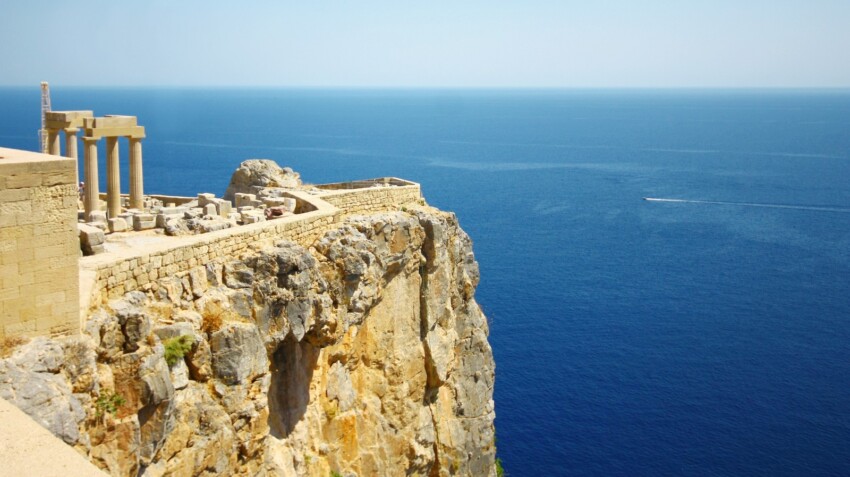
The Acropolis of Lindos is one of the most impressive archaeological sites in Greece, second only to the famous Acropolis of Athens in terms of historical importance and scenic beauty. Perched on a 116-metre-high cliff overlooking the crystal-clear Aegean Sea, this ancient citadel combines millennial history and breathtaking views in an extraordinary way.
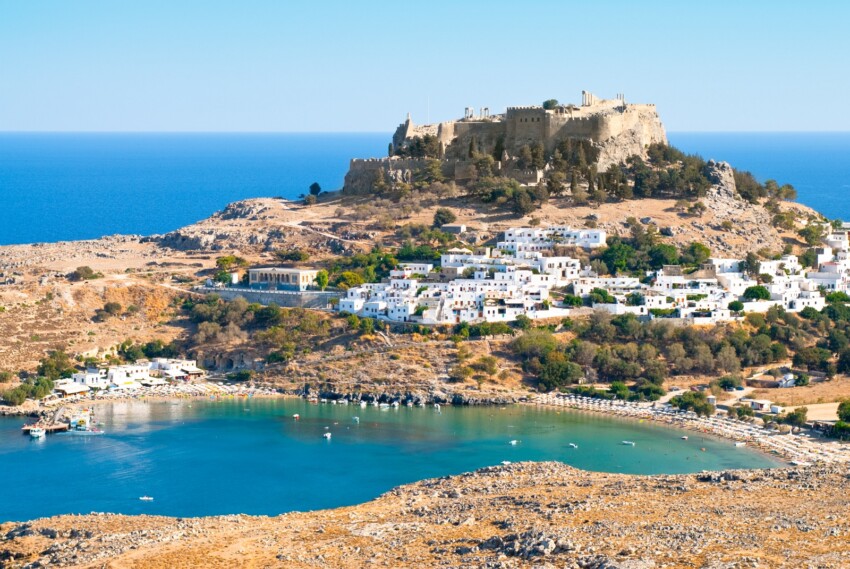
The archaeological complex is located in the picturesque village of Lindos, on the east coast of the island of Rhodes, 50 km from Rhodes town centre. Its strategic location has made it a key landmark for various civilisations, from the Dorians to the Knights of St. John, leaving behind layers of history that tell more than two thousand years of history.
The Temple of Athena Lindia, the heart of the acropolis, is a small temple (22 metres long x 8 metres high), built in the mid-4th century BC on the ruins of an older sanctuary. Its perfectly preserved Doric architecture testifies to the skill of the ancient Greek builders and the veneration of the city’s patron goddess.
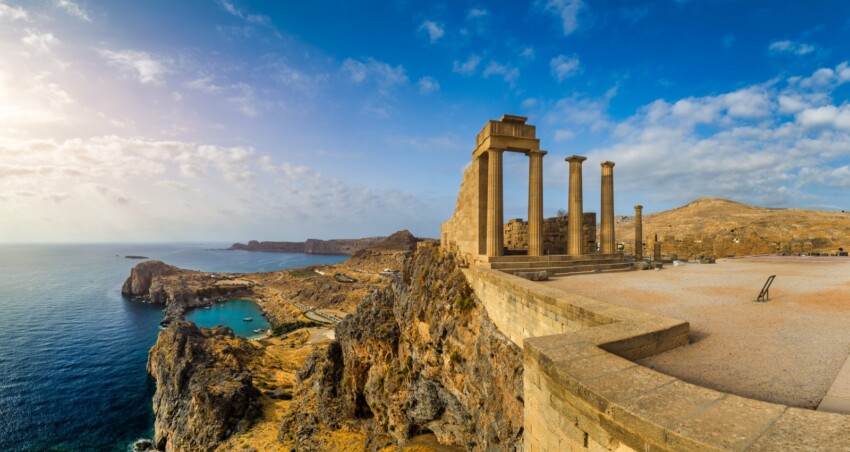
The origin of the Acropolis of Lindos has its roots in the 10th century B.C., when the Dorians founded the city of Lindos. The site experienced its heyday during the 6th century B.C. under the rule of Cleobulus, considered one of the Seven Sages of classical antiquity.
Originally, the sanctuary of the goddess appears to have consisted of a sacred grove in which a simple wooden pole or plank was worshipped as an idol. Only later did the Greeks assimilate the primitive deity ‘Lindia’ to Athena, introducing an image of the goddess before 688 BC.
The first temple dedicated to Athena was erected in Archaic times, but was replaced by a new one in Doric style in 330 BC. This new sacred building represented the culmination of the architectural evolution of the site, incorporating the aesthetic canons of Hellenistic art with a scenographic arrangement of buildings.
Over the centuries, the acropolis underwent several transformations. During the Roman and Byzantine periods, the site retained its religious and strategic importance. In the 14th century, the Knights of St. John built a castle on the ancient foundations, adding medieval fortifications that still characterise the outline of the acropolis today. These same knights also left their mark on the Medieval City of Rhodes and the Grand Master’s Palace.
The Temple of Athena Lindia constitutes the most valuable element of the entire complex. Built on the highest point of the acropolis, this sacred building in Doric style presents a perfect architectural symmetry with four columns on both main facades.
The interior of the temple still retains the rock carvings with the offerings of the worshippers and the pedestal where the cult statue of Athena once stood. The goddess was worshipped as the protector of navigation and trade, activities that were fundamental to the prosperity of Lindos.
The Propylaea represent the monumental entrance to the sanctuary, built in the first half of the third century BC with an external Doric colonnade. This structure, echoing the famous Propylaea of the Athenian Acropolis, led through a wall with five doors to the inner courtyard of the temple.
The staircase leading to the Propylaea has been poetically nicknamed ‘the stairway to Paradise’, because of the feeling of ascending to heaven that it offers visitors as they ascend. The Propylaea of Lindos directly recall those of the Acropolis of Athens, testifying to the influence of Athenian architecture throughout the Greek world.
The Hellenistic Stoa represents one of the most impressive buildings in the complex. At 87 metres long and with 42 Doric columns at the front, this Greek P-shaped gallery had both a practical and symbolic function.
According to tradition, the Greek P shape was meant to symbolise outstretched arms welcoming and welcoming pilgrims. This portico offered shelter to the faithful and provided a space for the social and religious activities of the community.
One of the most fascinating elements of the site is the relief of the trireme, a bas-relief carved on a rock at the foot of the citadel. This naval representation formed the basis of a statue depicting Admiral Agesander of Mikion, made by Pythocritus, the artist who was the author of the famous Nike of Samothrace.
The Castle of the Knights of St. John, built before 1317 on ancient Byzantine foundations, surrounds and protects the ancient remains. Inside the castle is a large courtyard with three cisterns and the remains of the Church of St. John, evidence of the overlapping of different historical periods.
Access to the Acropolis of Lindos requires the purchase of an entrance ticket for visitors over the age of 25. Children, teenagers and students enter free of charge, as do EU citizens under the age of 25 and NON-EU citizens under the age of 18 presenting proof of identity.
You can purchase it online at questo link or by filling out the form below.
The archaeological site opens at 8am and closes at 8pm during the summer months, remaining open every day of the week during the high season. Opening hours may vary during the winter months and on public holidays.
The recommended duration of the visit is about 2-3 hours, enough time to explore all levels of the acropolis and enjoy the views. It is strongly recommended to visit the site early in the morning, preferably at opening time, to avoid the scorching summer heat and crowds of tourists.
To reach Lindos from Rhodes town, one can use flights to Rhodes that land at Rhodes Airport, located about 50 km from Lindos. A popular alternative for visitors is to rent a car in Rhodes, which allows one to comfortably explore the entire island.
The route to the acropolis starts from the main car park of Lindos, located at the entrance of the village. From here, visitors can choose between two options:
On foot: The route goes through the characteristic white streets of Lindos village, gradually ascending towards the acropolis via a series of steps and terraces. The walk takes about 10-15 minutes.
Riding donkeys: At the entrance to the village is the ‘Donkeys station’: donkeys are stationed to accompany tourists on a tour of the acropolis. The cost is 8 euro per person.

 Hotel
Hotel  Budget accommodations
  Apartments
  Family Hotel
  Luxury Hotel
  Resorts