Ibiscus Hotel
Rhodes Town - 17, Nisirou str.
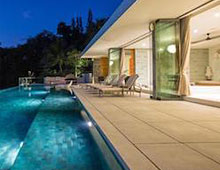
Situated on the most cosmopolitan sandy and pebbled beach of the city of Rhodes, a few minutes’ walk from the centre, the Ibiscus complex offers a small swimming pool.
Book now
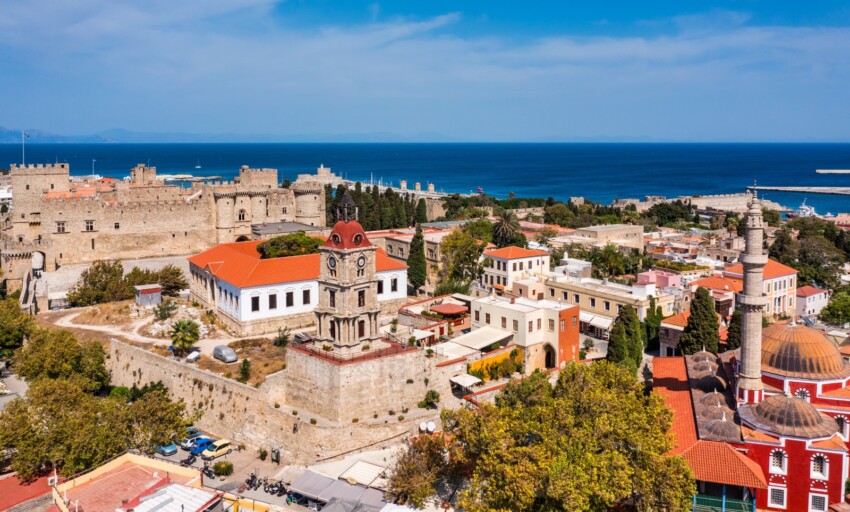
Rhodes is a unique city, capable of channelling the vibrancy of Mediterranean resorts into a modern, cosmopolitan area and preserving the charm of a millennial history in its medieval quarters, which are almost a world apart, enclosed within mighty walls that barely hint at the treasures hidden within.
It is the largest city on the largest island of the Dodecanese, the Greek archipelago closer to Turkey than to mainland Greece. Divided into Old Town and Lower Town, Rhodes is able to please tourists interested in history, art and culture and others looking for uninterrupted rows of pubs and discos; there is no shortage of beaches, surprisingly beautiful for city beaches.
Experience it as you like: a base for exploring the island, a destination for a city break alternative to the big European capitals, a hit-and-run visit during a cruise, a stop on a day trip from a seaside resort. Rhodes guarantees unforgettable emotions and memories for each of these situations.
Rhodes Town is rich in historical and cultural attractions. The list of things to see below includes the must-see attractions; however, if you stay in town for several days you will find more museums, monuments and parks to fill your days.
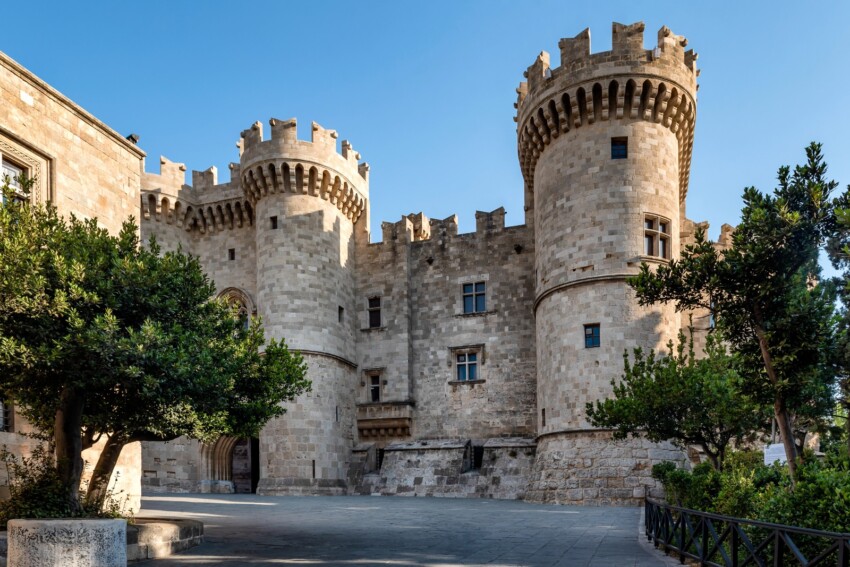
The top attraction in Rhodes Town is undoubtedly the Palace of the Grand Masters (also called the Knights’ Palace), a magnificent two-storey building with a portico on the ground floor and a grand interior staircase dating back to the 14th century.
Built on the ruins of an earlier Byzantine fortress, it was used as the seat of the 19 Grand Masters, supreme authority of the Order of the Knights of St. John, and as a refuge for the population in case of siege. Damaged by a powder magazine explosion in 1856, the present palace is the result of a painstaking Italian reconstruction that took place between 1937 and 1940.
Italian architects used authentic materials and traditional techniques, recreating the splendid mosaic floors that decorate the 158 rooms of the palace, many of them from Kos and dating back to Hellenistic and Roman times. The state rooms house an extraordinary collection of period furniture, 16th-17th century Flemish tapestries and antique sculptures. The crenellated towers dominating the old town offer a spectacular view of the medieval town and the port of Mandraki, while two permanent exhibitions illustrate the history of Ancient Rhodes and the Knights through archaeological finds and historical documents.
Even today, the swearing-in ceremony of new members of the Order of St John is still held in this palace.
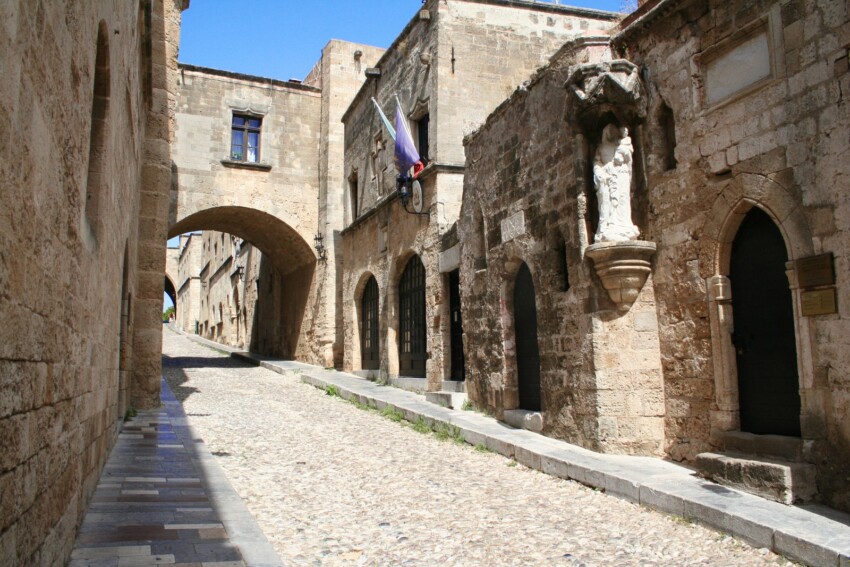
The Palace of the Grand Masters is located in the Knights’ Quarter, probably the most characteristic and fascinating area of Rhodes. Once out of the palace, stick around to unhurriedly explore the alleys and cobbled streets of this quarter north of the Old Town, built between the 14th and 15th centuries by the Knights of St. John.
The landmark buildings of this historical quarter are the fortified palaces and imposing mansions that look more like a fortress than a castle.
It is the most visited area of the city, partly because of its historical charm and partly because some interesting attractions are concentrated here. These include the 200-metre-long Street of the Knights, overlooked by splendid palaces renovated in the early 20th century by the Italians to remove Ottoman elements and restore them to their medieval splendour, and the Temple of Aphrodite (3rd century BC), one of the few ancient ruins visible within the Old City.
The Knights’ Quarter is entered through the splendid Liberty Gate.
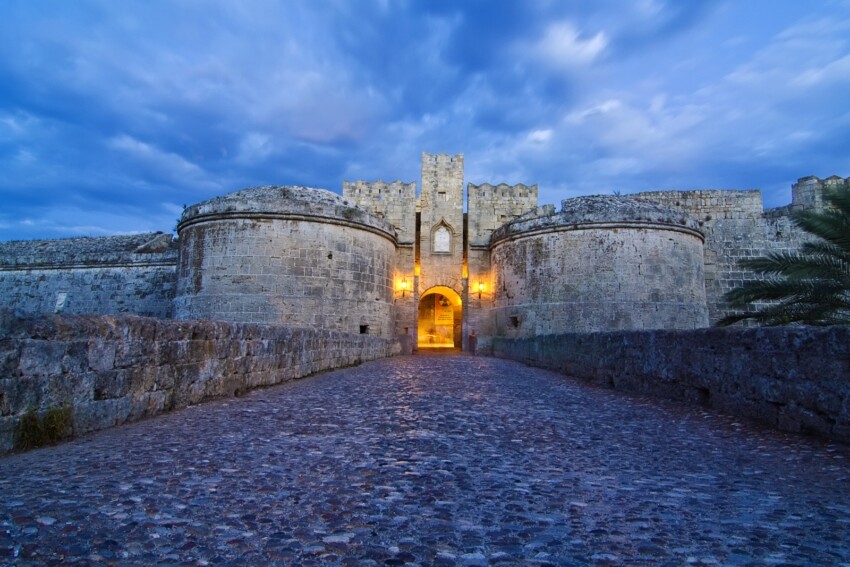
The walls of Rhodes are an impressive defence system that has enclosed the Old Town for over 500 years.
Perfectly preserved, they are open to the public on weekdays for a 1 km stretch: little compared to their total extension, but enough to get an idea of their grandeur. From the top of the walls you can enjoy splendid views over the rooftops of the Old Town.
The moat surrounding the walls has never been filled with water. It lost its defensive function to assume a recreational one: today it is a lovely urban park with green lawns and flower beds, perfect for a little relaxation between sightseeing.
The Marina Gate (Pyli tis Thalassis), the main entrance from the harbour, features a double defence system with an inner courtyard where enemies could be trapped under crossfire from the side towers.
St. Anthony’s Gate, adorned with the coat of arms of Grand Master Fabrizio del Carretto, shows the influence of 15th century Italian military architecture, while the Amboise Gate represents the pinnacle of medieval defensive engineering with its complex system of ravelins and moats. The latter owes its name to Grand Master Emery d’Amboise who had it built in 1512 to resist the new firearms.
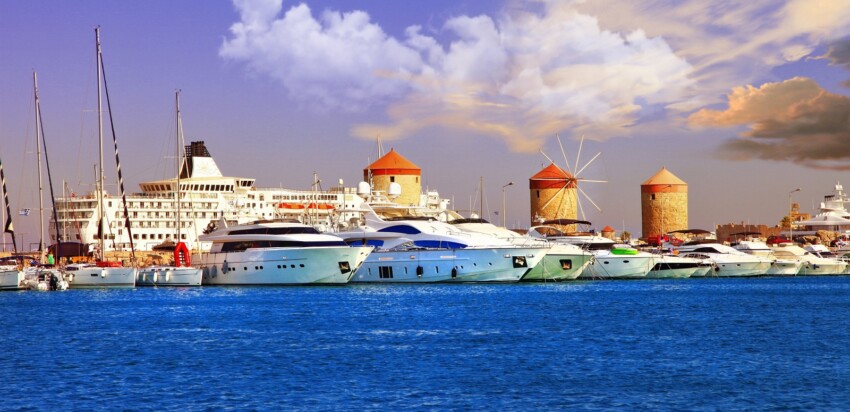
The ancient trading port of Mandraki has been the maritime heart of Rhodes since antiquity, when it served as the main port of call for merchant ships in the eastern Mediterranean. According to legend, it was here that the Colossus of Rhodes stood, the gigantic bronze statue of Helios over 30 metres high that was one of the Seven Wonders of the Ancient World. Built in the 3rd century BC to celebrate victory over the Macedonians, the Colossus collapsed during an earthquake in 226 BC, but its remains remained visible for almost nine centuries.
Today, the two columns at the entrance to the harbour are surmounted by two elegant bronze deer, which have become symbols of modern Rhodes. The modern port, redesigned during the Italian period in the 1930s, retains the charm of architectural rationalism with buildings with clean and functional lines. The morning fish market transforms the harbour into a colourful spectacle of everyday life, while the waterfront promenade offers spectacular views of the Old Town and is the meeting point of Rhodian social life during summer evenings.
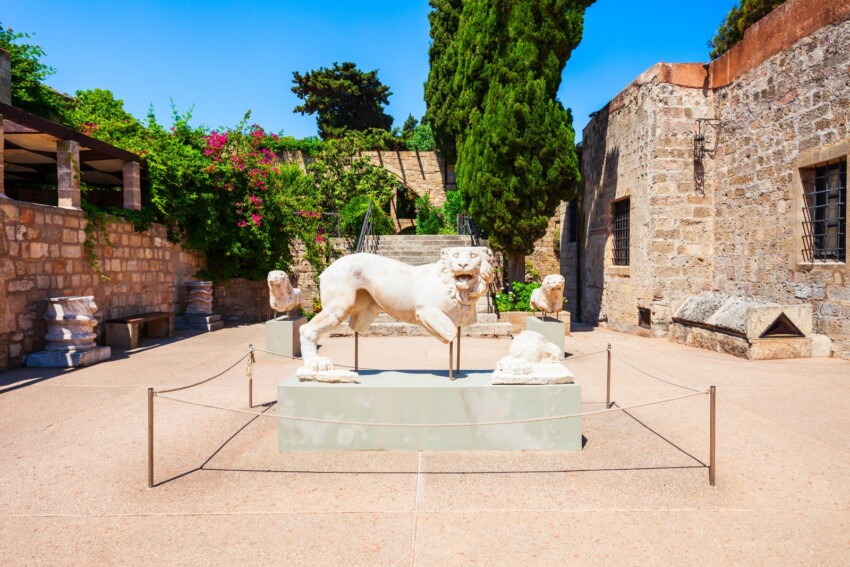
Housed in the magnificent 15th century Knights’ Hospital, the Archaeological Museum is one of the most important cultural institutions on the Greek island. The building itself is a masterpiece of late Gothic architecture, designed by Grand Master Jean de Lastic as a state-of-the-art medical centre. The central courtyard with its elegant two-storey loggia and the barrel-vaulted Knights’ Refectory testify to the architectural skill of the period.
The collection spans over three thousand years of history, from the Minoan to the Byzantine era. The most valuable piece is the Aphrodite of Rhodes, a Hellenistic marble sculpture from the 1st century B.C. depicting the goddess as she unties her sandals, considered one of the best Roman copies of Greek originals. The prehistoric, classical and Byzantine sections display ceramics, jewellery, coins and mosaics testifying to the cultural richness and commercial importance of Rhodes in the ancient world, when the Rhodian drachma was one of the most prized currencies in the Mediterranean.
A good excuse to leave the Old Town overrun with tourists is to visit an interesting museum dedicated to 20th century Greek art.
Located near the northern end of the Lower Town, an area usually ignored by tourists, the Museum of Modern Greek Art displays paintings, sculptures and engravings by Greek artists; the highlights of the collection are the paintings by Valias Semertzidis depicting war scenes and landscapes.
The museum has recently been expanded with the addition of a new wing; it also has two separate venues in the Old Town: the Municipal Art Gallery and a gallery housed in a deconsecrated 13th century church.
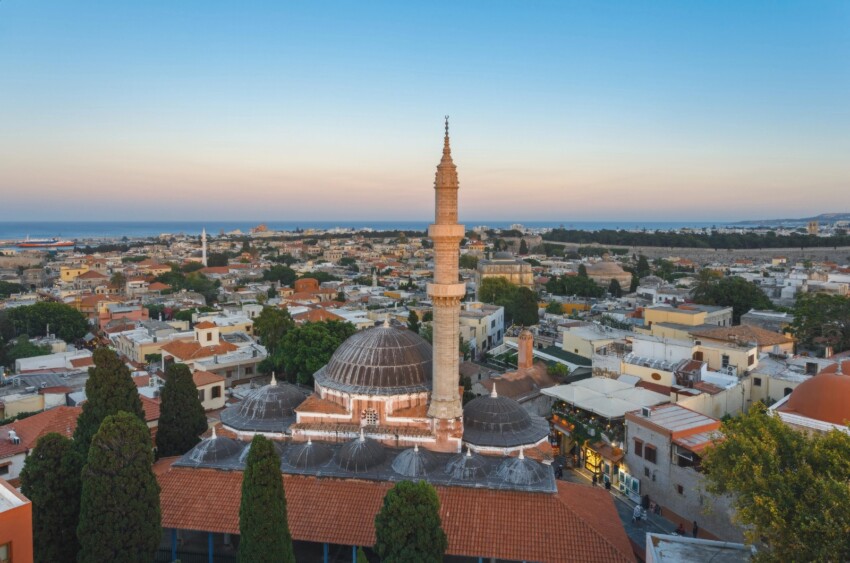
Built in 1522 to commemorate the Ottoman conquest of Rhodes by Suleiman the Magnificent, this elegant mosque represents the earliest and most important example of Islamic architecture on the island. Erected on the remains of a Byzantine church dedicated to the Apostles, it symbolises the transition from the Christian to the Muslim era. The architecture combines Byzantine and Ottoman elements in a harmonious synthesis: the central dome echoes the Byzantine tradition, while the 35-metre-high pink minaret features the typical geometric decorations of Islamic art.
The interior preserves beautiful mihrab decorated with turquoise and cobalt blue Iznik tiles, while the Koranic inscriptions in gold lettering were made by master calligraphers from Istanbul. The inner courtyard (sahn), surrounded by a portico with round arches, housed the fountain for ritual ablutions. During its heyday, the mosque was surrounded by a madrasa, a caravanserai and several shops forming an Islamic quarter in the heart of the medieval city.
Another area, another atmosphere: the Jewish Quarter of Rhodes is a handkerchief of narrow streets southeast of the Old Town.
Although rich in picturesque views and historical attractions, it is less visited than the Knights’ Quarter and the Turkish Quarter. Quiet and atmospheric, it is the right place for those who like to wander around the city without wading through crowds of tourists.
To learn about the history of the neighbourhood, sadly similar to Jewish neighbourhoods in other European cities that were depopulated due to deportations during World War II, you can visit the Jewish Museum of Rhodes. Access is through the Kahal Shalom synagogue: built in 1577, it is the only synagogue still functioning in Greece and preserves the original inlaid wooden bimah and the aron kodesh decorated in the Ottoman artistic tradition.
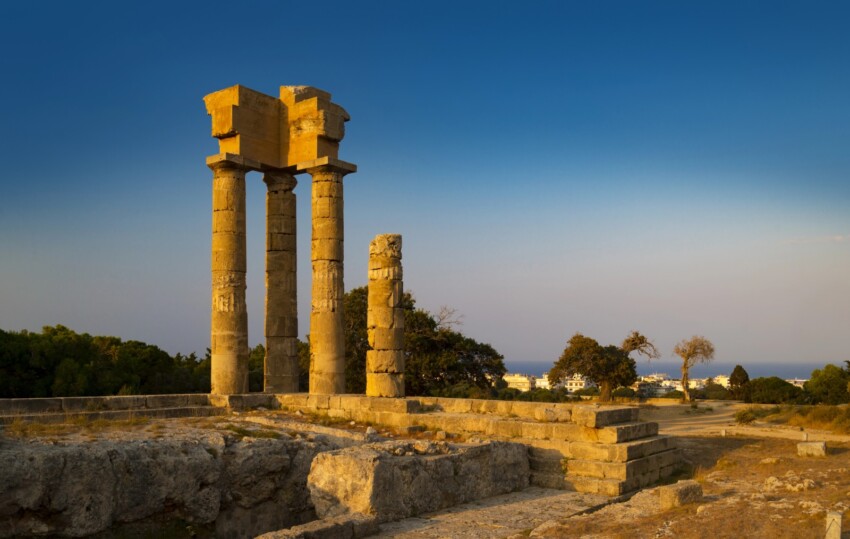
Located on the hill overlooking the modern city, the Acropolis of Rhodes – not to be confused with the more famous Acropolis of Lindos – represents the religious and cultural heart of the ancient Hellenistic city. The site preserves the monumental remains of what was one of the most important urban centres of the Greek world. The Temple of Apollo Pythios, of which three reconstructed Doric columns remain, was the religious focus of the acropolis and housed the cult of Apollo as the god of light, a deity particularly worshipped by Rhodians who considered their island sacred to the sun god Helios.
The 210-metre-long Hellenistic stadium could seat about 800 spectators during the Halieia, the sacred games that were held every four years and attracted athletes from all over the Greek world. The ancient theatre from the 2nd century BC, with its semi-circular cavea carved into the rock, took advantage of the site’s perfect acoustics and offered spectators a panoramic view of the sea during performances. The view from Mount Smith encompasses the entire modern city, the port of Mandraki and, on a clear day, the mountains of Turkey on the horizon.
Located on the northern tip of the island, the Rhodes Aquarium is an extraordinary example of 1930s Italian rationalist architecture and one of the most important scientific institutions in the eastern Mediterranean. Built in 1934-1936 and designed by architect Armando Bernabiti, it combines scientific functionality and architectural beauty with pure geometric lines, local limestone facades and perfect integration with the surrounding marine environment.
The underground tanks, dug directly into the rock and connected to the sea by natural channels, are home to over 40 species of fish typical of the eastern Mediterranean: giant groupers, moray eels, octopuses, rays and an extraordinary variety of colourful fish.
In the following map you can see the location of the main places of interest mentioned in this article.
It is rare to find beautiful beaches near the city centres or in the urban suburbs, but Rhodes is a happy exception. Indeed, one does not need to travel far from the city to find nice nooks and crannies where one can lay out one’s towel and stretches of clear blue sea where one can take a refreshing dip.
Among Rhodes’ city beaches, the most beautiful is Aquarium Beach, named after the building behind it. It is located at the northernmost point of the island and offers a splendid view of the coast of Turkey; despite being a city beach, it is never too crowded.
For those with little time on their hands, perhaps because Rhodes town is only a cruise stop, Zephyros Beach is a good solution. Although located a short distance from the harbour, in the eastern part of town, this well-equipped beach boasts surprisingly clean waters and is popular with locals.
If you are willing to travel a few kilometres, the most beautiful beaches you can find around Rhodes Town are Elli and Ixia, located along the west coast of the island. Both are equipped beaches; the latter is very long (a good 10 km) and alternates between areas with umbrellas and kiosks and others that are free.
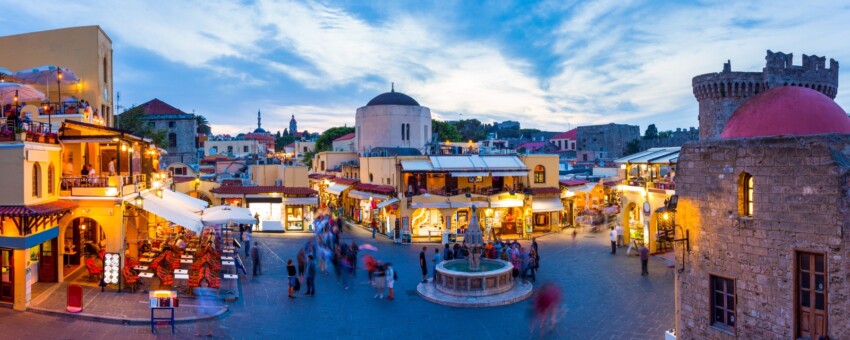
Rhodes offers the same variety of hotel facilities as a medium-sized European city, with proposals to suit all tastes and budgets. They range from inexpensive solutions such as 2-star hotels, studios and hostels to luxury accommodation such as 4- or 5-star hotels, mega-hotels of international chains and charming flats in historic buildings.
The price/quality ratio is generally good: the wide choice means that accommodation prices in the capital are somewhat lower than in the island’s most famous seaside resorts.
The areas with the greatest choice of hotels and holiday flats in Rhodes Town are the Old Town, particularly near the Palace of the Grand Masters, the harbour and the beaches in the centre. The former is preferred by tourists as it is the most charming and convenient for visiting the city’s tourist attractions.
We offer a selection of hotels at Rhodes Town to suit all categories of travellers. The most booked by tourists are the sea-facing hotels, often right on the beach. If you want to play it safe, choose one of the following: they are among the most booked hotels in Rhodes Town, sorted by number of reviews.
If you prefer space, privacy and the ability to prepare your own meals to a hotel holiday, book a holiday home at Rhodes Town. We recommend a few below, but in this case we advise you to book early because houses and apartments for rent at Rhodes Town are in high demand.
The city is about fifteen kilometres from Rhodes International Airport, which is served by numerous low-cost flights to/from major European cities. With a rented car, you can get to the centre of Rhodes from the airport in about twenty minutes.
For those who prefer to travel by public transport, there are local buses that connect the city and the airport with fairly frequent runs. Given the proximity, it is also possible to take a taxi: if several people share the expense, the cost is affordable.
Another popular way to reach the city of Rhodes is to take a cruise on the Mediterranean. You can also arrive by ferry from mainland Greece or from other islands, but the sea crossing is very long and without the comforts of cruises it could be a bit tedious. The port is located in the city centre.
What's the weather at Rhodes Town? Below are the temperatures and the weather forecast at Rhodes Town for the next few days.
It is perhaps the most famous attraction in Rhodes… but the least photographed. The reason is simple: it has not existed for over two thousand years.
We are of course talking about the Colossus of Rhodes, the gigantic statue of the god Helios considered one of the seven wonders of the world.
It was built between 304 and 293 BC to celebrate the victory over Demetrius I Poliorcetes, grandson of Alexander the Great. It collapsed into the sea 67 years later due to an earthquake and was never recovered or replaced by a reconstruction.
On several occasions the idea of building a new statue with the same characteristics as the original was proposed, but all plans were abandoned because it was too expensive.
The city of Rhodes is located at the northern tip of the island of the same name, of which it is the capital. The island is part of the Dodecanese, the easternmost archipelago of Greece that is washed by the southern Aegean. The coast of Turkey is less than 20 kilometres away.
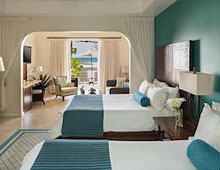 Hotel
Hotel 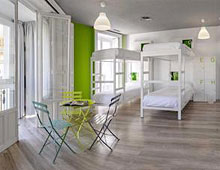 Budget accommodations
 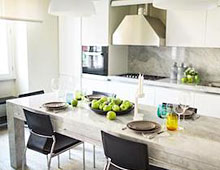 Apartments
  Family Hotel
 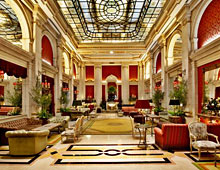 Luxury Hotel
  Resorts