Bestseller
Athens: Mythology of Delphi, Museum and Arachova Guided Tour
From 26,01 €
Buy the ticket
Delphi and oracle: an inseparable bond. An essential stop for fans of ancient Greece and those seeking the sites of myth, the name of Delphi is inextricably linked to the most revered and respected oracle in Greek religion.
According to ancient beliefs, the oracle was a woman, the Pythia, priestess of Apollo’s temple at Delphi: it was she who, surrounded by mysterious vapours, pronounced the expected and sometimes feared response. Her answer, although enigmatic, profoundly conditioned the consultant’s choices on even very serious issues, such as the decision to go to war or the exact location in which to found a new city.
Walking through the rugged landscape of the mountains on which the ancient ruins stand, it is not difficult to be pervaded by mysticism and to wish that one could still invoke a powerful oracle to clarify one’s mind on important matters.
Unfortunately, you won’t find anyone to tell you what to do with your life, but on the other hand, the remains of thousands of years old buildings in a natural setting of extraordinary beauty, exciting sunsets, a lively town centre full of typical bars and restaurants and a multitude of paths for peaceful walking await you.
And don’t forget that Delphi is the navel of the world, or so the ancients believed: thanks to the two eagles launched by Zeus in opposite directions, which met again right here in Delphi. There is a reason for this in Delphi: come and find out.
Most tourists come to Delphi on a day tour to visit the attractions related to the ancient legends that have made this city famous throughout the world and which certainly represent the top attractions.
If you have a little extra time, however, it is worth stopping by because there are other interesting things to see in Delphi, albeit less well known.
Ancient Delphi is the reason why everyone comes here, a timeless magical place. What we can admire today unfortunately does not give the idea of the opulence and magnificence of this city in ancient times, but it is enough to understand its importance and to be seduced by the millennial charm of these places.
Past the ticket offices, an ancient stone-paved sacred way will lead you down the mountainside towards the ancient ruins.
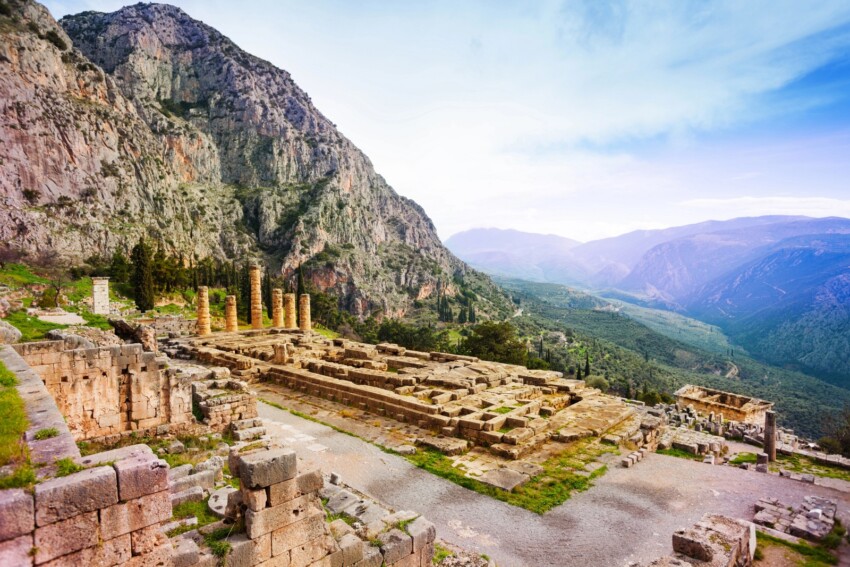
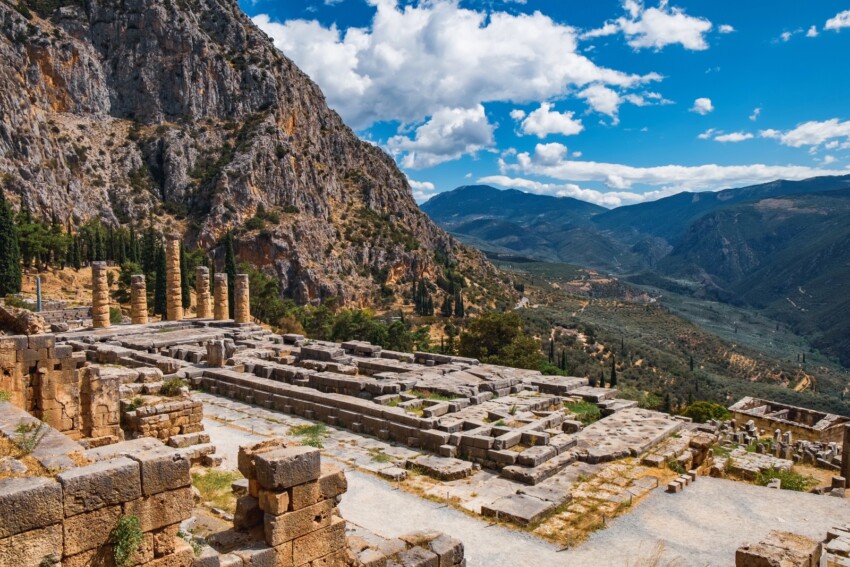
The must-see attraction at Ancient Delphi is of course the Sanctuary of Apollo, considered the home of the oracle.
It is a complex of buildings, streets, statues and columns dominated by the Temple of Apollo, dating back to the 4th century BC, and also including a theatre and stadium (considered the best preserved in Greece). From the highest tiers of the theatre there is a splendid view of the ancient city and the mountains in which it lies.
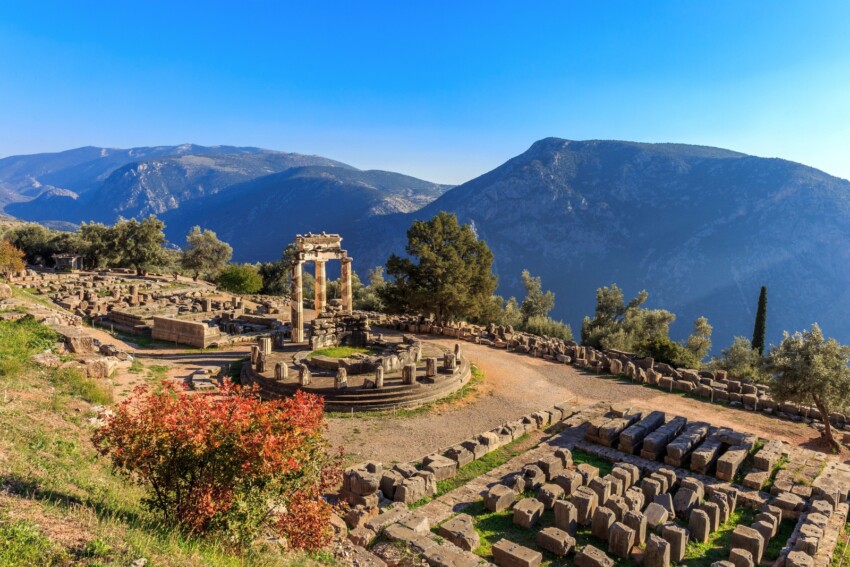
Other attractions in the archaeological park include the ancient gymnasium, the Castalia spring where worshippers purified themselves before consulting the oracle and the sanctuary of Athena Pronaia, which also includes a 4th century BC tholos.
The latter is the most photographed monument at Delphi: it is a circular structure formed by a three-stepped base on which 20 columns rested. Three can now be seen, reconstructed in the 1940s so that the distinction between the original (lighter) and restored (darker) parts is evident.
Many of the treasures of Ancient Delphi have been moved to a suitable location for conservation and display: the Archaeological Museum of Delphi, a must-see attraction for lovers of classical Greece, history and art.
Modern and functional, it is a magnificent museum with no less than 14 rooms. Highlights of the collection are the Auriga, a bronze statue celebrating a victory during the Pythian Games in 478 or 474 BC, and the sculpture of the Three Dancers on top of the Acanthus Column.
You can also admire fragments of metopes from the Treasury of the Athenians, parts of the frieze from the Treasury of the Siphni, the so-called twins of Argos (two kouroi, statues of young men) and the omphalós, a carved stone that in antiquity was placed in the spot that was considered the centre of the world.
A must for all theatre and Greek history lovers is the Delphic Festival Museum. Housed in an elegant early 20th-century house, the museum is dedicated to the Greek poet Angelos Sikelianos and his wife Eva Palmer, who worked hard to make Delphi one of the centres of theatre in Greece once again.
On display are photographs of the poet and his wife intent on recreating the solemn atmosphere of ancient theatre.
Not only antiquity: Delphi is a modern city in which cultural ferment is more vibrant than ever, as evidenced by the foundation of the European Centre of Delphi, a cultural centre desired by former Prime Minister Constantine Karamanlis to promote culture in Delphi and make it an international reference point.
The centre is used for performances, exhibitions and conferences and also includes an interesting sculpture park.
The best way to visit Delphi is with a guided tour. Most leave from Athens, here are the ones we recommend, perhaps in combination with other attractions such as Meteora.
The best way to admire the breathtaking scenery in and around Delphi is on foot, walking along epic hiking trails.
About 18 km from Delphi is the magnificent Corycian Cave, the largest in Parnassus, once the place where Pan and the nymphs were worshipped. It can be reached on foot with a fascinating if challenging walk: if you decide to do it, you will need the whole day; leave with suitable clothing for trekking and supplies of water and food.
Another rather popular walk is from Delphi to Chrissó and Kirra, which is easier than the previous one because it is largely downhill.
Delphi is one of the most visited resorts in Greece and the offer of hotels and B&Bs is quite extensive; there are, however, few flats and holiday homes.
Low-cost travellers will have no difficulty finding an unpretentious room in a guesthouse or a small family-run hotel; those who want more comfort can choose from 3- or 4-star hotels, including some boutique hotels and luxury hotels with swimming pools.
Accommodation in Delphi is concentrated in the modern part of the city, from which one can easily reach Old Delphi. Despite the wide offer, it is always advisable to book in advance.
The quickest and easiest way to reach Delphi is to rent a car. The city is about 170 km from Athens and can be reached easily via the E75 motorway.
Those who prefer to travel by public transport can take a bus from Athens; the journey time is about three hours and runs daily. However, it is not possible to get to Delphi by train because the two cities are not connected.
Another possibility is to visit Delphi on a day tour from Athens or you can choose a longer tour that also includes a visit to The Meteors.

 Hotel
Hotel  Budget accommodations
  Apartments
  Family Hotel
  Luxury Hotel
  Resorts