Bestseller
From Athens: Small-Group Mycenae, Epidaurus & Nafplio Trip
From 29,44 €
Buy the ticket
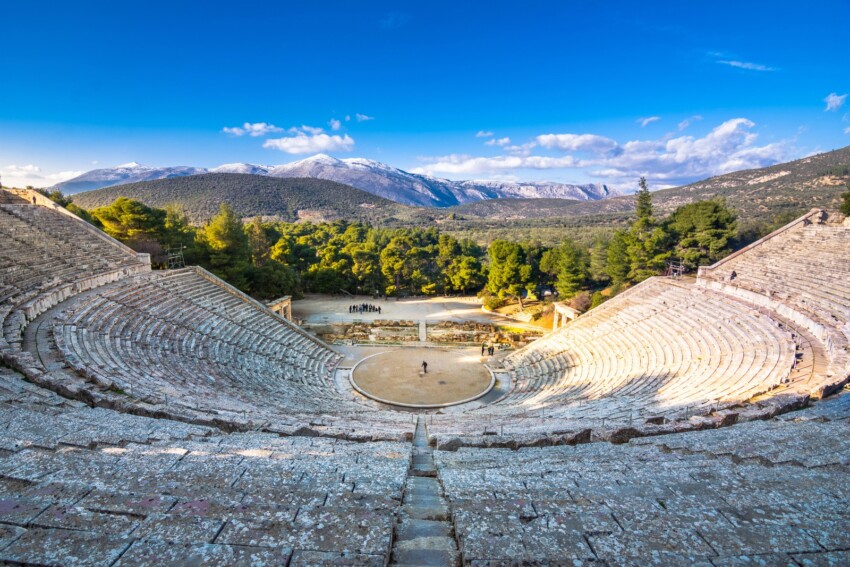
The jewel in the crown of the Argolis, a land whose name already evokes myths and legends far back in time, is the Ancient Theatre of Epidaurus, a thousand-year-old construction that combines architectural genius and religious mysticism.
A magnificent example of classical perfection, characterised by impeccable symmetry, it is one of the Peloponnese’s top attractions. It is a must-see destination both for those staying in the area, perhaps in the pretty town of Nafplio, and for those who want to take exciting day trips from Athens.
There are so many theatres in Greece, why come all this way to see another one? There are good reasons. First of all because the one at Epidaurus is one of the best-preserved theatres of antiquity, secondly because it is surrounded by beautiful green scenery that makes it particularly impressive.
And then you too will surely want to try the coin game…. Ask your guide, partner or friend to wait for you on the proscenium, climb up to the last row of steps and signal your accomplice to drop a coin. Incredulous, you will be able to hear the sound of the coin hitting the ground without the need for any microphone, speaker or headphones.
Such is the acoustics of the Ancient Theatre of Epidaurus that architectural scholars, musicians, actors and visitors never cease to be amazed. This same portentous wonder thrills the spectators of the plays and concerts that still take place today, more than two thousand years after its construction, in one of the most beautiful theatres in ancient Greece.
The magic of myth is more alive than ever: come and discover it.
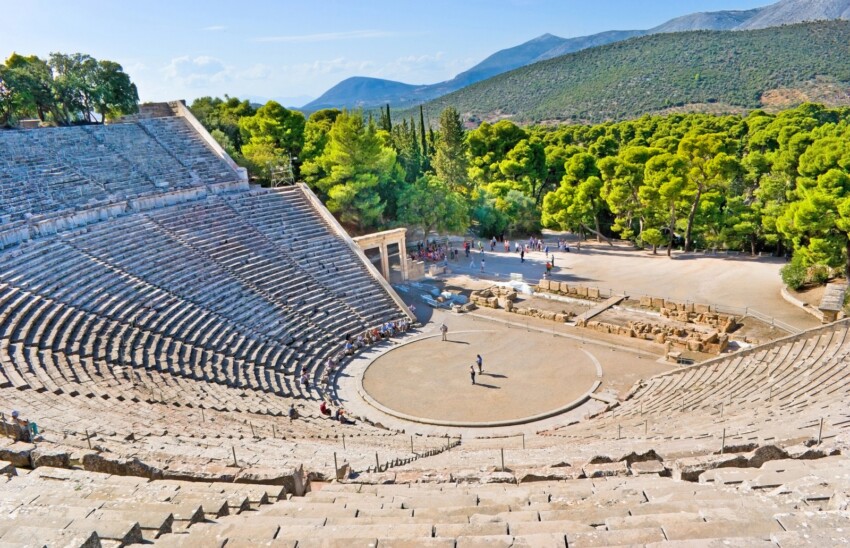
The Ancient Theatre of Epidaurus was built around the 4th century BC to a design by the architect Polyclitus the Younger. It stands on the western side of Mount Cynortion and was part of a complex of buildings that formed the Temple of Asclepius, the Greek god of medicine who had the centre of his cult in the city of Epidaurus.
The sanctuary dedicated to Asclepius was considered in antiquity to be the most important centre of healing in the whole of Greece: thanks to its importance, the city was able to enrich itself and endow itself with a theatre that later became more famous than the sanctuary itself. The spectacles of music, singing and dramatic games that were held in the theatre were directly linked to this cult and therefore it was believed that attending the performances had a beneficial power for the health of body and soul.
The theatre’s structure is typical of a classical Hellenistic theatre, with three clearly distinct areas: cavea, a semi-circular tiered structure reserved for the audience; orchestra, a circular space in the centre of the theatre; and stage, which originally comprised a two-storey stage and proscenium. The stage has a diameter of 20 metres.
It currently has 55 tiers of seats and a capacity of 14,000 spectators; originally there were 34 tiers, 21 were added later by the Romans. These numbers are probably not random: they are in fact related to the so-called Golden Section of antiquity, the irrational number 1.6180339887 with which symbolic and religious meanings were associated.
Until the mid-19th century, the theatre fell into oblivion, hidden by trees and shrubs growing on the slopes of the hill. The first excavations took place in the second half of the 19th century; excavation and restoration work continued until 2016, allowing us today to admire a theatre that looks very faithful to the original.
To this day, the theatre is still used for plays and concerts; these are mainly tragedies and other classical theatre performances, but there are also occasional contemporary events with famous international guests.
The feature that has made the theatre of Epidaurus so famous is its acoustics: every sound can be heard from the proscenium up to the top row. Without any amplification, even very faint sounds, such as a falling coin, can be heard.
How it was possible to create a theatre with such perfect acoustics remained a mystery for centuries, but such perfection made it difficult to think of pure chance. Yet perhaps this is indeed the case…
Recent studies have shown that the exceptional acoustics of the theatre of Epidaurus are due to the limestone from which the tiers of seats were made and not to the slope of the theatre as was previously believed.
The rough stone acts as a filter eliminating low frequency sounds, in particular
the actors’ voices. The missing frequencies are reconstructed by the spectators’ brains through a mechanism called ‘virtual pitch’. It is something similar to what happens during telephone conversations with a poor signal.
It is unthinkable that architects in ancient times would have known the acoustic qualities of limestone, which explains why the exceptional result obtained in Epidaurus has never been replicated in other Greek theatres.
Joining a guided tour turns the visit into an enlightening experience: the expert local guides will tell you fascinating anecdotes about the construction of the theatre, show you the secrets of the perfect acoustics, and explain the religious rituals that took place here. Most guided tours from Athens to the Epidaurus Theatre also include a visit to Mycenae, creating an exciting full-day experience through Greek history.
If you are a fan of ancient history or if the allure of the millenary ruins is irresistible to you, stay in the area after visiting the Epidaurus Theatre: there are other attractions nearby that might interest you.
Staying in the area, you can see the ruins of the temple of Asclepius, remains of the stadium and the Tholos, a circular white marble building whose function remains unknown.
In the city of Epidaurus, it is possible to visit an archaeological museum displaying artefacts found in the surroundings.
Reaching the theatre of Epidaurus by car from Athens is quite easy: just take the motorway to Corinth, exit at the junction for Epidaurus that you will find after the canal and from there follow the signs.
If, on the other hand, you want to travel by public transport, plan for at least one change. There are no direct buses or trains from Athens to the theatre: you will first have to take a bus to Epidaurus or Nafplio (the latter can also be reached by train) and then a local bus to the theatre.
The easiest way to visit the Ancient Theatre of Epidaurus without travelling by car is to join a day tour from Athens or Nafplio.
Day tours from Athens usually include a visit to the Corinth Canal, the theatre and the city of Nafplio; those from Nafplio generally include Mycenae in addition to the theatre and the Corinth Canal.
The city of Epidaurus is located in the Argolis, the eastern part of the Peloponnese, the indented peninsula that forms the southern tip of mainland Greece and is connected to Attica by the Corinth Canal.
It is 125 km from Athens and about 35 km from Corinth and Mycenae. The ancient theatre is located about ten kilometres from the city centre.

 Hotel
Hotel  Budget accommodations
  Apartments
  Family Hotel
  Luxury Hotel
  Resorts