Bestseller
From Thessaloniki: Day Trip to Dion and Mount Olympus Park
From 49,30 €
Buy the ticket
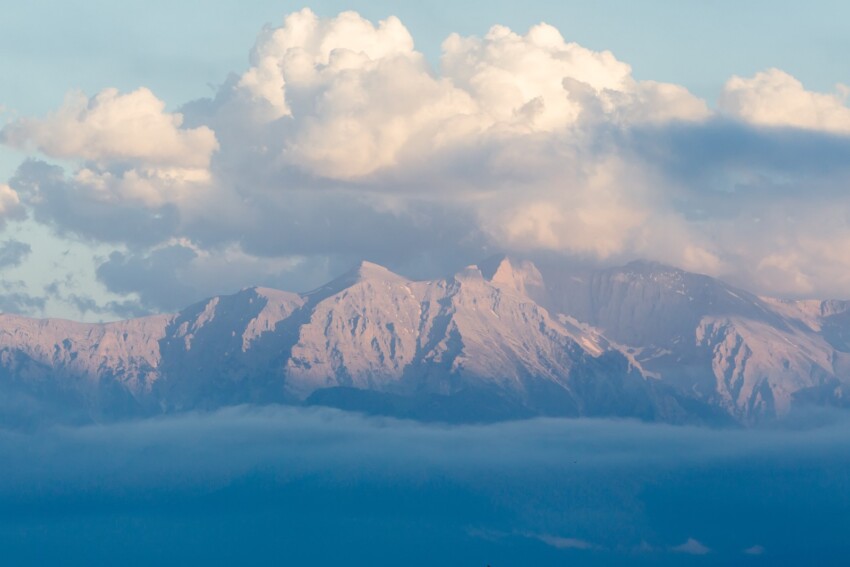
Mount Olympus, called ‘Olympos’ by the Greeks, at 2917 metres above sea level is the highest mountain in the country and is a place with a truly unique and fascinating history. Since the time of the ancient Greeks, in fact, Mount Olympos was considered the ‘holy mountain of the gods’ and was a territory not accessible to human beings. This mountain, however, is not only linked to ancient Greece but also to the figure of Alexander the Great, who often visited the city of Dion at the foot of Olympus. Over the centuries, this massif has inspired myths and legends and bewitched writers, poets, rulers and soldiers. Now let yourself be captivated by this land and treat yourself to the thrill of a visit to the legendary Mount Olympus.
The Mount rises in an area north of Greece, between Thessaly and Macedonia, and is part of the Mount Olympus National Park, which was established in 1938. Due to its great natural and cultural importance, Mount Olympus was declared a UNESCO Biosphere Reserve in 1981. This area is a site of outstanding excellence in which the protection of the natural environment takes place in complete harmony with the social and economic development of the local communities. There are numerous villages with an ancient history that have developed at the foot of Mount Olympus and have been able to preserve the appearance of yesteryear by carrying on traditions with a history stretching back thousands of years.
The park covers an area of around 120 square kilometres and contains a unique floral and faunal heritage. In addition to more than 1,500 different types of plants, there is an initial zone of evergreen broadleaf trees (between 300 and 500 metres), to which are added beech, fir and conifer woods and the unwooded high mountain meadows. In terms of fauna, there are more than 30 species of mammals and hundreds of species of birds, reptiles, insects and butterflies.
Lovers of hiking in the midst of nature can find a wide variety of trails and itineraries of varying length and difficulty here. In addition to these, there are thousand-year-old archaeological sites, small towns and many sacred places.
There is a large number of churches and monasteries on Mount Olympus, some of which date back to the 11th century and are repositories of a long history. These are frequented not only by many praying pilgrims but also by visitors from different parts of the world.
The ancient Monastery of Agios Dionysios is actually composed of two different complexes: the older one is located at an altitude of 830 metres, while the other was built in the 1950s and houses a brotherhood of twenty-four monks who organise many spiritual and charitable activities.
The oldest monastery is located some 17 km away from Litochoro, inside the Enipeas Gorge. The foundation of the monastery dates back to 1542 by the monk Agios Dionysios who decided to open a monastery and dedicate it to the Holy Trinity.
Unfortunately, during the Second World War, the old monastery was almost completely destroyed by bombing and was only partly rebuilt respecting its original architecture. The tomb of Agios Dionysios is still inside the restored catholicon of the monastery.
From the monastery starts a magnificent path through the greenery that leads in about thirty minutes to the Holy Cave (Agion Spilaion) of Agios Dionysios, where there is a spring of holy water.
At an altitude of 2800 metres, Mount Olympus is home to the Church of the Prophet Elijah, which is known to be the highest church in the Balkans. The religious building stands on the Plateau of the Muses and was built in the 16th century by the monk Dionysius, who also founded the Holy Trinity Monastery.
The building has a very simple structure. Inside is a small altar framed by icons depicting the saints of the Orthodox Church. The view from up there is truly spectacular, so it is recommended that everyone take the scenic walk to the church.
Litochoro is a small Greek town nestled between Mount Olympus and the Thermaic Gulf on the Aegean Sea. Thanks to its location, Litochoro boasts a unique climate, as a salty sea breeze blows on one side and fresh mountain air blows on the other.
The town has retained its original appearance and is characterised by small alleys, houses built according to Macedonian architecture and craftsmen’s workshops.
Litochoro is considered by many to be an ideal base from which to explore the Olympus area due to its location and the presence of several good accommodation facilities.
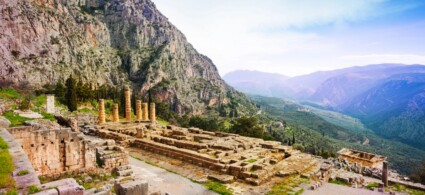
Dion is a locality in Macedonia that lies at the eastern foot of Mount Olympus. Considered to be a holy city of the Macedonians since antiquity, several excavations have been carried out in Dion that have unearthed truly ancient remains. The finds date back in particular to the 5th century B.C. when the Macedonian civilisation was led by King Archelaus.
The Archaeological Park of Dion includes the Ancient Theatre, which is where performances and tragedies are still staged today, the Ancient Livitra and the burial place of the mythical Orpheus, poet and musician of antiquity. There is also a beautiful Archaeological Museum here, which houses the numerous artefacts found during excavations in Dion and the surrounding areas.
Not to be missed is a visit to Platamonas Castle, one of the most beautiful and best-preserved fortresses in Greece dating back to the Frankish era.
The Holy Monastery of the Virgin Mary Kanalon was founded by two monks, Damian and Joachim, in the 11th century. The site is located at an altitude of 820 metres near the town of Leivithra. Over time, the building has undergone several renovations that have allowed it to reach us almost intact. Now the monastery houses a female monastic community belonging to the Holy Metropolis of Elassona.
The Enipeas Gorge is a beautiful natural site that can be reached by a route through the countryside. You can follow a roughly 9 km long route (with more than 700 metres of altitude difference) that winds through the valley of the Enipeas River. The starting point is the car park of Prionia while the finishing point is Myloi, a locality just outside Litohoro.
The forest path allows one to visit the Enipeas Gorge by crossing several wooden bridges. Along the walk you pass the monastery of Agios Dionysios and you will also find a series of natural pools that were created by the flow of waterfalls. In these pools you can bathe in cool, clear waters, so don’t forget to bring your swimming costume.
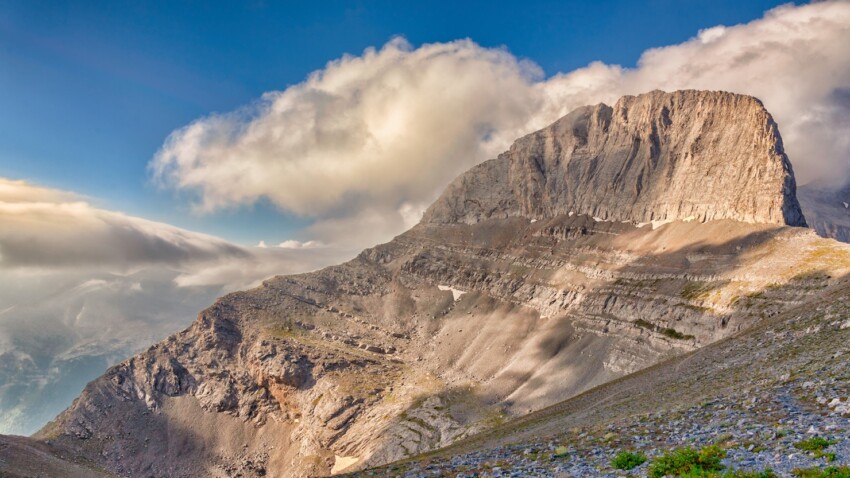
Within the Mount Olympus Park there are several hiking trails, but also scenic walks that lead to the discovery of small villages, waterfalls or ancient monasteries. Among the most beautiful, but also most demanding routes is certainly the one that leads up to the Mytikas peak (2917 metres) , which is the highest point of Mount Olympus. The route usually starts from Prionia, the last village accessible by car, which is located at an altitude of 1,100 metres and from there you can reach the peak in about two or three days. This is a hike for trained people who can walk for up to 7 to 8 hours a day for several days.
A somewhat easier route to do in a day is the Agios Konstantinnos – Koromilia – Petrostrouga route. This route offers spectacular views, starting from Agios Konstantinos and following the forest road from Dion to Koromilia. Halfway along the hike you pass Kokkinos Vrachos where you will find the most beautiful waterfalls of Mount Olympus as they are 18 metres high. This is also for experienced people as the route is approximately 9 km long but has more than 1,000 metres of positive altitude difference.
Among the easier scenic walks, on the other hand, is the one that leads to the Prophet Elias Church. The starting point is the Rifugio Giosos Apostolidis and from there in about 1 km (with 150 metres of positive height difference) it is possible to reach the church, which is located at an altitude of 2,800 metres and offers views of truly breathtaking panoramas.
Litochoro, Athens and Thessaloniki are just some of the towns from which most people decide to visit Mount Olympus. In these cases, one of the best solutions is to take advantage of a guided tour to discover the area. Guided tours include not only transfers to the starting point for the Mount Olympus excursion (a very important detail if you have not rented a car) but also the presence of an experienced guide who will lead you to discover the main sites of interest.
The car (or the private bus organised by tour operators) is definitely the best way to get to Mount Olympus.
From Thessaloniki it takes just over an hour to reach the town of Litochoro, which is located right at the foot of the mountain. The destination is reached by travelling first along the A1 and then along the E75 to the Litochoro/Dion exit. From Athens, on the other hand, it takes approximately four and a half hours to reach the town by travelling along the E75.
Those wishing to travel by public transport from Thessaloniki can take the train to Litochoro in just over an hour. From Athens it takes approximately four hours to get to Litochoro and it is necessary to change trains in Larissa.
The nearest airport is Thessaloniki, which is approximately 110 km from Litochoro.
The choice of where to stay to visit Mount Olympus is really relevant to avoid wasting too much time travelling. Thessaloniki is one of the most popular starting cities for those who want to visit the mountain. This is a location not too far from Mount Olympus that boasts many different types of accommodation, so it is easy to find accommodation to suit your needs.
Alternatively, it is also possible to stay in Litochoro, a small town at the foot of Mount Olympus where accommodation and restaurants can be found.
For those who want to reach the top of the mountain, accommodation is available in refuges along the route, but it is always best to book a place in advance.
Mount Olympus, in Greek ‘Ὄλυμπος’, was considered by the ancient Greeks to be the abode of the gods, so much so that it was thought that the throne of Zeus, who was known as ‘the Lord of Olympus’, was located at its summit. It seems that it was the writer Homer who first identified Olympus in his writings as the ‘home of the twelve Olympian Gods’. Its summit was, thousands of years ago as today, continuously surrounded by clouds that were said to conceal the luxurious dwellings of the gods built by Hephaestus, the god of terrestrial fire.
According to legend, Zeus, after ousting his father Cronus and winning the fight over the Titans and Giants, established a new divine order by dividing the world with his two other brothers, Poseidon and Hades. This decision resulted in Zeus becoming god of the sky, Poseidon god of the sea and Hades god of the underworld.
According to the various tales that have come down to us, life on Olympus proceeded amidst vicissitudes and quarrels between the 12 gods, but they often gathered at banquets where they ate nectar and ambrosia and were cheered by the presence of the Muses. The ascent to Mount Olympus was precluded to human beings and anyone who attempted it would have been lost in the curtain of clouds surrounding the Mount and would never have made it back.
 Hotel
Hotel  Budget accommodations
  Apartments
  Family Hotel
  Luxury Hotel
  Resorts