Mediterranee
Patra - Agiou Nikolaou 18
Book now
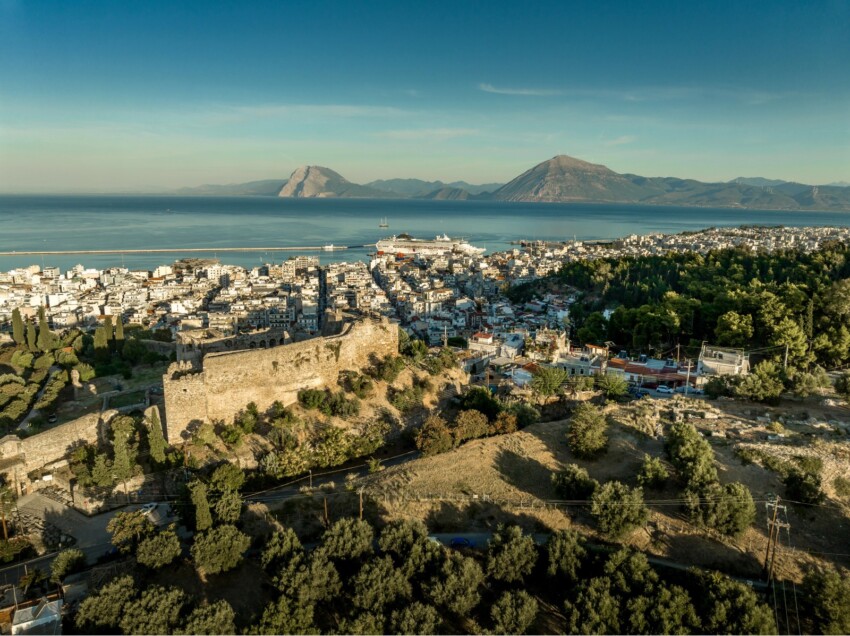
Patras (in Greek Pátra) is Greece’s third-largest city by population, with approximately 300,000 inhabitants, and the principal port of the Peloponnese. For many travellers arriving from Europe by ferry, it is their first contact with mainland Greece: they disembark, climb into a car and drive off towards the Peloponnese or Athens without ever truly stopping. Those who take a day, or even just a few extra hours, discover a layered city that is anything but anonymous, with four thousand years of history, a vibrant university scene and some of Greece’s most underrated monuments.
The city develops on a hillside sloping down towards the Patras Gulf, with the modern port below and the historic district of Ano Poli above, where low-rise houses with their flower-filled balconies stand alongside the walls of the medieval Kastro. In between, the nineteenth-century Neoclassical centre, rebuilt after the War of Independence in 1821, with the colonnades of Georgiou Square and the mansions along the waterfront that reveal the ambitions of a city that aspired to become the capital of the new Greek state.
Patras is also a university city, home to one of Greece’s largest universities, which ensures constant cultural energy and a vibrant scene of bars, music and gastronomy that far exceeds what you might expect from a transit hub. Its Carnival, held every year between January and March, is the largest and most participated in Greece, second in importance in Europe only to those of Venice and Nice, featuring costumed processions, allegorical floats and weeks of celebrations that involve the entire city. The city’s patron saint is the Apostle Andrew, whose relics are housed in the basilica bearing his name, a pilgrimage site for Orthodox Christians from around the world.
Patras is not a postcard city, but it is a city meant for walking. Its main attractions are concentrated in two distinct areas: the Neoclassical centre around Georgiou Square and the upper district of Ano Poli, connected by sloping streets and a funicular railway. Beyond the urban perimeter, the Rio-Antirrio Bridge and the rack railway to Kalavryta round out a surprisingly rich tourist landscape.
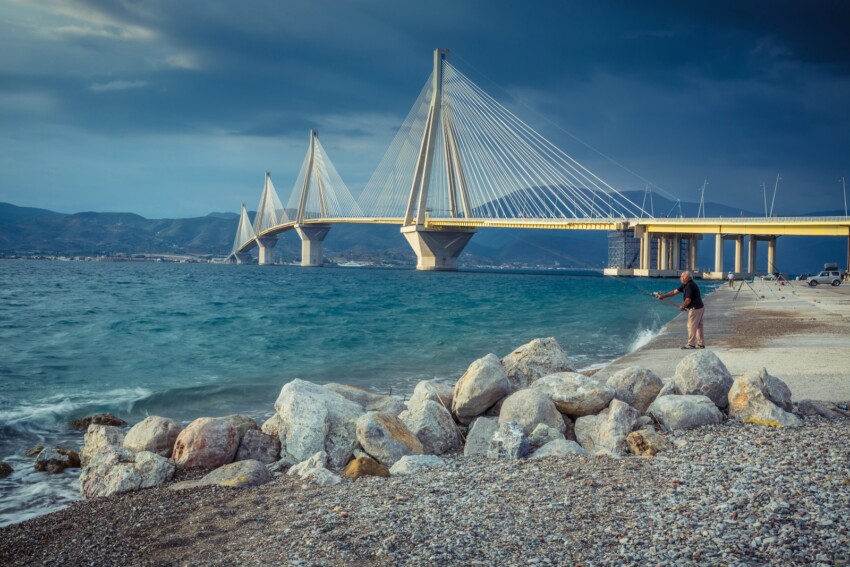
The Rio-Antirrio Bridge, inaugurated in August 2004 for the Athens Olympic Games, is the most impressive engineering work of modern Greece and one of the most technically advanced in the world. It spans the Gulf of Corinth for a total of 2,880 metres, of which 2,252 metres is the main span supported by four pillars 164 metres high, placed on seabeds as deep as 65 metres in an area of high seismic activity. The anchoring system for the pillars, designed to withstand earthquakes exceeding magnitude 7, was conceived by engineer Jörg Schlaich and represents a technical solution still studied today in European engineering faculties. Before its construction, the only way to cross the gulf was by ferry between Rio and Antirrio, a service that had connected the two shores for centuries.
The bridge is visible from the entire Patras bay and dominates the city’s skyline from the waterfront. To appreciate it up close, the best way is to walk or cycle along the pedestrian walkway: the view over the gulf, with the profile of the Acarnania mountains on one side and the Peloponnese on the other, is among the most striking in mainland Greece.
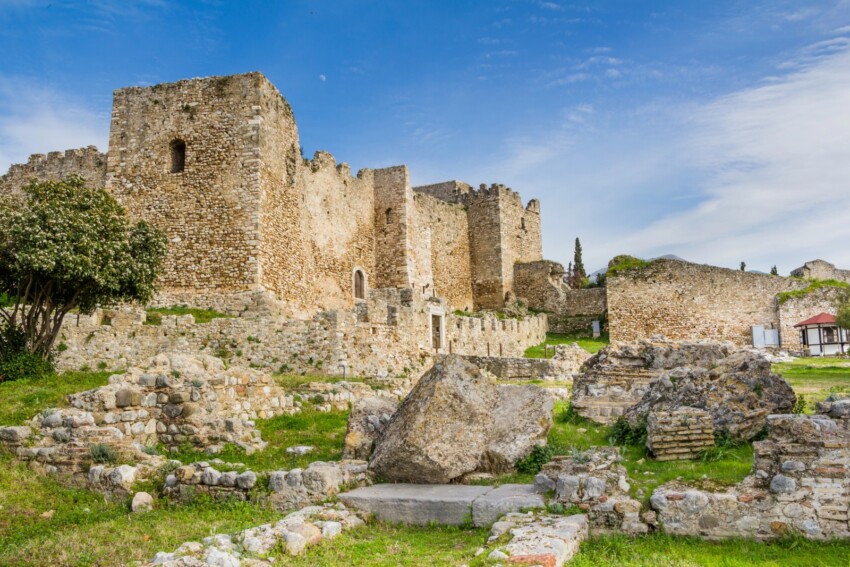
The Patras Kastro is the medieval fortress that dominates the city from atop the hill, originally built by the Romans on the pre-existing Greek acropolis and later rebuilt by the Byzantines in the sixth century, then by the Franks, Venetians and Ottomans in successive phases that layered one upon another. The sixteenth-century Venetian curtain wall is the best preserved, with its corner towers and main entrance on a round arch. Within the enclosure are remains of buildings from various periods, wells, cisterns and the ruins of a small church. The fortress is surrounded by a park with pine groves that provide shade and coolness even on the hottest days.
The real reason to climb to the Kastro is the view: from here you embrace the entire Patras bay, the Gulf of Corinth, the Rio-Antirrio Bridge and, on clear days, the silhouettes of Cephalonia and Zante on the horizon. At sunset, the raking light on the waters of the gulf makes the spectacle particularly striking. You can reach it on foot by climbing through Ano Poli in about twenty minutes from the centre, or by car following signs for the acropolis. Opening hours: generally open daily from 8:00 to 20:00 in summer, with reduced hours in winter. Admission is free.
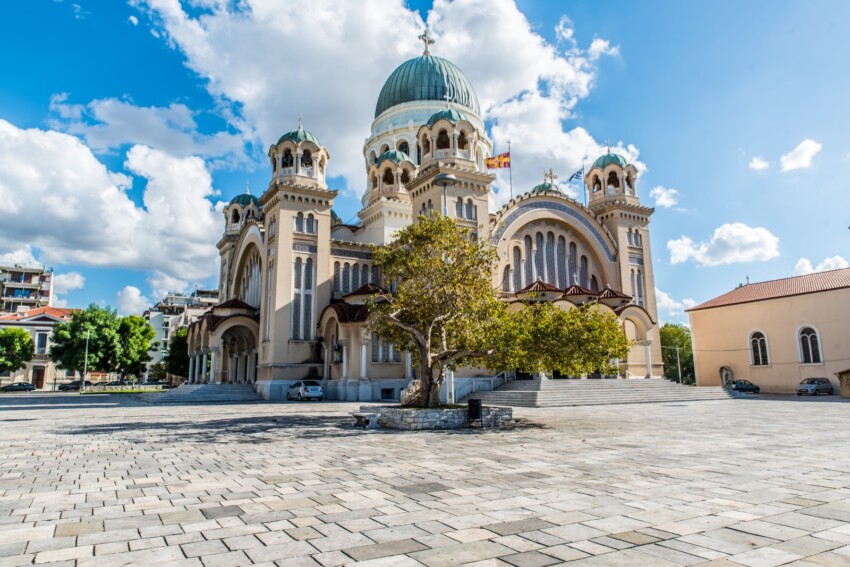
The Basilica of St Andrew is the largest religious building in Orthodox Greece and one of the principal Christian pilgrimage sites in the Eastern Mediterranean. Built between 1908 and 1974 on the site where, according to tradition, the Apostle Andrew was martyred in the year AD 60 on an X-shaped cross (still called the “Cross of St Andrew” today), the basilica can accommodate over 7,000 worshippers in its main nave. The central dome, covered in green tiles, is visible from every corner of the city and from the bay. The interior is lined with polychrome marble and frescoes on gold backgrounds created by Greek artists of the twentieth century, in a style that revives Byzantine tradition whilst adapting it to the scale of a modern place of worship.
The church preserves the relics of St Andrew: the apostle’s head, kept in a silver reliquary, and a fragment of the cross on which he was martyred. These relics remained in Patras until 1460, when they were taken to Rome to save them from the Ottoman invasion, and returned only in 1964 at the wish of Pope Paul VI, in a gesture of reconciliation between the Catholic and Orthodox churches. The feast of the patron saint, 30 November, draws tens of thousands of pilgrims. The basilica is open daily and admission is free. It is located just a few minutes’ walk from the port, so it is easily visited even for those with only a few hours before re-boarding.
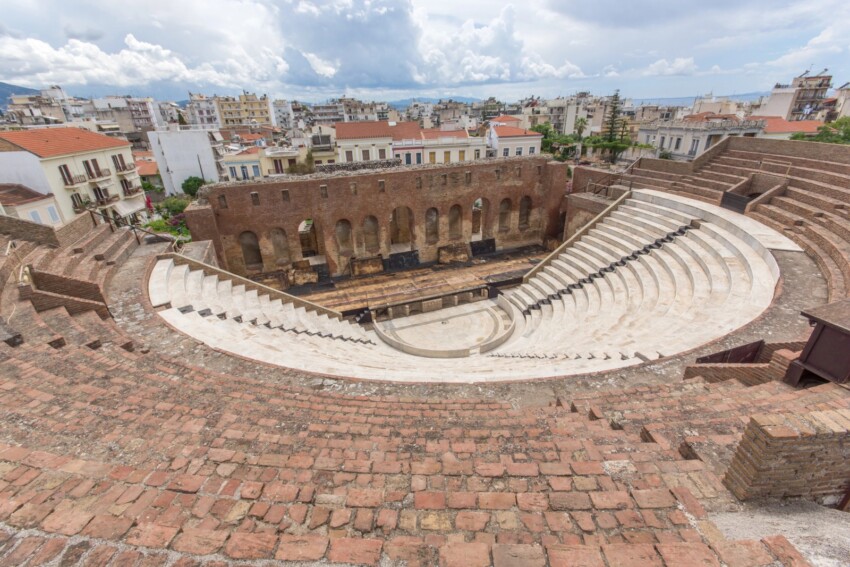
The Roman Odeon of Patras is one of the best-preserved ancient theatres in Greece, built in the first century AD on a pre-existing Hellenistic structure and restored during the twentieth century with original materials recovered during excavations. With a capacity of approximately 2,300 spectators, it features the characteristic horseshoe shape with white marble seating arranged on the natural slope of the hill, the stage with three entrance doors and remains of the rear portico. Unlike many ancient Greek theatres, the Patras Odeon still has perfectly functional acoustics, so much so that it is regularly used for concerts, dance performances and theatrical productions during the summer months as part of the Patras Cultural Festival.
The theatre is located in the upper district of the city, just a few minutes’ walk from the Kastro, and both sites can be comfortably visited in the same morning. Excavations around the Odeon have uncovered further Roman structures, visible through protective panels around the perimeter. Opening hours: from 8:00 to 20:00 in summer, with earlier closing in winter. During the summer festival period, advance ticket purchase for evening performances is recommended as seats sell out quickly.
The Patras Archaeological Museum is one of the most important regional museums in Greece and houses a collection spanning from Prehistory to late Roman antiquity. Its most significant galleries are those dedicated to the Roman imperial period, when Patras was Colonia Augusta Aroe Patrae, one of the few Roman colonies in Greece and a leading commercial centre on the Gulf of Corinth. The showpieces of the collection are the floor mosaics from the second and third centuries AD, discovered in residential buildings in Patras: the mosaic depicting “Theseus and the Minotaur” and the one with “Ariadne and Dionysus” display pictorial quality comparable to the finest examples from Pompeii. Noteworthy too is the section dedicated to Roman glass, with over 500 pieces documenting the production techniques of the era.
The museum is housed in a modern building that facilitates chronological reading of the collections. Labels are in Greek and English. A complete visit takes approximately one and a half hours.
Georgiou I Square is the social and architectural heart of Patras, one of the most elegant Neoclassical squares in Greece. Designed by Bavarian architect Friedrich von Gärtner in the first half of the nineteenth century and completed by Greek architect Stamatios Kleanthis, the square is ringed by continuous colonnades on all four sides, with three-storey Neoclassical buildings housing cafés, bookshops and shops. At the centre is the public garden with mature trees offering shade during the hottest hours. The Apollo Theatre, overlooking the square and inaugurated in 1872, is one of Greece’s oldest opera houses: its Neoclassical façade with Ionic columns is one of the city’s most photographed architectural elements.
From the Neoclassical centre, pedestrian shopping streets radiate out towards the Patras waterfront, revitalised in recent years with a promenade running from the port to Rio. The Agiou Nikolaou district, the main pedestrian high street of the centre, comes alive from 6 pm onwards with bars, tavernas and clubs frequented by the university population. Walking towards the port you still encounter some of the nineteenth-century Neoclassical mansions that survived the chaotic growth of the twentieth century, with their wrought-iron balconies and pastel-coloured façades. The city that nineteenth-century Greeks imagined as the capital of the new state still has, in these streets, the outline of that ambition.
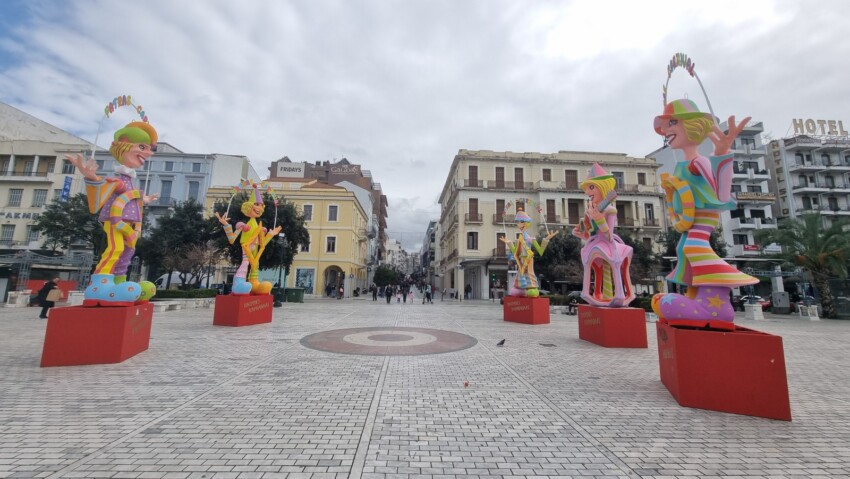
The Patras Carnival is the largest in Greece and one of the most important in Europe, with documented origins tracing back to the seventeenth-century Venetian rule. Every year, between January and March, the city transforms for weeks into a festive space involving the entire population: costumed processions, masked balls in the squares, theatrical events, concerts and the traditional children’s carnival, with thousands of children in costume parading on the Saturday before Shrove Tuesday. The climax is the grand procession on Saturday evening, with allegorical floats up to ten metres high paraded for several kilometres through the crowds, followed by the symbolic burning of the “Carnival King” on the seashore.
The Patras Carnival attracts around 500,000 visitors annually during peak season. Those wishing to participate should book accommodation at least two months in advance, as availability runs out quickly throughout the city and surrounding areas. The full programme of events is published on the Patras Carnival official website, typically from December onwards. Beyond Carnival dates, it is worth noting that Patras also hosts the International Film Festival in autumn and a calendar of musical and theatrical events during the summer at the Roman Odeon.
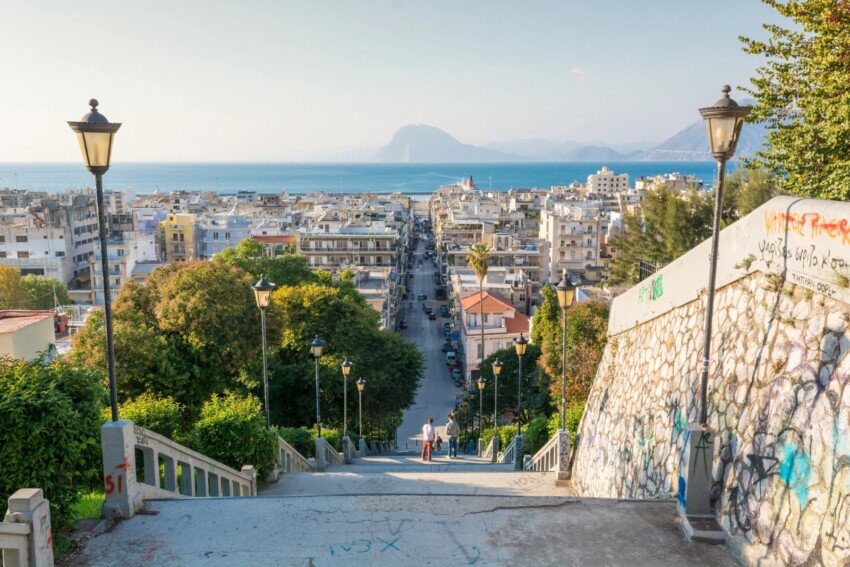
Ano Poli, the “upper city” of Patras, is the quarter that best preserves the character of past centuries. As you climb the flights of steps and sloping streets rising from the lower city, you encounter brick and timber houses with pot-filled balconies, small churches nestled between buildings, craft workshops and informal tavernas serving home cooking. It is still an authentic quarter, inhabited by families who have lived here for generations, far from organised tourism. The St Nicholas staircase, descending from the Kastro towards the centre, is flanked by murals created by local and international artists, one of the most visible signs of the cultural renewal that has touched Patras over the past decade.
Not far from the centre, the old port district is undergoing a transformation similar to that of Ladadika in Thessaloniki: the old port warehouses, decommissioned when commercial activities shifted to the new port, are being converted into cultural spaces, galleries and restaurants. The Carnival Museum, opened in a restored building near the waterfront, traces the history of the Patras Carnival with original costumes, archival footage and documentary materials. Admission is free and a visit, even for those not particularly interested in Carnival itself, offers an interesting window into Greek popular culture.
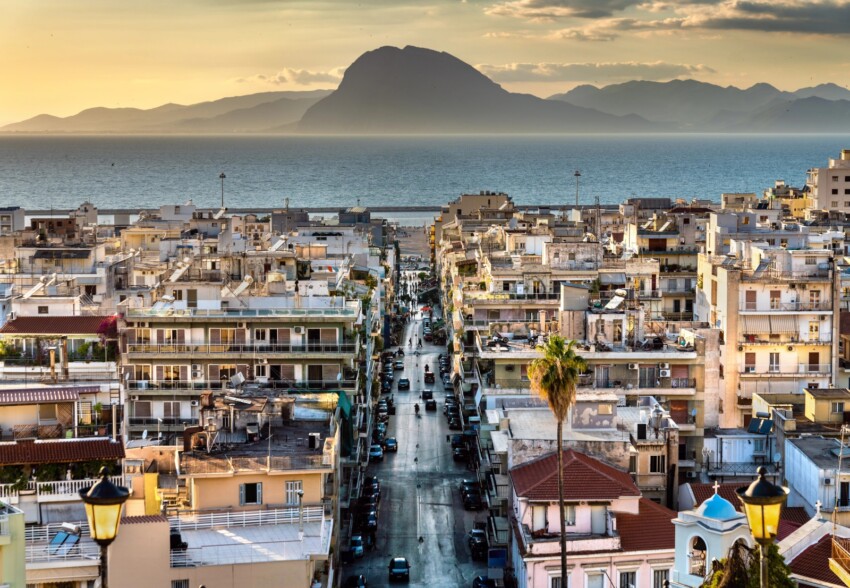
Patras boasts a diverse range of accommodation options with prices generally lower than classic tourist destinations. The most convenient area for tourists transiting through the port is the neoclassical centre around Georgiou Square, just a few minutes’ walk from the ferry terminals: mid-range to upmarket hotels housed in restored period architecture, with direct access to waterfront restaurants and main attractions. Those seeking the heart of the nightlife scene head to the Agiou Nikolaou district, the main pedestrianised street, featuring boutique hotels in 19th-century buildings with bars and clubs right on your doorstep. For those arriving by car who prefer to avoid city-centre traffic, Rio, six kilometres north towards the bridge, offers smaller hotels with easy parking and equipped beaches within easy reach.
Prices in Patras are generally lower than Athens and Thessaloniki: a good mid-range central hotel costs between €70 and €150 per night during peak season. Availability drops significantly during Carnival, when booking well in advance is essential.
Patras is Greece’s principal gateway port from Western Europe. The port, divided into the south port (Terminal A, for international ferries) and north port (for the Ionian Islands), connects directly with major Adriatic ports. International ferries arrive at Terminal A, located about 4 km from the centre and reachable by taxi in just a few minutes. For information on ferry routes and schedules, see our guide to Patras port.
Those arriving by air have two main options. Araxos Airport (code GPA), 45 km from Patras, operates mainly in summer with charter flights and some low-cost routes from Central and Northern Europe: it’s the most direct option, but flight frequency is limited. Alternatively, Athens International Airport “Eleftherios Venizelos” (ATH), roughly 220 km away, offers connections worldwide and is reached from Patras by direct KTEL buses in approximately 3 hours, with departures every half hour from Othonos-Amalias station near the waterfront. For details on flights and connections to Patras airport, see the dedicated guide.
Those travelling overland can reach Patras from Athens in around 2 hours 30 minutes via the A8 motorway (E65/E94): a scenic stretch overlooking the Gulf of Corinth with the canal visible from above in the early part of the journey. KTEL buses run every half hour between the two cities. The train, operated by Hellenic Train, covers the same route with intermediate stops in approximately 3 hours, offering the chance to admire the gulf from the carriage windows.
Patras is an ideal base for exploring the Peloponnese and the Ionian Islands. Car hire allows you to explore with maximum flexibility among archaeological sites, monasteries and coastal areas.
The archaeological site of Olympia lies around 110 km from Patras, roughly 1 hour 40 minutes’ drive south along the western Peloponnese. This is where the ancient Olympic Games were held for twelve consecutive centuries, from 776 BC to 393 AD. The site preserves the remains of the Temple of Zeus, the largest in the Peloponnese, and the Temple of Hera, one of Greece’s oldest. The original stadium, with its 192-metre earth track, remains walkable. Olympia’s Archaeological Museum houses the pediment of the Temple of Zeus and the celebrated statue of Hermes by Praxiteles. A full day is needed to explore both the site and the museum.
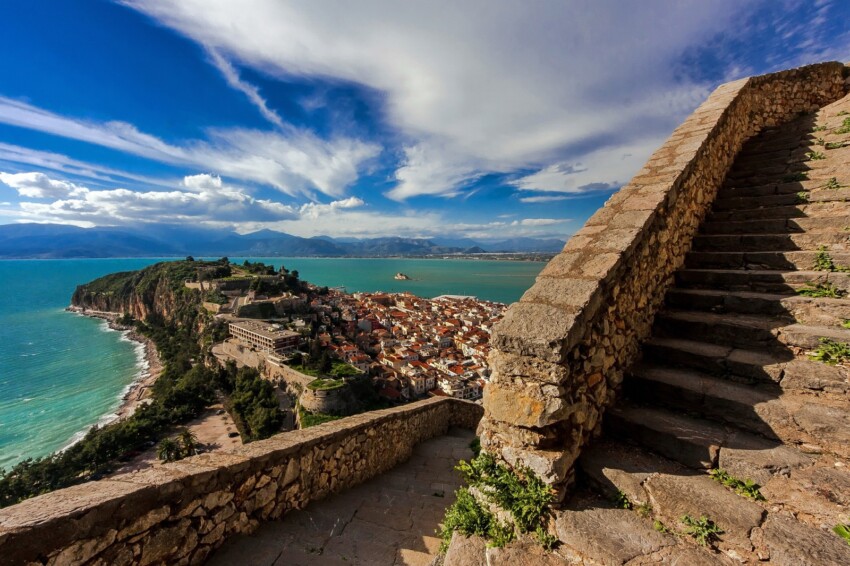
The Peloponnese opens south of Patras with an unmatched density of historical sites and landscapes in Greece. Nafplio, around 180 km away, was the first capital of the modern Greek state, with an intact Venetian centre and the Palamidi fortress towering above the city via 216 steps. Mycenae, 190 km away, preserves the Lion Gate and the Treasury of Atreus, 14th-century BC tholos tombs. Epidaurus, 210 km away, boasts ancient Greece’s most acoustically perfect theatre, with 14,000 seats and preservation allowing summer theatrical performances to this day. Sparta and Mystras, further south, require at least an additional night’s stay to be seen with proper attention.
Seasonal ferries depart from Patras’s north port for Kefalonia and Ithaca, with crossings of around 3 hours. Kefalonia, with its white pebble beaches and emerald waters, Melissani caves and the village of Fiskardo, ranks among the Ionians’ finest destinations. Smaller and less crowded Ithaca retains an authentic atmosphere and hilly landscapes that fully justify its literary fame as Odysseus’s homeland. Zakynthos is reached by ferry with a change at Kyllini, roughly 80 km south of Patras.
Just 55 km from Patras, crossing the Rio-Antirrio Bridge, lies Nafpaktos, the “Lepanto” of Venetian sources and history books, where in 1571 the fleet of the Holy League defeated the Ottoman fleet in the Mediterranean’s most significant naval battle. The Venetian old town remains intact, with walls descending to the small circular port, one of Greece’s most photographed. The Venetian fortress atop the hill is reached on foot in roughly twenty minutes via the walls. It can be explored comfortably in half a day combined with crossing the bridge.
About 60 km from Patras, reachable in an hour’s drive or by regional trains on the coastal line, lies the departure point for one of Europe’s most spectacular railways. The Diakofto-Kalavryta rack railway, built between 1885 and 1896 by an Italian company for Greek entrepreneurs, winds 22.3 km up the Vouraikos River Gorge through a series of hairpin bends, rock-hewn tunnels and bridges suspended above the torrent’s waters.
At Kalavryta, the terminus, stands the Monastery of Agia Lavra, where on 25 March 1821 the flag of the Greek revolution against Ottoman occupation was blessed: a place of fundamental symbolic importance for modern Greek history. The village of Kalavryta itself is sadly remembered for the massacre of 13 December 1943, when occupying German troops executed all males above 15 years old, 696 people in total.
What's the weather at Patras? Below are the temperatures and the weather forecast at Patras for the next few days.
Patras is located at the north-western tip of the Peloponnese, on the Gulf of Patras, at the entrance to the Gulf of Corinth. It sits approximately 220 km from Athens (2 hours and 30 minutes by car), 110 km from Olympia and 55 km from Nafpaktos. The Rio-Antirrio Bridge connects it directly with north-western mainland Greece, with the Meteora accessible in approximately 3 hours and Igoumenitsa in around 3 and a half hours along the Ionian coast.

 Hotel
Hotel  Budget accommodations
  Apartments
  Family Hotel
  Luxury Hotel
  Resorts