Thessaloniki is one of Europe’s most layered cities: founded in 315 BC by Cassander of Macedon to honour his wife Thessalonica, sister of Alexander the Great, it has experienced Roman, Byzantine and Ottoman rule over two thousand three hundred years, each leaving monuments that remain perfectly legible in the urban fabric. The result is a city where a simple walk takes you from a Roman emperor’s triumphal arch to an Early Christian basilica UNESCO heritage site, through to the lanes of an Ottoman quarter that has remained almost untouched.
Those seeking concentrated attractions will find them here: Thessaloniki’s old town is compact and walkable. The Nea Paralia waterfront, renovated in the 2000s, stretches for roughly five kilometres from the White Tower to the harbour, passing museums, contemporary sculptures and cafés overlooking the Thermaic Gulf. The Roman-imperial sites of the Arch of Galerius and the Rotunda are less than a quarter-hour’s walk from the main square, and the market district is just minutes away from both.
The architectural heritage is recognised by UNESCO, with fifteen Early Christian and Byzantine monuments inscribed in 1988. But Thessaloniki can surprise you on the contemporary front too: the Modiano Market, restored in 2022, has become one of the eastern Mediterranean’s most interesting food spaces, and the metro system inaugurated on 30 November 2024, after twenty years of construction, houses over 300,000 archaeological artefacts discovered during excavations within its stations.
In this guide you’ll find the main attractions of Thessaloniki, organised to help you plan your time based on your interests, complete with opening hours, practical advice and details that only those who know the city well can share. For those coming from the Chalcidice Peninsula or heading to the Meteora, Thessaloniki also makes an excellent base.
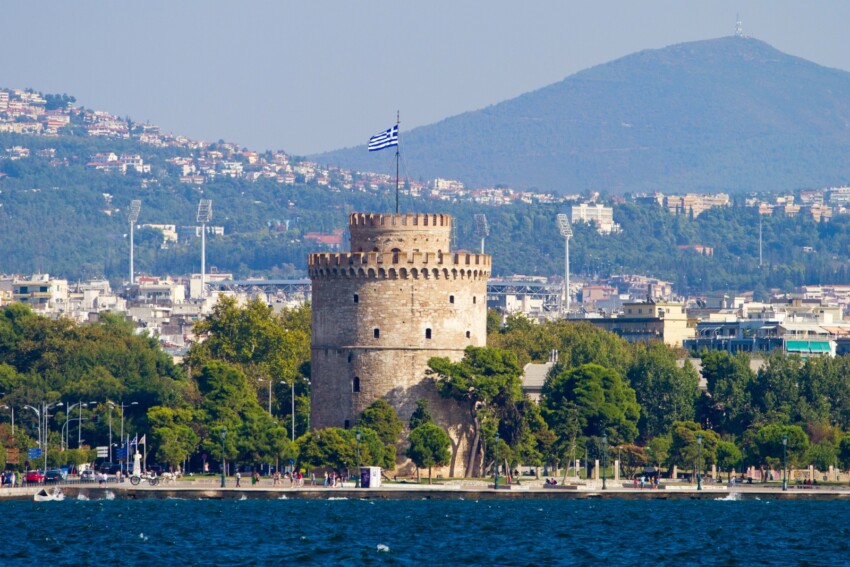
Standing 34 metres high and overlooking the waterfront, the White Tower is Thessaloniki’s instantly recognisable symbol worldwide. Built by the Ottomans around 1535 as part of the city’s defensive system, it served primarily as a prison for three centuries, earning it the name “Tower of Blood” for the executions that took place within. Legend has it—confirmed by some contemporary historical sources—that in 1890 a prisoner was released in exchange for whitewashing the entire structure, hence the current name. Today it houses a multimedia museum dedicated to Thessaloniki’s history, with seven levels covering the Roman period, the Byzantine era, the Ottoman age and the transition to modern Greece in 1912.
The visit takes roughly an hour. It’s worth climbing to the top floor, where the panoramic terrace offers a 360-degree view of the city, the Thermaic Gulf and, on the clearest spring and autumn days, even the foothills of Mount Olympus.
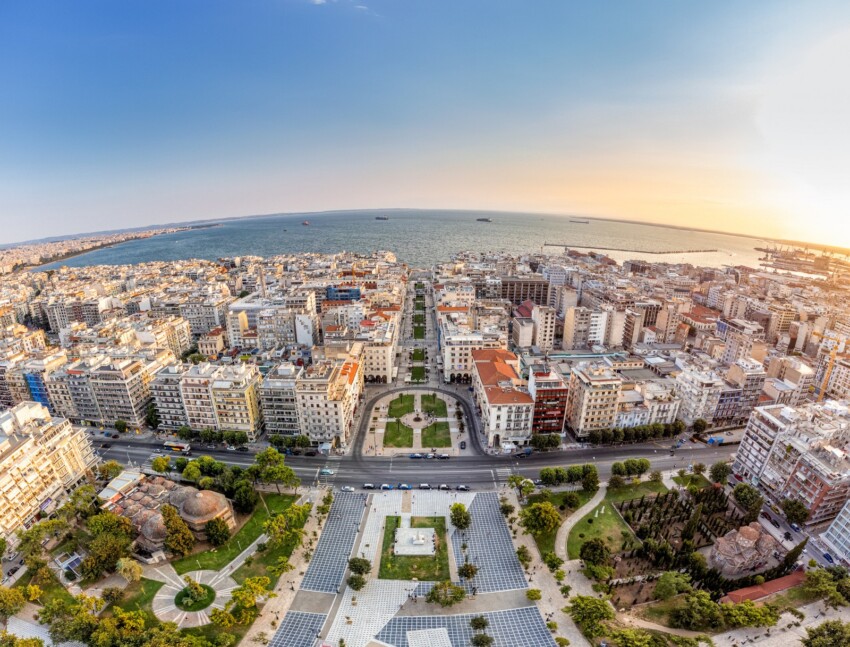
Aristotle Square is the geometric heart of Thessaloniki: a large rectangular piazza open to the sea, designed in the 1930s by urban planner Ernest Hébrard following the great fire of 1917 that destroyed a third of the city. The architecture of surrounding buildings blends Neo-Byzantine and Neoclassical elements, with arcades sheltering ground-floor cafés. This is the right place to start your day with a Greek coffee and observe the city’s rhythm, or to find starting points for walks to nearby monuments. On the seafront side, it opens directly onto the Nea Paralia promenade, the grand waterfront that runs five kilometres to the harbour.
Along the waterfront you’ll encounter the sculpture of the Umbrellas by Zongolopoulos, one of Greece’s most photographed public art installations, particularly striking at sunset when the slanting light from the Thermaic Gulf passes through it. Just beyond stands an equestrian monument to Alexander the Great, six metres high, gazing seaward. The promenade is equipped with cycle paths and benches, and in any season it’s busy with locals and visitors: early morning it’s almost silent, by evening it hums with local life.
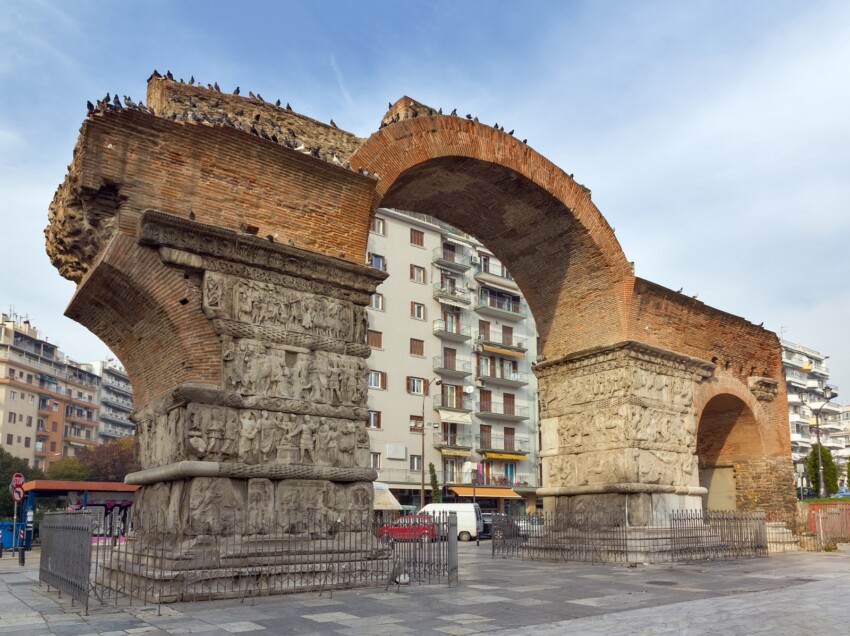
A few minutes’ walk from Aristotle Square, along Egnatia Street, stands the monumental complex that the Roman emperor Galerius had built from 297 AD onwards to celebrate his victory over the Sassanid Persians. The Arch of Galerius, known locally as the Kamara, is one of the best-preserved Roman structures in the Balkans: the sculpted panels on its four pillars narrate in detail the emperor’s military campaigns, with scenes of battles, sacrifices and processions. Look at them closely, as the quality of the carving rivals that of the Arch of Constantine in Rome. The original structure had eight piers; two survive, but they suffice to convey the monument’s imposing scale.
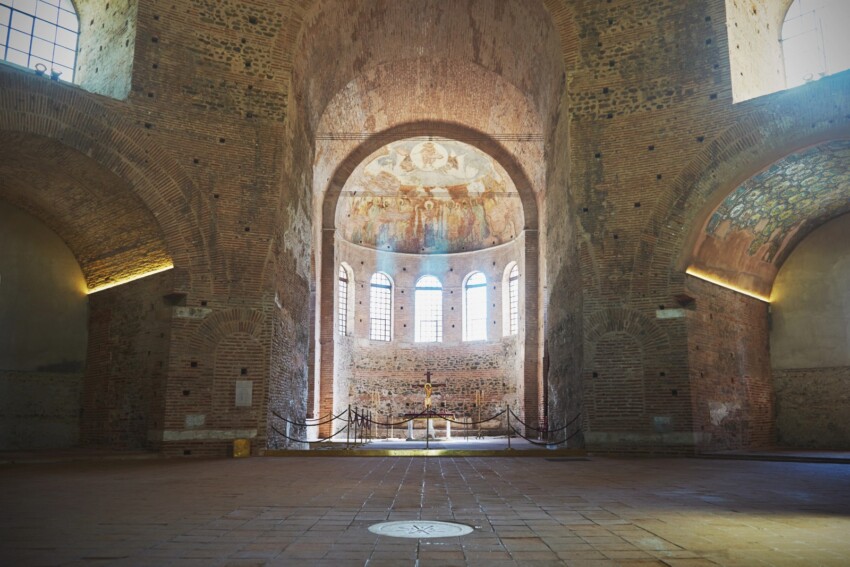
Fifty metres away stands the Rotunda, a circular building with walls over six metres thick, probably built as a mausoleum for Galerius but never used as such. In the 5th century it was converted into a Christian church, then in 1590 into an Ottoman mosque: the adjacent minaret is still visible. The gilded mosaics of the vault, dating to the Early Christian period and restored in recent decades, are among antiquity’s most precious. Both monuments are part of the 1988 UNESCO sites.
The Thessaloniki Archaeological Museum is northern Greece’s principal antiquities museum and one of the country’s most important cultural institutions. Its collections span from prehistory to late antiquity, with particular emphasis on the Macedonian era: it displays artefacts of extraordinary quality from Pella, capital of the Kingdom of Macedon, from Sindos, Vergina and other regional sites. Among the most celebrated pieces is the Derveni Crater, a 4th-century BC bronze vessel decorated with Bacchic scenes in relief, considered a masterpiece of ancient metalwork. The intricately chased gold leaf wreaths, discovered in Macedonian aristocratic tombs, astound with the precision of their execution.
The museum is located in the “Culture Quadrilateral”, alongside the Museum of Byzantine Culture, MOMus and Alexander Park. Allow at least two hours for your visit, three if you have a particular interest in Macedonian archaeology.
Opened in 1994 in a building designed by architect Kyriakos Krokos, the Museum of Byzantine Culture won the 2005 European Museum of the Year Award—a recognition reflecting both the quality of its collections and the way they are presented. Eleven permanent galleries house over 3,000 artefacts documenting the period from the 4th to 15th centuries: mosaics, frescoes, icons, textiles, jewellery and ceramics, largely from Thessaloniki churches and excavations and from Macedonia. A distinctive feature is that many objects, unlike in most other museums, are not enclosed behind glass, and the multimedia presentations are of notably higher quality than the usual standards of historical museums.
Gallery 4, dedicated to the Middle Byzantine period (8th-12th centuries), is not to be missed, with enamelled gold bracelets decorated with birds and rosettes, and a beautifully illuminated Gospel codex on parchment. Gallery 6 explores castle defensive systems through video installations and artefacts from Macedonian castles. The museum has a café, bookshop and educational workshops.
The Basilica of Saint Demetrius is Thessaloniki’s most important Christian place of worship and one of Greece’s largest Early Christian buildings. Built in the 7th century on the site where, by tradition, the martyr Demetrius, the city’s patron saint, was imprisoned and executed during Diocletian’s persecutions. The original five-aisled structure was devastated by fire in 1917 and reconstructed afterwards, but the parts that survived the flames, including some columns and the apse mosaics, display the extraordinary quality of Early Christian art. The 7th-century mosaics depicting Saint Demetrius among the faithful are among Asia Minor’s and the Balkans’ earliest examples of figurative mosaic.
Below the main aisle you can access the crypt, rediscovered in the 1940s during reconstruction work, which preserves the Roman baths where, by tradition, Saint Demetrius was imprisoned. Access to the crypt requires a separate entry and deserves the extra time. The church has been a UNESCO site since 1988. Entry is free, though a contribution may be requested for the crypt. Hours: mornings and afternoons daily, with breaks during liturgical services: check on arrival before entering, especially on 26 October, the saint’s feast day, when the city’s most widely attended annual celebration takes place.
Ano Poli, literally “upper town”, is the only neighbourhood of Thessaloniki spared by the 1917 fire: the flames started here but the wind pushed them downward, leaving this part of the city intact. Climbing along steep, cobbled lanes, you find timber-frame houses of Ottoman-Macedonian style, courtyards with geranium pots, tiny Byzantine churches nestled among dwellings and informal tavernas serving home cooking. It’s a vibrant neighbourhood: as Lonely Planet notes, its inhabitants are often artists, intellectuals and professionals who have chosen a neighbourhood away from city-centre noise. The atmosphere differs from anywhere else in the city.
From Ano Poli you can reach the best-preserved stretches of the Byzantine walls, built in the 4th century and extended in the medieval period, which encircle the hill for several kilometres. The Heptapyrgio fortress (Yedi Kule in Turkish, “seven towers”), the city’s acropolis, served as a state prison until 1989 and is now open to visitors. The finest spot is the Trigonio Tower, from where at sunset you see the entire expanse of the Thermaic Gulf: an experience locals consider among the most characteristic in all northern Greece. To reach Ano Poli, take buses 22 or 23 from Eleftherias Square.
The Modiano Market is one of the eastern Mediterranean’s most interesting food spaces. Built between 1922 and 1930 by architect Eli Modiano in the heart of the old Jewish quarter, it has the form of a covered basilica with around 75 stalls arranged by product type: hard and semi-hard Greek cheeses, olives of every variety, Balkan spices, cured meats, seafood, meat, artisan bread and fresh-baked biscuits. Following its 2022 restoration, which preserved the original glass and iron structure, it now also hosts modern restaurants with balconied terraces overlooking the main market, a bar and a zero-waste brunch spot. Morning is the best time to visit, when the stalls are at full capacity.
Adjacent to Modiano, the Kapani Market dates to 15th-century Ottoman times and is the city’s oldest. Here the tone is rawer and more authentic: fish vendors, butchers, local vegetables and spices in a labyrinth of lanes that feels lived-in rather than touristic. Further on, the Bezesteni, built by Sultan Beyazid in the 15th century with six lead-covered domes, is an Ottoman covered market that mainly sold textiles. Nearby, the neighbourhood of Ladadika, former 19th-century olive-oil warehouses near the harbour, is today the main hub of evening life with restaurants, bars and tavernas in cobbled streets.
Few visitors know that Thessaloniki was home until 1943 to the eastern Mediterranean’s largest Sephardic Jewish community: over 50,000 people, called by contemporaries “the Mother of Israel”, who in the 19th century constituted the absolute majority of the city’s population. The Jewish Museum of Thessaloniki, founded in 1997 and located in the old town, documents seven hundred years of this community’s life through documents, photographs, ritual objects, embroidered textiles and testimony of everyday existence. The 1943 deportation, which sent almost the entire community to Nazi concentration camps, is addressed with rigour and respect in a dedicated section.
The museum occupies a 19th-century mansion and has received funding in recent years for expanding its collections and renovating displays. The visit takes about an hour but is emotionally dense, and many visitors find it shifts perspective on a city often thought of immediately as Greek or Ottoman, overlooking this third fundamental layer of its identity.
In the heart of the old town, near the commercial thoroughfare Egnatia Street, lie the remains of Thessaloniki’s Roman Forum and Agora. The complex, under excavation and study since 1962, was the city’s political and commercial centre during its imperial phase, between the 2nd and 4th centuries AD. The most legible elements are the columns of the northern portico, the agora’s paving in white marble slabs, and remains of the Odeon, a small covered theatre used for lectures and concerts with a capacity of roughly 400. The site is open to the public and partly accessible via raised walkways allowing you to view excavations from above.
A technical detail many visitors appreciate: the stations of the metro system inaugurated in November 2024 incorporate display cases with artefacts found during excavations, particularly at Venizelou and Agia Sophia stations. Stations that are, in effect, underground museums. The most convenient station for the old town is Venizelou, just minutes from the Roman Forum and Modiano Market.
Thessaloniki is far more than ancient history. MOMus, the Metropolitan Organisation of Museums of Visual Arts of Thessaloniki, is a network of museums encompassing the State Museum of Contemporary Art, the Museum of Contemporary Art of Macedonia, the Thessaloniki Museum of Photography and the Centre for Contemporary Art. The Museum of Contemporary Art11 is housed in one of the buildings in the International Fair quarter (Egnatia 154), with rotating exhibitions that bring Greek and international artists into dialogue on themes of political and cultural significance. The temporary exhibitions are among Greece’s most up-to-date, with frequent collaborations with European institutions. It’s worth checking the programme before your visit to see what’s on.
The Museum of Photography12 is located in the restored warehouses of the old port, dating from the 1990s, alongside the Cinema Museum and the Centre for Contemporary Art: a cultural hub that becomes an events venue in the evenings, hosting screenings and special openings. Thessaloniki hosts the International Film Festival every October–November, one of the most important in the Mediterranean, bringing European premieres and art-house films to the city over a week of screenings in city-centre cinemas.
Just 50 kilometres from Thessaloniki—roughly an hour’s drive—lies Pella, the capital of the ancient Kingdom of Macedonia and birthplace of Alexander the Great. The archaeological site, systematically excavated from the 1950s onwards, has revealed a 70,000-square-metre agora, sanctuaries, craft workshops and palaces. What makes Pella essential viewing is the exceptional quality of its pebble mosaics: in the House of Dionysus and the House of the Abduction of Helen, floors of black and white pebbles display scenes from mythology and hunting with a narrative technique and mastery of perspective that is remarkable for the 4th century BC. They rank among the finest ancient mosaics in Greece.
The Archaeological Museum of Pella, adjacent to the site, displays everything that cannot be seen in situ, including sculptures, ceramics, coins and everyday objects. A combined visit to the site and museum typically takes two to three hours. Pella is easily reached by car or regional KTEL buses from Thessaloniki station. If you have more time, you can combine your visit with the site of Vergina (75 km from Thessaloniki), home to the Macedonian royal tombs discovered in 1977, including the tomb attributed to Philip II, father of Alexander the Great.
In the following map you can see the location of the main places of interest mentioned in this article.
To see Thessaloniki’s main attractions properly, allow at least two full days, or three if you want to include a trip to Pella or Vergina. The historic centre is best explored on foot: from the White Tower to the Arch of Galerius is about twenty minutes, and the market district and Jewish Museum are a further ten minutes’ walk. Ano Poli requires some effort for the climb, but it’s accessible by bus. For trips outside the city, car hire in Thessaloniki offers the most flexibility. The best season is spring (April–May) and early autumn (September–October), when temperatures are pleasant and sites are less crowded.
For accommodation, the historic centre between Aristotle Square and the Modiano Market puts most historical attractions within easy reach. If you prefer staying near the waterfront, you’ll find the Ladadika quarter with its restaurants just a few minutes away.
 Hotel
Hotel  Budget accommodations
  Apartments
  Family Hotel
 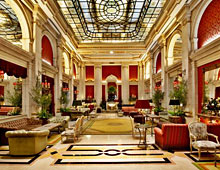 Luxury Hotel
  Resorts