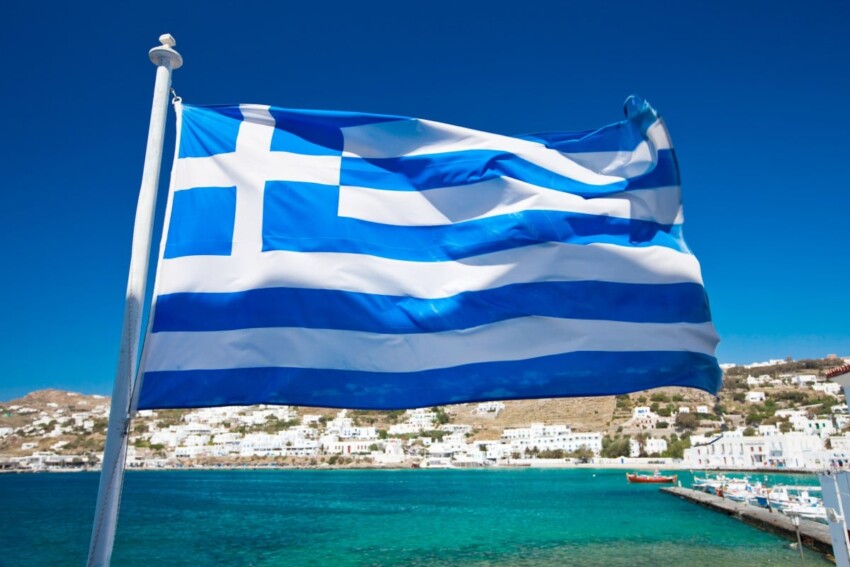
The flag of Greece consists of nine horizontal blue and white stripes and a blue square at the top left on which a white Greek cross is depicted.
The current flag came into force in the 1970s at the end of the colonels’ dictatorship, when Greece became a democratic country again. There are at least eight previous versions since the year of independence from the Turks; they all differ little from the current one.
Greeks seem to be very fond of their national flag and it is indeed very common to see it flying not only in museums and official monuments, but also from terraces, shops, hotels, boats and other privately owned premises. Since you will see it almost everywhere, aren’t you curious to know a little about its history and meaning?
Why is the flag of Greece blue and white? Why are there nine stripes? And is the cross a religious symbol or does it refer to some lineage?
As with many national flags, there is no single explanation for the meaning of the colours and symbols used for the Greek flag. However, let us look at the most common hypotheses.
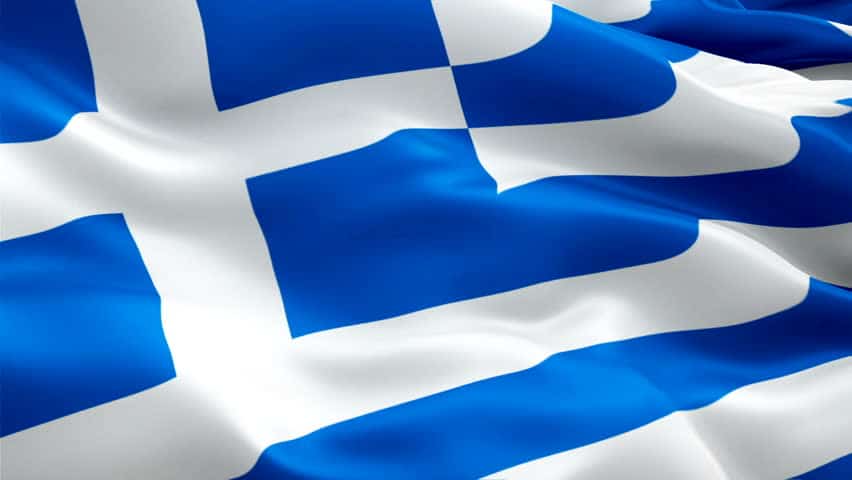
The colours white and blue were the colours of the Royal House of Bavarian origin that ruled Greece from the end of Turkish rule until 1862. This could therefore be the historical explanation for the colours of the Greek flag.
According to another theory, which is widespread but lacks historical foundation, the colours are a visual reference to the sea (blue of the water and white of the foam), an element of the land with which Greece is identified. An even more poetic theory sees blue as the colour of the sky and white as the clouds or the purity of the Greek soul.
The most plausible version seems to be that according to which the number nine is a reference to the victorious Hellenic Revolution that in 1821 put an end to Turkish-Ottoman rule, which had lasted more than 400 years.
Nine are in fact the syllables of the phrase ‘Liberty or Death’ in Greek (E-lef-the-rì-a i Thà-na-tos) and nine are the letters of the word ‘freedom’, both key expressions of the revolutionary movement.
According to other theories there are nine in homage to the muses, mythological figures of ancient Greece who personified the supreme ideal of Art.
The cross seems to bring everyone together: it is clearly the cross of the Greek Orthodox Church. Not only is Orthodox Christianity the official religion of Greece, but the Greek people recognise it as playing a fundamental role in the struggle against the Turks.
It was mainly a cultural role: during Ottoman-Turkish rule, Greeks could not learn to read and write in their own language; knowledge and use of Greek was passed on in unofficial schools run by priests. In this sense, they are credited with a very important role in the formation of national identity.
 Hotel
Hotel  Budget accommodations
  Apartments
  Family Hotel
  Luxury Hotel
  Resorts