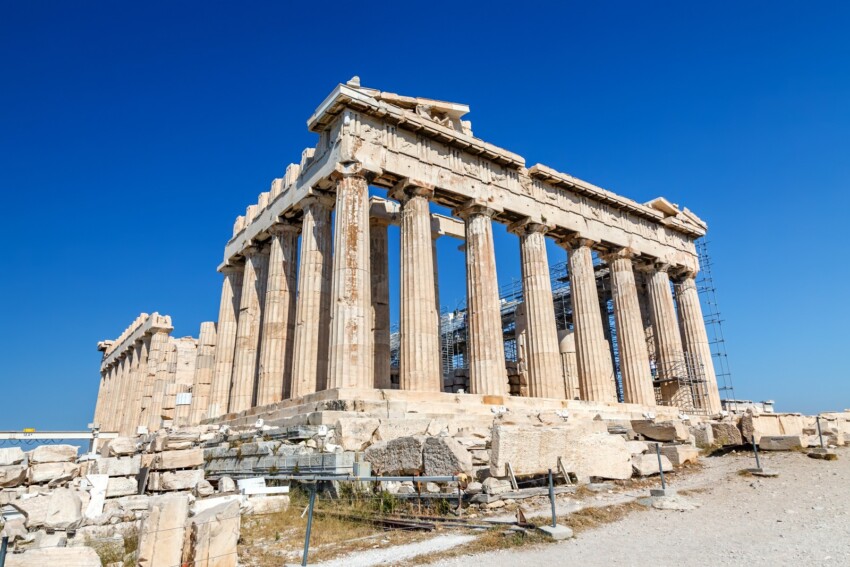
Greece is a land so rich in history, art and culture that it has been called the cradle of western civilisation. The culture of Greece has evolved over thousands of years, starting with the Minoan and Doric civilisations that have left important evidence of their greatness throughout the Greek territory.
Temples and theatres are among the most remarkable surviving buildings. Greece is the place where tragedy and comedy originated and were performed inside majestic theatres, the result of skilful structural calculations that allowed the best staging and the greatest emotional involvement of the audience, places where the polis gathered to celebrate the ancient stories of the myths written by Aeschylus, Sophocles and Euripides for tragedy, Cratinus and Aristophanes for comedy, to name but a few.
Also immense is the ancient Greek philosophical thought of which the greatest representatives were Socrates, Democritus, Plato and Aristotle.
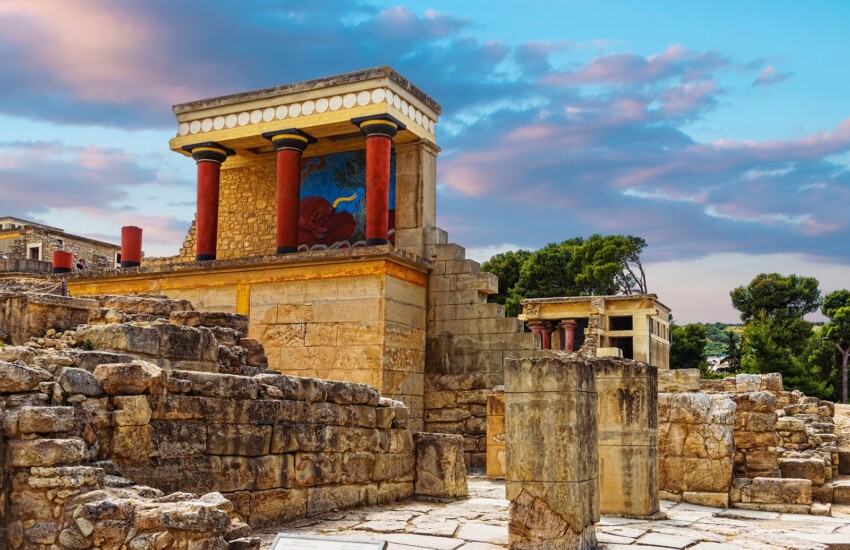
The museums in Greece are many and of great importance, as are the archaeological sites, the most important of which are the Acropolis and the Acropolis Museum, the Agora in Athens, the National Archaeological Museum in Athens, the Oracle of Delphi and the Archaeological Museum in Delphi and the Palace of the Great Masters in the city of Rhodes, spanning more than 4,000 years of history, witness to the greatness first of Mycenaean Greece, then of the Classical period, through the rule of the Roman Empire and later the Byzantine Empire. Other sites not to be missed, also UNESCO heritage sites, are the Minoan palace of Knossos in Crete, the Byzantine monument of Nea Moni in Chios, the Wall of Polycrates and the Tunnel of Eupalinosa in Samos and the perched monasteries of Meteora in Kalabaka.
The Greek people are particularly attached to their traditions, especially on the Greek islands where Greek culture, which varies from village to village, is also passed on through traditional costumes, religious or non-religious festivals and sometimes food. Modern Greek culture tends to combine Western and Eastern elements.
One thing to keep in mind is that Greeks, despite being very religious, are very superstitious and practically everyone thinks that someone can cast the evil eye on them, out of jealousy or envy, through compliments. To avoid the evil eye, among other things, Greeks wear a small blue pearl with a white eye painted on it.
Name day for the Greeks is just as important, if not more so, than birthday, engagement is taken very seriously and is celebrated with a series of rituals that is actually a kind of small wedding, and Easter is the most important religious festival for the Greeks and is a mixture of the sacred and the profane that is very much felt throughout the nation.
Greek cuisine is about sharing food and drink with family and friends and is one of the fundamental elements of the culture.Liqueurs play an important role in meals: Ouzo is the most famous alcoholic drink in Greece, while Tsipouro, in Crete called Raki, is similar to Ouzo but with a stronger aniseed taste.
The Rebetiko originated in Asia Minor and is a sung narration, of popular origin, accompanied by the music of the bouzouki and baglamas. The narrator is a man with a rough voice and the song is opened by taximi (improvisation). The themes generally dealt with, often in a satirical manner, give voice to human feelings and this explains the great popular success that rebetiko had, especially between the 1920s and 1940s.
The bouzouki is a member of the lute family. The number of strings varies from a minimum of 4 to a maximum of 12. Traces of similar instruments can be found in pre-Hellenic and Egyptian civilisations. The baglamas is a small bouzouki, no more than 60 centimetres long, and dates back to Byzantine times, when it was used in churches to give pitch to the singer. Other typical instruments are the outi, a short-handled lute, the sandouri (a trapezoidal stringed instrument) and the tombeliki, a drum.
The Rebetiko dance is the zeibekiko, a series of increasingly complex figures performed by one man. The chassapiko is a dance of three men holding each other by the shoulder and its name, butcher, dates back to the period of Ottoman rule. The tsifteteli is a belly dance performed by a woman.
There are many museums in Greece that contain important archaeological finds from some of the country’s most important archaeological sites such as Delphi, Delos and Olympia, to name but a few, Byzantine museums or folklore museums.
Greece has more than 100 archaeological museums, including the Acropolis Museum, the National Archaeological Museum in Athens and the Archaeological Museum in Thessaloniki, and more than 50 folklore art museums that keep alive the values of rich modern Greek culture. In addition, Greece is home to three theatre art museums, the Greek Theatre Museum, the Kotopouli Marika Museum and the Spathario Ombra Theatre Museum.
Most museums in Greece are open every day except Mondays.
The charm of the past is still alive in Greece and it is impossible not to be captivated by it. Every corner of the Hellenic country is practically an archaeological site: the Peloponnese, Mount Olympus, Delos, Delphi, Argos, Mycenae, Knossos, Sparta, Corinth and, last but certainly not least, the capital Athens.
Since the end of the 19th century, Greece has also been the territory of archaeological missions by other nations. France began and today as many as fifteen foreign countries operate in Greece, each with several excavation groups.
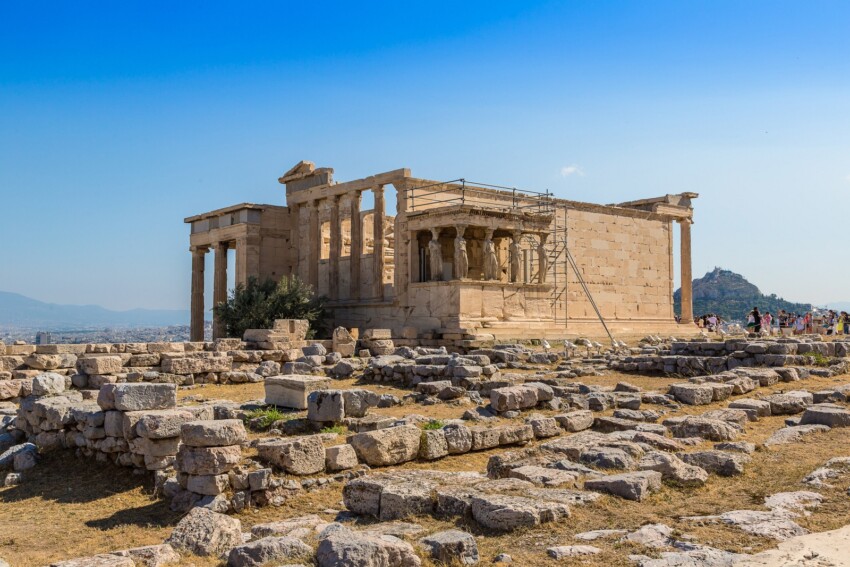
The Acropolis of Athens is the most representative of the Greek acropolises and a monument of global importance. It is a fortress, flattened at the top, that rises above the city of Athens.
It is a coastal settlement included in the municipality of Corinth. Overlooking the Saronic Gulf, the city was, during the Classical period, one of the two seaports of the Doric polis and one of the most important Greek trading ports.
Located in Anatolia, in the region of Caria, Knidos was an ancient Greek city. Some monumental remains of the ancient settlement survive, such as cyclopean walls, the remains of two harbours and two theatres, as well as traces of a large building, possibly a temple.
Located in the central part of the island of Crete, Knossos is the most important archaeological site of the Bronze Age. It was an important centre of the Minoan civilisation and its palace is linked to the myth of Minos and the labyrinth built by Daedalus, and that of Theseus and the Minotaur.
Delphi, also known as Delphi, is an important archaeological site on the slopes of Mount Parnassus. It was the navel of the Greek world, the seat of the most important and revered oracle of the god Apollo.
Delos or Delos is a small island in the Cyclades near Mykonos. In antiquity the island was called Ortigia or Ortyghia, and has been inhabited since 3000 BC.
Epidaurus is a small Greek city in Argolis, known mainly for its sanctuary dedicated to Asclepius and for its theatre, still used today for theatrical performances.
Located in the southern part of the island of Crete, Phaistos is one of the most important sites of the Minoan civilisation.
The Heraion of Samos is a temple dedicated to Hera on the island of Samos in the north-eastern Aegean, built by the architects Theodoros and Rhoikos in 540 BC.
Near the city of Argos, the ancient city of Mycenae had an acropolis, on which the famous Lion’s Gate, the tomb of Agamemnon and the royal palace can be found.
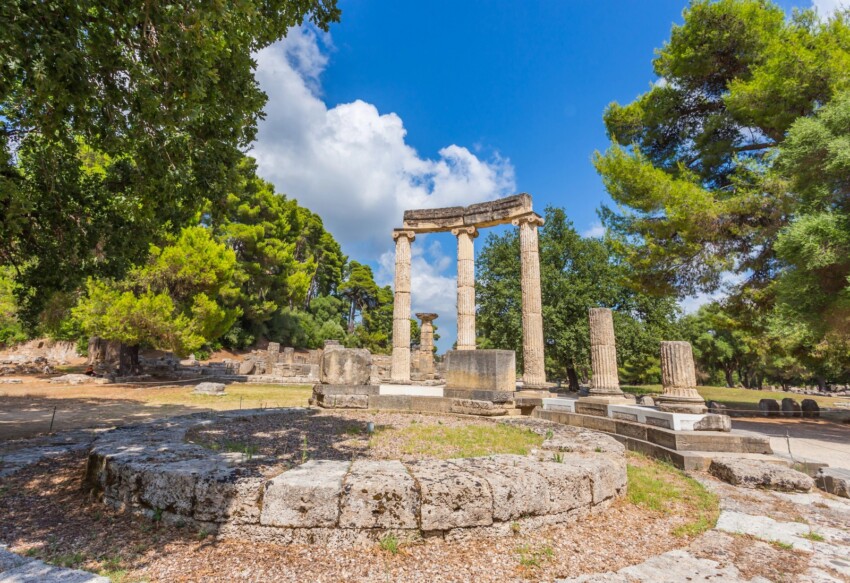
A place of worship of great importance, Olympia is most famous for being the seat of the administration and holding of the Olympic Games.
The Pythagoreion, on the island of Samos, is a complex consisting of an ancient fortified harbour and the remains of numerous structures from Greek and Roman times, including a remarkable ancient aqueduct.
Tiryns is an ancient city in Argolis, Greece. Only a few archaeological remains of the city remain: the walls and the ruins of the Royal Palace, discovered by Heinrich Schliemann between 1884 and 1885.
Vergina or Verghina is a small northern village in the region of Central Macedonia. Nowadays, it is one of the most important archaeological sites. It is named after a legendary queen who died by suicide in the Aliakmone River where she had thrown herself in order not to fall into the hands of the Turks. With the discovery of the tomb of Philip II, it has been proven that the first capital of ancient Macedonia is to be identified in Vergina.
Ancient Greece was the cradle of Western progress. Its philosophy, theatre, medicine, art, democracy and sport marked the culture of us all, and even today, the history of Greece lurks behind our everyday life and our world.
The first human settlements date back 40 thousand years before Christ, mainly in the northern part of modern-day Greece. Subsequently, several regional areas were formed, corresponding to continental Greece, the ‘Helladic’ area, Crete, the ‘Minoan’ area, the Aegean, the ‘Cycladic’ area, and Asia Minor, the ‘Trojan’ area.
Towards the end of the 3rd millennium B.C., the Greek area followed two different developments: Crete and the Cyclades were characterised by the expansion of cities and the maintenance of an intense level of trade, while in the Peloponnese and Central and Northern Greece there was a decisive cultural regression.
Between the 16th and the first half of the 15th century B.C., Mycenaean communities developed in many areas of Southern and Central Greece. During the 15th century B.C., they began their expansion into the Aegean: into Cyprus, Asia Minor and Egypt. The Mycenaeans replaced the Cretans, and between 1,300 and 1,200 BC their culture, with the definitive development of palatial architecture, was at its peak in Mycenae, Tiryns, Pylos, Athens, Thebes and Orchomenos.
Compared to the Minoan civilisation, one notices the placement of settlements in well-defended and fortified locations.
The Archaic period lasts until the 8th century BC. Greece slowly emerges from Mycenaean regression, resumes economic exchanges, agricultural and productive activities, population growth, the development of places of worship, the formation of city communities and the rediscovery of writing. Upper Archaic Greece still has a high regional characterisation and is divided into
The beginning of the ancient Greek period traditionally coincides with the date of the 1st Olympiad (776 BC). By contrast, the traditional date for the end of the Ancient Greek period coincides with the death of Alexander the Great in 323 BC or with the integration of Greece into the Roman Empire in 146 BC.
During the 8th century B.C., the powers that were the Mycenaean ruler gradually passed into the hands of the heads of the more aristocratic families, who divided up the monarch’s competences. The renewed urban settlements took on the name of pòleis. The polis is a political society, structured around the notion of citizenship and community ideology.
The new cities developed around the temple of the patron deity and the agora, the large square where the people gathered and made collective decisions about the civil life of the polis.
Next to the Greek polis, or city state, since archaism, there is the federal state, composed of the individual ethnic groups that inhabited the region. The federal state is characterised by the coexistence of a federal and a local citizenship. In the 4th century BC, with the weakening of the polis, the federal states acquired a progressively greater role.
Between the 8th and 7th centuries BC, Greek colonists settled on the coasts of southern Italy (Basilicata, Calabria, Campania, Apulia) and founded several cities, which became part of Magna Graecia and were annexed to Rome during the 3rd century BC.
Philip II of Macedon succeeded in imposing peace and unity between the different polis in 346 BC. Following the conquests of his son Alexander the Great, Greek culture is united with that of Asia Minor, Eurasia, Central Asia, Syria, Mesopotamia, Iran, North Africa and India, and a civilisation – known as Hellenistic – is born, which is still today an unsurpassed model of philosophy, religion, science and art.
This civilisation spread from the Atlantic Ocean to India, and its culture succeeded in giving a major impetus to the law, economics and politics that would later form the basis of Roman civilisation. The Hellenistic Age proper is conventionally said to begin with 323 BC, the year of Alexander’s death, and end with the Roman conquest of Egypt (Battle of Actium in 31 BC).
Athens, Pergamum and Rhodes, attacked by Philip and Syria, invoked the protection of Rome, which had just concluded the Second Punic War against the Carthaginians. Greece became a Roman protectorate in 146 BC, while the Aegean islands became part of it in 133 BC. Greece became one of the key provinces of the Roman Empire.
Roman culture became Hellenised and Rome brought its own law, institutions and civil and military technology to Greece. The pax romana allowed Greece to prosper economically and socially until the period of the barbarian invasions. From the second half of the 1st century, Greece and the Hellenised East (Asia Minor in particular) began to Christianise.
In the 5th century AD, with the destruction of the Empire due to the barbarian invasions, Greece is invaded and plundered. Although remaining within the Eastern Roman Empire, Greece assumed a more marginal position and many of its cities began a gradual and unstoppable process of decline.
The Crusades transformed Constantinople into the capital of the Latin Empire and Greece remained one of the strongholds of Christianity until the conquest by the Ottoman Empire on 29 May 1453.
The Turks dominated the whole of Greece until the first decades of the 19th century. In 1821, with the Greek War of Independence, the Greeks declared the country’s independence, which was not officially achieved until 1829. The Dane George I replaced Otto I at the head of the country. In World War I, Greece entered on the side of the future victors and managed to gain territorial extension to the east.
At the end of World War II Greece was liberated from the German Nazis, but was plagued by a long civil war. The king’s government forces prevailed over the communists and Greece became a protectorate of the USA. In 1974 the dictatorship falls following the Turkish conquest of northern Cyprus and democracy returns to Greece. The process that led to Greece’s integration into the European Community began.
 Hotel
Hotel  Budget accommodations
  Apartments
  Family Hotel
  Luxury Hotel
  Resorts