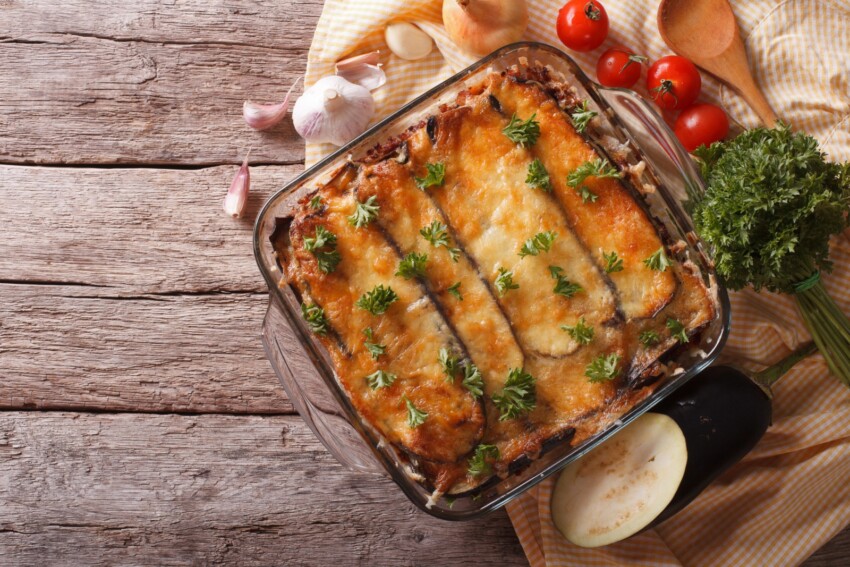
Moussaka is more than just a dish in Greek gastronomic culture: it is a culinary institution that tells centuries of Mediterranean history. This layered flan of aubergine, minced meat and creamy béchamel conquers millions of visitors to Greece every year in search of authentic flavours.
When you order a moussaka in a traditional taverna, you will immediately notice the difference with versions you might have tasted elsewhere. The golden surface of the slightly crunchy béchamel sauce hides perfectly balanced layers of ingredients that come together in a harmony of flavours.
Contrary to what many believe, moussaka in its current form is relatively recent. Celebrated Greek chef Nikolaos Tselementes codified the modern recipe in the 1920s, introducing French béchamel and standardising the proportions of ingredients.
Before Tselementes, there were simpler versions of the dish, without the layer of béchamel that we now consider essential. The word itself comes from the Arabic ‘musaqqa’a’, meaning ‘moistened’, a reference to the tomato sauce that permeates the ingredients. Aubergines, a key ingredient, reached Greece via Arab trade routes around the 8th century.
The quality of moussaka depends on the selection of ingredients. The aubergines must be long varieties typical of Greece, with firm, less watery flesh. The meat traditionally used is a mixture of ground beef and lamb, with proportions varying according to regional preferences.
The basic sauté includes chopped onions, garlic, ripe tomatoes and tomato paste. Essential spices include cinnamon powder (the distinctive Greek touch), black pepper, bay leaf and oregano. The ragout takes at least 45-60 minutes to cook over low heat.
Greek béchamel differs from the French version in the addition of egg yolks and kefalotyri or graviera cheese. This modification makes it thicker and tastier, creating that golden top layer characteristic of moussaka.
Travelling through Greece, you will discover that each region interprets moussaka according to its own traditions. In Crete, many cooks add a layer of fried potatoes to the base, while in the Dodecanese islands, it is common to find versions with courgettes instead of aubergines during summer.
During Orthodox Lent, Greek taverns offer vegetarian versions replacing meat with lentils, mushrooms or chopped nuts, and béchamel with vegetable milk preparations.
Although moussaka is considered a Greek dish, there are variations in all Balkan countries. Turkish moussaka is simpler, without béchamel sauce, while the Romanian version uses potatoes instead of aubergines. In Egypt, moussaka is vegetarian, made of fried aubergines with tomato sauce and chickpeas.
Finding excellent authentic moussaka requires a bit of research and getting away from the more touristy areas. The best preparations are found in family-run tavernas, where recipes have been handed down for generations.
In Athens, the Psyrri district and the area around the central market hide culinary gems where moussaka is served in generous portions straight from the steaming pan. Avoid restaurants with photographic menus in several languages: these are signs of tourist-oriented cuisine.
Moussaka is always served hot. When ordering, ask how long it takes to prepare: a good taverna will wait at least 15-20 minutes to serve you a freshly baked portion. Watch how the locals eat moussaka: many accompany it with a Greek salad (horiatiki) and fresh bread.
If you want to recreate this dish at home after your trip to Greece, here is the traditional recipe for 6-8 people. The preparation takes about 2 hours, but the result will repay the effort.
For the aubergines
1 kg long aubergines, 200 ml extra virgin olive oil, coarse salt
For the meat sauce
500 g mixed minced meat (beef and lamb), 2 medium-sized onions minced, 3 cloves of garlic minced, 400 g peeled tomatoes, 2 tbsp tomato paste, 1 glass of red wine, 1 tsp cinnamon powder, 1 tsp dried oregano, 2 bay leaves, salt and black pepper, 4 tbsp extra virgin olive oil
For the béchamel sauce
1 litre whole milk, 100 g butter, 100 g flour, 4 egg yolks, 100 g kefalotyri or grated parmesan cheese, nutmeg, salt
Wash the aubergines and cut them into longitudinal slices about 8-10 mm thick. Place them in a colander, sprinkle each layer generously with coarse salt and leave for 30-40 minutes. This process removes the bitterness and excess water.
Rinse the aubergines thoroughly under running water and dry them by blotting with kitchen paper. In a large frying pan, heat the olive oil and fry the aubergine slices over medium-high heat until golden brown on both sides, about 3-4 minutes per side. Place them on blotting paper to remove excess oil.
In a large saucepan, heat 4 tablespoons of olive oil and fry the chopped onions until translucent, about 5 minutes. Add the garlic and sauté for 1 minute. Add the minced meat and cook, stirring until it loses its pink colour, breaking it up with a wooden spoon.
Pour in the red wine and allow the alcohol to evaporate for 2-3 minutes. Add the crushed peeled tomatoes, tomato paste, cinnamon, oregano, bay leaf, salt and pepper. Stir well, lower the heat and cook for 45-60 minutes, stirring occasionally, until the sauce thickens and the liquid reduces. The sauce should be dry, not brothy.
In a small saucepan, heat the milk until hot but not boiling. In another, larger saucepan, melt the butter over medium heat. Add the flour all at once and stir vigorously with a whisk for 2-3 minutes, taking care that it does not take on colour.
Pour in the hot milk a little at a time, continuing to stir with the whisk to prevent lumps from forming. Cook the béchamel over medium-low heat for about 10 minutes, stirring constantly, until it thickens and coats the back of a spoon. Remove from the heat, add salt and grated nutmeg.
Let cool for 5 minutes, then incorporate the egg yolks one at a time, stirring well after each addition. Finally add half of the grated cheese and stir until completely melted.
Preheat the oven to 180°C. Lightly grease a rectangular baking dish of about 30×20 cm with olive oil. Place a layer of aubergine slices on the bottom, slightly overlapping. Spread half of the meat sauce on top, levelling well.
Add a second layer of aubergines and cover with the remaining meat sauce. Finish with a final layer of aubergines. Pour the béchamel sauce on top, spreading it evenly with a spatula until the surface is completely covered. Sprinkle with the remaining grated cheese.
Bake for 45-50 minutes at 180°C, until the surface becomes golden and slightly crispy. If the surface browns too quickly, cover with aluminium foil. Once cooked, remove from the oven and leave to rest for at least 15-20 minutes before cutting: this step is essential to allow the layers to compact.
The moussaka can be prepared the day before and reheated: indeed, many claim it tastes even better the next day, when the flavours have blended perfectly. Store it in the fridge covered with cling film and reheat it in the oven at 160°C for 20-25 minutes.
If you want to lighten up the recipe, you can grill the aubergines instead of frying them, brushing them with olive oil. The result will be less rich but still delicious. For a more authentic version, add 1-2 thinly sliced potatoes as the first layer, following the Cretan tradition.
 Hotel
Hotel  Budget accommodations
  Apartments
  Family Hotel
  Luxury Hotel
  Resorts